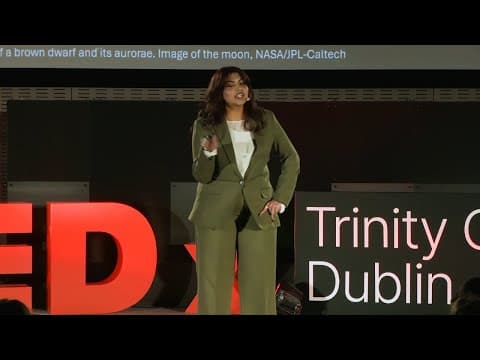
Cloudy with a Chance of Exomoons | Ishna Tripathi | TEDxTrinityCollegeDublin
Audio Summary
AI Summary
The speaker recounts a personal experience witnessing the aurora borealis in Dublin, an event that sparked a profound curiosity about the universe. This initial wonder, shared with their parents, highlighted that one doesn't need to be a scientist to be moved by celestial phenomena.
This curiosity led the speaker to explore auroras beyond Earth, focusing on Jupiter. They explain that Jupiter's aurora, far more powerful than Earth's, is not caused by the sun but by its volcanic moon, Io. Io's constant volcanic activity spews material into space, which is then captured by Jupiter's immense magnetic field, creating the vibrant auroras. The speaker notes the significant impact of this seemingly small moon on Jupiter's atmosphere, which inspired their own research.
The speaker's research focuses on brown dwarfs, celestial objects larger than Jupiter but smaller than the sun. These brown dwarfs also exhibit auroras at their poles, but unlike Earth, they lack a nearby star to provide the necessary particles. The speaker hypothesized that a hidden exomoon, similar to Io's influence on Jupiter, could be responsible for the auroras observed on these solitary brown dwarfs.
To test this hypothesis, the speaker utilized data from the James Webb Space Telescope. They explain the "transit method," where astronomers analyze changes in a celestial object's brightness as something passes in front of it. However, observing brown dwarfs is challenging due to their constantly changing light caused by storms and clouds. The speaker developed a technique using light curves, which analyze how brightness changes over time and splits light into different colors, to differentiate between the dimming caused by clouds and that caused by a potential exomoon.
While the current analysis indicates no exomoon was found around the studied brown dwarf, the speaker emphasizes that this negative result is still a valuable scientific discovery. It has led to improvements in their research tools and made the scientific process more accessible. The speaker looks forward to future advancements in telescopes like the Habitable Worlds Observatory and the Extremely Large Telescope, which will build upon this research and allow for more detailed observations.
Ultimately, the speaker connects their scientific endeavors back to the fundamental human emotion of wonder. They argue that curiosity, born from this wonder, is essential for humanity, driving scientific progress and discovery. The talk concludes with a call to action for the audience to step outside, observe the night sky, and let their own curiosity lead them to ask questions that could change their perspective on the universe.