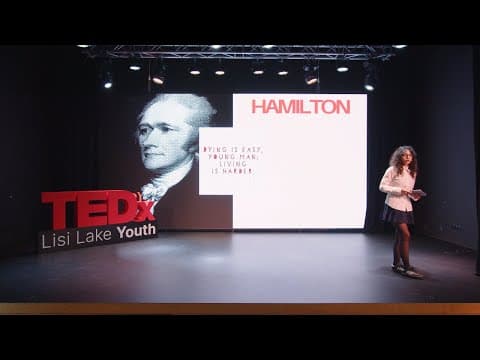
Who Lives, Who Dies, Who Tells Your Story | Anastasia Zurabashvili | TEDxLisi Lake Youth
Audio Summary
AI Summary
The transcript argues that current generations, particularly the speaker's, are too passive, comfortable in a "gap" between acknowledging problems and acting to solve them. This inaction stems from a diffusion of responsibility, where the presence of many people diminishes individual accountability, leading to a reliance on others to fix issues. Examples like the Kitty Genovese case and a man burned in Pakistan illustrate how bystanders, even when filming, fail to intervene.
The speaker contrasts this with historical figures like the young revolutionaries of 1776 and Alexander Hamilton, who acted decisively despite their youth and lack of power. Hamilton, at 17, actively contributed to building a nation, demonstrating that engagement and action, rather than waiting for permission or perfect conditions, are crucial. The analogy of a burning art gallery, where people write essays instead of grabbing a fire extinguisher, highlights this disconnect.
The core message emphasizes that civic responsibility isn't tied to age or status but begins when one stops waiting for a mandate. Legacy is presented not as a goal but as a daily choice to be engaged and care for future generations, like the anonymous designers of everyday infrastructure. The call to action is to recognize that the gap between the world's current state and its potential is one's own to close, urging listeners to move from observation to participation. The speaker concludes by posing whether individuals will be those who tend to the world or assume someone else will, as the consequences of inaction are already evident.