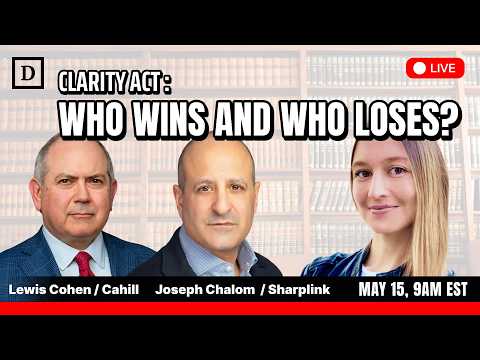
🔴 STABLE Act Showdown: Who wins and who loses?
AI Summary
The discussion centers on the "Clarity Act," a market structure bill that recently passed markup in the Senate Banking Committee and is headed to the full Senate. Both Joe and Louis, experienced professionals bridging traditional finance and crypto, emphasize the bill's significance for the future of decentralized finance (DeFi) and the broader financial ecosystem.
Louis provides a historical overview of the bill, noting its evolution from earlier House efforts like "Fit 21." He highlights the challenges in its journey, including a pulled markup due to concerns over stablecoin yield and DeFi protections. A compromise, brokered by Senators Brooks and Tillis, paved the way for the recent markup. The bill's passage out of committee with bipartisan support, including votes from two Democratic senators, is seen as a major step forward, though their final votes on the Senate floor are not guaranteed due to outstanding issues like ethics.
Joe outlines the bill's primary impacts: providing much-needed clarity for DeFi and enabling institutional participation, and acting as a significant accelerant for stablecoins. He anticipates a DeFi surge due to the resolution of regulatory overhang, clear carve-outs for bonafide DeFi activities, and a shift from a "buy and hold" stablecoin strategy to one focused on "buying and using." This will favor transaction velocity, leading to increased stablecoin deployment and activity-based yield rewards, akin to early credit card incentives. Issuers will retain their economics, and increased borrowing, lending, and swapping activities are expected, potentially extending to tokenized real-world assets.
Louis elaborates on how the bill facilitates this DeFi surge by defining parameters for decentralized protocols. He stresses that "DeFi in name only" will not suffice, with a move from "common control" to "coordinated control" in defining decentralization. The bill provides clear lines, helping developers and legal counsel understand what constitutes decentralized activity and avoid regulatory pitfalls. He also touches on the importance of security councils and incident response teams, finding a balance between protecting user assets in emergencies and general upgrade key control.
Joe further details the regulatory uncertainty that DeFi protocols have faced, including risks from the SEC (unregistered securities), CFTC (unregistered commodity exchange, illegal leverage), and FinCEN (unlicensed money transmitting business). He argues that the Senate bill resolves this by clarifying money transmitter liability for developers based on decentralization and control of customer funds. A crucial element for Joe is the incorporation of the Blockchain Regulatory Certainty Act (BRCA), which categorically states that entities not controlling customer funds are not money transmitters. This clarity is vital for DeFi and the future integration of tokenized assets.
Cammy acknowledges the historical uncertainty and the awkward mechanisms DeFi protocols developed to navigate it. The bill's clarification that DeFi protocols are not inherently money transmitters and that responsibility for KYC/AML lies with entities controlling customer funds is seen as a common-sense regulatory understanding.
Louis expresses optimism about the bill's potential to foster a thriving DeFi ecosystem in the US. He critiques the idea that all securities must be on-chain through non-DeFi rails, emphasizing the need for free and neutral platforms like Ethereum and Solana. The neutrality of these open chains, where assets deterministically follow code, is the "air that tokenization breathes."
Joe identifies the bill's winners: clarity on crypto ownership (SEC vs. CFTC), exchanges with less legal ambiguity, a flight to quality with fewer speculative listings, venture funding, and institutional investors. Stablecoins are poised to become mainstream financial infrastructure, benefiting issuers and driving payroll, cross-border payments, and treasury movements. The bill will bring crypto activity back onshore, leading to more US-domiciled token launches and DeFi experimentation. He views business models reliant on offshore activity as losers. He also foresees a division within DeFi, with credibly decentralized, open-source protocols with distributed governance winning, while protocols with centralized control and admin keys will be deemed losers.
Louis highlights the preservation of the token safe harbor provision, which is beneficial for smaller projects. However, he points out a limitation outside the banking committee's jurisdiction: unfavorable tax treatment for token launches compared to traditional equity or debt financing. He hopes for future tax committee action to address this "speed bump." He also notes the potential for creative solutions like 501c4 foundations. Louis is excited about the integration of agentic AI with DeFi and stablecoins, seeing it as "rocket fuel" for the ecosystem.
Regarding the path forward, Louis and Joe acknowledge the remaining hurdles. Ethics provisions are a significant point of contention, particularly for Democratic senators. Joe mentions potential amendments from Senators Reid (stripping BRCA protections) and Warner (control test for decentralized protocols) that could weaken the bill. The overarching challenge is time, with a tight legislative calendar.
Joe anticipates a vote in June, with a target of July 4th, though a slip to August is possible. He believes the outcome will be known within weeks. Louis emphasizes the importance of the banking lobby's stance and potential give-backs, as well as the need for dialogue with law enforcement agencies regarding BRCA provisions.
On the question of presidential signature, Joe believes the inclusion of ethics language is the only potential blocker. However, both he and Louis express confidence that a compromise will be reached, as the administration would not support a bill it cannot sign. Louis suggests that ethics can be addressed in various ways without being overly partisan.
Looking ahead, assuming the bill passes, Joe stresses the importance of implementation and "day two" considerations, including SEC rulemaking, CFTC interpretation, Treasury guidance, and FinCEN decisions. He cautions against regulatory ambiguity replacing statutory ambiguity. Joe is particularly bullish on tokenization, predicting a massive acceleration from the current $32 billion market to trillions. He envisions entire ETF complexes and large-scale asset tokenization, reinforcing the need for stablecoins and enabling DeFi participation for tokenized assets. He likens this to the "electronification of equity markets" and calls it the "next financial revolution."
Louis agrees with the bullish outlook on Ethereum but also praises Solana, seeing a strong duopoly as beneficial. He highlights the importance of competition among intermediaries, both traditional and decentralized, to offer user choice and drive market growth. He stresses that regulations should allow both self-custody and intermediated services to coexist.
When asked about actionable steps for the public, Louis encourages direct engagement with representatives in Washington D.C., emphasizing their accessibility. He suggests writing letters or visiting offices to voice support for the bill. Joe recommends participating in the technology by opening crypto accounts, holding stablecoins, and engaging in DeFi activities to understand the user experience and the potential benefits for retail investors, such as earning interest on idle cash or participating in proxy voting. He views this as a crucial time for learning and participation in a rapidly evolving financial landscape.