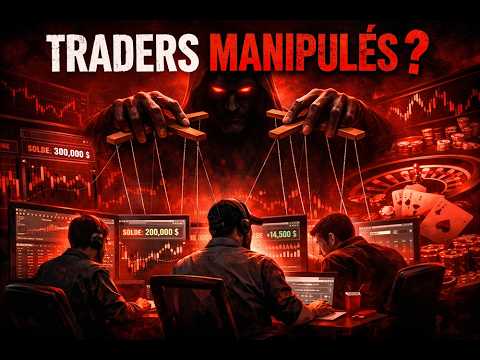
J’ai changé d’avis sur les Prop Firms (et voici pourquoi)
AI Summary
This summary outlines a significant shift in perspective regarding the retail proprietary trading firm (prop firm) industry. Once a proponent of these platforms during the 2024 boom, the speaker now characterizes them as "disguised casinos." This change of heart stems from the observation that the industry has shifted from a model of education and empowerment to one of aggressive fee extraction and statistical attrition.
### The Broken Promise and Statistical Reality
The original appeal of prop firms was simple: a trader with limited capital could pass a low-cost test and gain access to significant funded capital with zero personal risk. The promise included regular payouts, rapid scaling, and financial freedom. However, the speaker highlights data from Derivative Trading that paints a much bleaker picture. Statistical analysis shows a direct correlation between the length of time a trader stays in the "game" and the likelihood of total loss.
The figures are staggering: the median loss for a participant in the prop firm system is approximately €7,000 per year. Many traders, especially those in the Anglo-Saxon world who speak more openly about finances, report spending upwards of $10,000 in just a few months on challenge fees, account resets, and data subscriptions. Rather than a small "lottery ticket" to success, the system has become a cycle of debt where the participant pays thousands to a firm that has no intention of ever providing a real payout.
### A Conflict of Interest: The Casino Model
The fundamental issue is a latent conflict of interest. Prop firms do not profit from successful traders; they profit from registration fees, resets, and failed challenges. Because these firms rarely replicate trades on the actual market, payouts come directly out of the firm’s pocket. Consequently, the system is designed for failure.
To ensure a 90% or higher failure rate, firms implement "aggressive trailing drawdowns." These rules prevent trades from "breathing," meaning a trader might be correct about a market move in the long run but will be liquidated by a temporary fluctuation. Some firms have gone as far as banning volatile but profitable assets like precious metals. Even when a trader succeeds, they face opaque rules, unilateral account closures, and payout delays. The speaker describes the payout process as a "circus," where traders are sometimes asked to film themselves in specific ways to prove they aren't "cheating."
### The Rise of "Industrial Gambling"
The speaker critiques a specific segment of the industry: educators who teach the "Martingale" strategy. This involves opening 20 accounts simultaneously, "burning" 18 of them through high-risk news trading, and hoping two survive to produce a payout. This is not trading; it is "industrial gambling."
These educators often sell courses priced between €8,000 and €10,000, using the revenue to fund their own gambling cycles. They present their results as reproducible strategies while hiding the massive capital required to sustain such a high-failure model. This creates a moral problem, as beginners are led to believe they are learning a professional skill when they are actually being taught to gamble with a negative statistical edge.
### The Case Study: A Disciplined Failure
To illustrate that the problem lies with the system rather than the trader, the speaker shares the experience of his brother-in-law. Despite being highly educated, disciplined, and personally coached, he eventually quit after losing money over the long term. He was able to pass challenges easily, but the "behavioral design" of the funded accounts—specifically the trailing drawdowns and daily loss limits—created artificial stress. This system forced him to take losses on trades that were fundamentally sound, proving that even a talented student is statistically destined to fail within these specific constraints.
### Professional Trading vs. Retail Prop Firms
The speaker draws a sharp distinction between institutional trading and retail prop firms using a medical analogy: institutional trading is like a hospital with specialists, while retail prop firms are like a supermarket pharmacy.
* **Institutional Desks:** Traders have dedicated risk managers, adjustable limits based on market volatility, and documented strategies focused on where the money is moving (e.g., bonds or safe-haven currencies).
* **Retail Prop Firms:** Everything is opaque and unilateral. Rules change weekly, and the firm focuses only on controlling losses to ensure they occur regularly.
### Regulatory Shifts and the Future
Regulation is finally catching up. European regulators like Italy’s Consob and France’s AMF, along with the CME, have begun issuing warnings. Major firms like Apex are tightening their rules to hunt down "Martingale" users because they are losing money to these exploitative strategies. The speaker predicts that if these firms do not reinvent themselves or acquire regulated brokers, the model will eventually disappear, and traditional CFD and futures brokers will reclaim the market.
### Recommendations and Mea Culpa
The speaker concludes with a "mea culpa," admitting he was wrong to promote prop firms as a legitimate path for undercapitalized traders. He now recommends that traders return to regulated CFD brokers. While CFDs were once criticized, they allow for professional strategies like spreads and dollar-neutral trading with much lower capital requirements and more transparency than prop firms.
For those seeking a professional career, the speaker suggests building a "track record" on a real account with a regulated broker. This record can be used to apply to legitimate "buy-side" firms or physical prop firms like SMB Capital, Futex, or Optiver. These institutions offer real salary and bonus structures based on skill, not a cycle of paid challenges. The final message is clear: stop buying lottery tickets and start building a real, reproducible edge in a regulated environment.