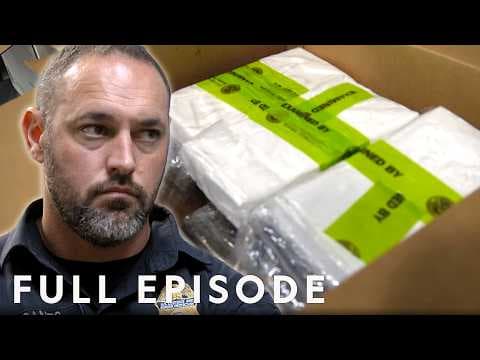
Blitzed at the Border (Full Episode) | To Catch a Smuggler
Audio Summary
AI Summary
The episode delves into various operations by law enforcement and border protection agencies to combat drug trafficking and other illicit activities across the United States. It highlights the vigilance required at ports of entry, airports, and within communities to intercept contraband and apprehend offenders.
One segment focuses on a suspicious shipment from Mexico, bound for Miami. Officers identified a full-sized trailer carrying only a few small boxes at the front, which raised immediate suspicion. The trailer was sent for X-ray inspection. Subsequently, a suspicious package was found, leading to the cordoning off of the area and the deployment of the bomb squad. An officer used an X-ray system to image the package, and the images were developed in a mobile unit. Ultimately, the package was deemed harmless, turning out to be art. The incident underscored the officers' role in ensuring safety, prompting discussions with the importer on future cooperation.
Another narrative follows Officer Pacheco at Atlanta's airport, a major transit hub for international passengers. He explains that most drugs found in Atlanta are distributed nationwide, and their focus is often on single passengers rather than large cartels. Pacheco, in his last few days at the port before moving to a field office, emphasizes working extra hard. He encounters a young woman traveling to Virginia, who initially claims it's her first time in the U.S., but records show she traveled previously. Her bright purple bag also catches his attention, as such bags are often used by smugglers due to their low cost. Despite initial inconsistencies and a search of her bags, no contraband is found, and she is released.
The scene shifts to San Diego County, where Agent Nick and the Fentanyl Abatement and Suppression Team (F.A.S.T.) conduct a directed patrol in City Heights, an area with a high number of overdose incidents. Their goal is to limit fentanyl overdoses and stop criminal activity, acknowledging the easy availability of illicit fentanyl from Mexico. During surveillance, Agent Nick observes a hand-to-hand exchange. He stops one individual, who drops a foil packet. Although no arrest is made for drug possession, Agent Nick provides the individual with an outreach card listing resources for fentanyl addiction, emphasizing harm reduction and temporary housing options. Later, the team observes another hand-to-hand exchange involving three people. They stop the individuals and find methamphetamine. One female suspect has an outstanding parole warrant, while another is arrested for furnishing meth. The third individual, possessing a user amount, receives a citation. Agent Nick highlights that F.A.S.T. targets both large-scale drug operations and smaller street-level dealing, as both contribute to overdose deaths and the cycle of addiction.
Back at the Atlanta airport, Officer Pacheco continues his work, focusing on flights from "hotbeds for narcotics" like Kingston, Jamaica. He looks for passengers with unexplained travel patterns, short trips, or frequent trips. He interviews a woman who appears nervous, avoids eye contact, and pauses before answering questions. Her inconsistent story about her stay duration in the U.S. and her previous visits raises suspicion. While her bags are searched, no immediate contraband is found. She is taken to another room for further questioning by other officers, as her intentions for visiting the U.S.—whether for tourism or illegal work—need to be clarified. If found to be working illegally, her visa could be canceled, and she could be sent back.
At a port of entry, Officer Torres and Dierlam inspect buses arriving from Mexico. Every traveler exits the bus, and the bus is scanned by an X-ray machine. An anomaly is detected in the floorboard area of a bus, indicating square objects not supposed to be there. Officers begin inspecting the undercarriage and interior of the bus. They note previous instances of finding cocaine and meth hidden in floorboards, walls, and sides of buses. After a thorough inspection, they discover that the anomaly is merely a difference in the seat support structure, not contraband. The bus is cleared, and passengers proceed.
In a high-stakes undercover operation, Agent Matt and his team prepare to meet a known drug trafficker to conduct a reverse deal for fentanyl pills. The undercover agent will furnish 50,000 fentanyl pills to the trafficker, who is expected to arrive with a large amount of cash. This type of operation is dangerous but necessary to apprehend prolific traffickers. The subjects arrive in a white Alfa Romeo and a Mercedes. During the interaction, the subjects appear to notice surveillance and leave the location. The undercover agent re-establishes communication, and a new meeting location is arranged.
At another port of entry, officers inspect a tractor-trailer. While the tractor and trailer appear normal, an anomaly is found in the reefer unit. Officers drill into the unit and discover a crystalized powder, which is later confirmed to be cocaine using a Gemini detector. The load weighs 28.88 kilos. The driver is escorted for withdrawal, his tractor and trailer are seized, and he is sent back to Mexico. The officers express satisfaction in removing drugs from the streets, contributing to the safety of communities.
Finally, Agent Matt discusses the evidence from the fentanyl operation. The seized fentanyl pills, previously confiscated in another operation, are repurposed for evidence, demonstrating the defendant's possession and intent to distribute. The $13,040 in cash recovered from the vehicle will undergo an administrative judicial process for forfeiture. The operation resulted in the seizure of vehicles and over a six-figure sum, taking significant fentanyl traffickers off the streets and aiming to impact the fentanyl crisis both locally and nationally.