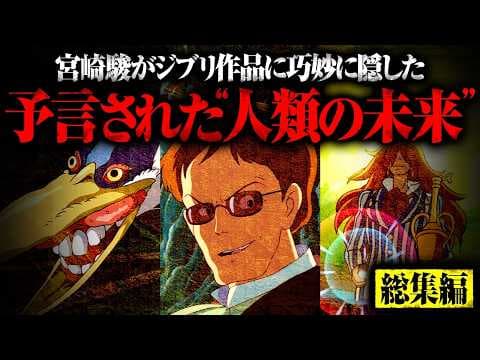
【総集編】宮崎駿監督が作品に隠した”全人類への警告”がヤバすぎる・・・
Audio Summary
AI Summary
This discussion delves into the hidden meanings and profound messages within Studio Ghibli films, specifically "Ponyo on the Cliff by the Sea," "Castle in the Sky Laputa," and "How Do You Live?". The analysis reveals that Director Hayao Miyazaki often embeds complex layers of meaning, drawing from mythology, history, and personal experiences, to convey powerful themes about humanity, nature, and the future.
"Ponyo on the Cliff by the Sea" is presented as a film that, despite its outwardly simple appearance, contains strange and unsettling content, leading to mixed reactions. A popular theory suggests that the movie depicts a world of death and scoring midway through, especially given that characters like a grandmother, previously unable to walk, are seen running around after a massive tsunami. The film's music director's comments, suggesting it portrays a world of death and scoring, further fuel this theory.
Ponyo, whose real name is Brunhilde, a Valkyrie from Norse mythology who brings death, escapes her home and meets Sosuke. Her father, Fujimoto, a former human submarine crew member, is attempting to end the age of humanity by collecting "Water of Life" to usher in an age of the sea, reminiscent of the ancient Pangea continent. His actions are influenced by Captain Nemo's hatred for humanity due to war and environmental destruction. Ponyo's accidental release of the Water of Life grants her immense magical powers, causing a storm and intertwining the present, past, and world of the dead. The film's ending, where Ponyo becomes human and lives happily with Sosuke, seems to contradict the tragic models of "The Little Mermaid" and Brunhilde. However, Miyazaki revealed that he intentionally created a happy ending to rewrite the tragic narratives he couldn't accept as a child. The concept of reincarnation and the immortality of the soul are suggested as underlying themes, implying that Ponyo and Sosuke are reincarnations of these tragic figures, destined for a happy ending in this life.
"Castle in the Sky Laputa" is explored through its title's origin and Miyazaki's influences. The name "Laputa" comes from Jonathan Swift's "Gulliver's Travels," referring to a floating island. The film's opening sequence, depicting civilization's rise and fall, is interpreted as a warning against unchecked technological advancement and humanity's detachment from nature, echoing the biblical Tower of Babel. Notes on Miyazaki's image boards explicitly mention "Babel," reinforcing this connection. The flying ore and Laputa's advanced technology symbolize human ambition to reach God-like power. The heroine Sheeta, a descendant of Laputa's royal family, ultimately uses a spell of destruction ("Bals") to prevent the villain Muska from exploiting Laputa's power, highlighting the importance of humility and connection to the Earth. The film's background notes suggest that Laputa was created by a "fierce god" who eventually abandoned humanity, leading to a cycle of civilizations rising and falling. The Lapita people's love for the earth and nature, as expressed in Sheeta's dialogue, contrasts with the destructive ambition of Muska. The film also draws parallels with ancient civilizations like Sumer and incorporates elements like "boneglyphs" and water drawing techniques, subtly linking it to broader historical and mythological narratives.
"How Do You Live?" is presented as Miyazaki's most autobiographical and complex work, created after he reversed his retirement. The film's unusually long production period and the fact that it was entirely self-funded by Studio Ghibli, without external sponsors, indicate Miyazaki's desire for complete creative freedom. Despite its critical acclaim and global success, many viewers found the film incomprehensible. Producer Toshio Suzuki's early revelation that the film is Miyazaki's personal work, and that certain characters are modeled after people close to him (such as the protagonist Mahito being Miyazaki himself, and the Prince being Isao Takahata), served as a "spoiler" that diverted attention from deeper hidden messages.
The film operates on multiple "layers" of meaning: the main story, Miyazaki's personal elements, and a true hidden message. The self-referential nature of the second layer (Miyazaki's autobiography) was intentionally brought to the forefront, making it difficult for audiences to perceive the third, deeper layer. This third layer, according to the analysis, is Miyazaki's version of the Bible, a prophecy depicting the fate of the world. Project proposals from 2016 reveal Miyazaki's anticipation of a major war or catastrophe and his struggle to decide what kind of film to make in such times. He considered either a peaceful film or one set in wartime, ultimately choosing the latter, knowing it would be "overtaken by the times."
Producer Toshio Suzuki later confirmed that "How Do You Live?" is "Hayao Miyazaki's version of the Bible, a visual record of the later part of the Bible," specifically referring to the Book of Revelation. The film is subtly infused with Christian symbols, such as crosses (on bedding, bandages, and even in shadow designs) and lilies (a symbol of resurrection). The blue heron, a prominent character, is linked to Bennu, the Egyptian prototype of the phoenix, symbolizing death and rebirth. The mysterious island Mahito reaches is compared to Arnold Böcklin's "Isle of the Dead," and the "grave wood" tree is associated with the wood of Jesus's crucifixion. Pelicans, often depicted on crosses, are also featured.
The story's "Great Prince" is seen as a representation of Isao Takahata, who was a mentor and rival to Miyazaki. The 13 sin stones that balance the Prince's world are interpreted as the 13 feature films Miyazaki directed. The Prince's world, a fragile construct, reflects Miyazaki's emotional state after Takahata's death. Mahito's refusal to inherit the Prince's world, and the Parrot King's subsequent destruction of it, symbolize Miyazaki's decision to forge his own path, independent of Takahata's legacy. The proliferating parakeets in the lower world are a metaphor for the hierarchical, dominant societies of Europe, tying into the film's global message.
The film's ending, where the lower world collapses and human reincarnation ends, suggests that the current world order is ending, and the future is left to individual choices. The core message is a prophecy about the end of the world and a call for humanity to confront uncomfortable truths and find new ways to live in a changing era. Miyazaki's work is presented not just as a creative expression but as a profound warning and guide for humanity's future.