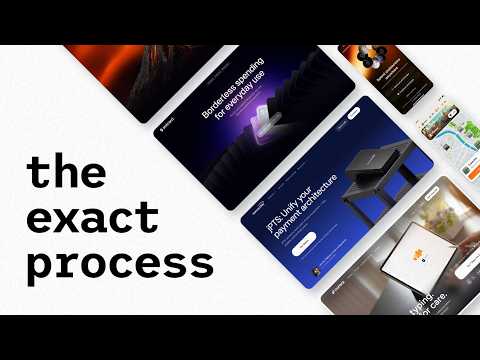
Our World Class App Design Formula
AI Summary
To predictably transform a raw vision into a world-class app or website, a six-stage formula is employed, designed to de-risk each step of the process. This formula has helped clients raise significant capital and scale to tens of thousands of users. The process ensures that engineering moves quickly after handoff and users have a meaningful experience with the product. Many founders struggle to find design partners that deliver consistent success, often due to teams either rushing into visual design too soon, spending excessive time on research that proves impractical, or completely skipping research. Furthermore, many overlook the strategic aspect of emotional design, leading to rework, misalignment, and forgettable products.
The system used to achieve predictable results consists of six key parts: onboarding, discovery, UX, UI, emotional integration, and delivery.
The process begins with **onboarding**, which focuses on establishing clarity and setting the client up for success. This involves providing a dedicated client portal, often in Notion, that centralizes timelines, tasks, decisions, files, and meeting notes. This singular source of truth prevents details from being scattered across emails and chats, which can slow down projects and increase the risk of misunderstanding. On day one, clients receive access to communication channels, file storage, and a Notion client OS, along with a welcome checklist and a summarized discovery and strategy document. This transparent environment ensures alignment among all project stakeholders.
With a solid foundation from onboarding, the project moves into **discovery**. This stage involves at least one project discovery workshop to define high-level outcomes, constraints, and success metrics. It’s a strategic phase that dictates all subsequent steps. A common pitfall for agencies is either jumping directly into UI design or spending months on research. The balanced approach used here involves collecting references to align aesthetic tastes and establish clear guardrails, analyzing direct and indirect competitors by testing their apps, and conducting focused product research to de-risk key decisions for critical flows before design work begins. This approach provides clear targets without excessive time expenditure.
The **UX stage** translates the strategy into structure. This begins with mapping out core user journeys and "wire flows" for the entire app, prioritizing key flows over less critical screens like settings. Before creating high-fidelity wireframes for priority flows, low-fidelity layouts may be drafted to gain buy-in on less refined ideas quickly. The primary goal of this stage is to explore and communicate direction as rapidly as possible, focusing on problem-solving rather than visual details. This helps avoid the high risk of creating a suboptimal user experience that can occur when teams jump straight into visuals. During this stage, journeys, states, and edge cases are aligned early on, and potential emotional design moments are identified on specific screens to ensure design accounts for feeling, not just function. Prototypes are created for important interactions to simulate and validate the experience, establishing the full flow and logic before visual design begins.
Once the structure is solid, the project progresses to the **UI phase**, where the app's visual appeal is developed. This starts with exploring broad concept directions for the entire product experience, using mood boards, concept screens, and various visual approaches. After extensive experimentation and feedback, the team moves into high-fidelity visual design and builds out reusable UI patterns. The UI stage is tackled with meticulous attention to detail, as even minor inconsistencies—such as misaligned border radii, overuse of color shades, or unintentional visual emphasis—can significantly detract from a world-class feel and complicate development. To prevent this, an airtight QA protocol is implemented, checking every visual detail on every screen. This involves scrutinizing the tiniest elements, from microcopy to precise opacities, and then systematizing these components into an entire design library.
While the UI phase makes the app look world-class, it's not enough to evoke a strong emotional connection. This leads to **emotional integration**, a core expertise. In this phase, the emotional moments identified earlier are revisited, and those most relevant to business goals are chosen. Animations created are designed to be lightweight and often interactive, using tools similar to those employed by industry leaders to create high-performing, delightful user experiences. In today's competitive landscape, where many products achieve basic usability, emotional touchpoints are crucial for differentiation. The focus is on strategically designing emotional responses that drive user behavior and stickiness. Examples include using colors to reinforce key actions in a crypto project, creating unique first impressions for a trading platform, implementing tiered reward systems for gaming apps, integrating logo types with core app experiences for note-taking apps, and front-loading emotional connection during onboarding for fintech clients to build trust. These moments are selected based on strategic goals, aiming to evoke specific feelings at particular points in the user journey to incentivize continued engagement. This is not about superficial animations but about deep strategic thinking to achieve a business impact.
Finally, the project concludes with **delivery**, preparing the product for a seamless handoff. This involves cleaning up files, addressing any remaining edge cases, states, or accessibility details, and conducting a final round of QA across the entire project. This meticulous cleanup prevents small issues from escalating into larger problems post-handoff. The source files are packaged, specifications are included, and components are tidied to ensure the client's engineering team has everything necessary for successful implementation.
In summary, the six steps—onboarding, discovery, UX, UI, emotional integration, and delivery—collectively reduce risk, optimize time, and elevate quality, ensuring predictable, world-class app results.