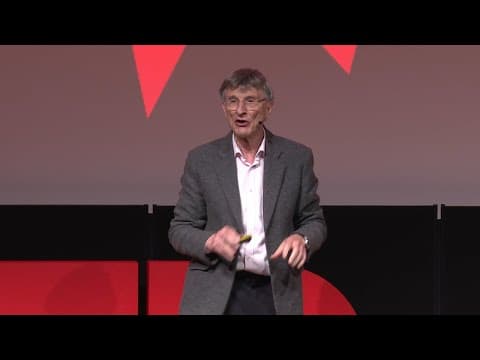
Good Judgment: Here’s How | Professor Sir Andrew Likierman | TEDxLondonBusinessSchool
Audio Summary
AI Summary
The speaker aims to change how we think about making important choices, highlighting that while we learn many things in life, judgment is often overlooked despite its crucial impact on outcomes. Drawing from personal experience, global conversations, and research, the speaker shares findings on the significance of good judgment.
An example illustrating this is the Titanic disaster, where 1,500 lives were lost, not due to the cold or the ship's condition, but because a decision was made to remove lifeboats to improve the view from first-class cabins. This underscores that judgment, in this case, poor judgment, has severe consequences.
There are four key reasons to focus on judgment:
1. It's less painful to make good judgments than to learn solely from mistakes.
2. We rely on each other's judgment in all aspects of life, making it a vital quality in our interactions.
3. Professionalism hinges on applying knowledge contextually, with professional judgment being central to any profession.
4. In an era of AI, human judgment becomes even more critical, not less.
We make countless judgments daily, from minor decisions like what to eat to significant ones involving high risks or novel situations. Judgment is also essential when interpreting rules, applying formulas, making budget choices, or deciding if past experiences are relevant to current circumstances.
The speaker uses the examples of the Suez Canal and Panama Canal to illustrate the importance of context. Ferdinand de Lesseps successfully built the Suez Canal, but his attempt to replicate the same methods for the Panama Canal failed due to vastly different environmental conditions and geographical challenges. This shows that past success doesn't guarantee future success in a new context, and context is paramount for judgment. Similarly, relying on general rules or simple lists, like those used by Charles Darwin in his decision to marry, is insufficient. Even lists require judgment to determine the weight and applicability of each item.
Judgment is defined as a combination of individual qualities and knowledge relevant to a specific situation. It involves understanding one's experience and recognizing when it is or isn't applicable.
The speaker breaks down judgment into six elements, illustrated by a daily bike ride in London:
1. **Knowledge and Experience:** Knowing how the app works, where bikes are, and parking availability.
2. **Awareness:** Being alert to London traffic.
3. **Trust:** Believing the app is accurate and the bike is reliable.
4. **Feelings and Beliefs:** Liking cycling but acknowledging its risks.
5. **Delivery:** The ability to actually execute the decision (e.g., cycling).
6. **Context-Specific Factors:** Not cycling in the rain.
These six elements are applicable to complex choices in family, health, home, and finance. While we generally improve with experience, overconfidence and habits can hinder judgment.
The role of AI is also discussed. AI doesn't eliminate the need for human judgment. Instead, human judgment is involved in three key ways: deciding whether to use AI and which type, formulating the question effectively, and interpreting the AI's response. Furthermore, humans are instrumental in training and programming AI. The future will involve humans and machines working together.
Poor judgment is characterized by not listening, not learning, surrounding oneself with like-minded people, overconfidence, ignoring evidence, and being driven by unchecked emotions. Good judgment, conversely, involves considering experience and knowledge, awareness, trust, understanding feelings and beliefs, and the ability to deliver.
The speaker concludes by emphasizing that judgment is a process, context-specific, and can be learned and improved. By focusing on good judgment, we increase our chances of achieving our desired outcomes.