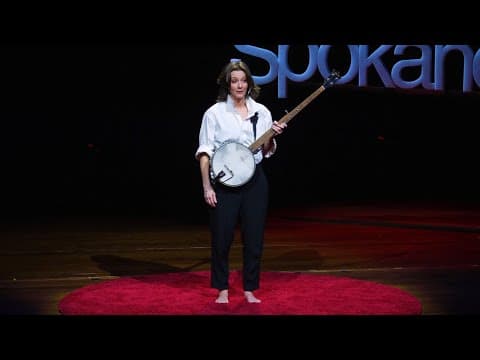
Free the Songs! Oral Tradition in a Recording Society | Olivia Brownlee | TEDxSpokane
Audio Summary
AI Summary
The speaker reflects on lessons learned from recording a song a month for eleven years, emphasizing the crucial distinction between a song and its recording. A recording is likened to a photograph – a backup memory of a single, posed moment, not the living, complex reality of a person or a song. The act of making records is a serious business, requiring collaborators who can highlight special moments while remaining unobtrusive. The speaker admits that the permanence of recordings, available for all humanity to observe, can be intimidating.
A turning point came with the realization that a recording is not a song, just as a picture is not a person. Most songs can be taught and described without their recorded version, much like one can describe friends and family without a photograph. While documentation offers comfort that a recorded thing can endure, the speaker has come to value the live performance of a song above its recording. Recordings are seen as mere snapshots, while the songs themselves are alive, evolving with each live performance. The true magic occurs when others begin to sing along, and even more so when they sing the songs without the original performer, signifying a deeper, more organic preservation.
This perspective has influenced the speaker's songwriting, shifting focus from the esoteric to lullabies, drinking songs, and themes rooted in daily life, local people, family, and the natural environment. These types of songs are more likely to resonate with and be shared by the people the speaker interacts with most. The belief is that good songs and ideas survive not just through robust recording, but crucially through being robustly remembered and shared with trusted individuals.
The speaker then introduces a new song, created after interviewing people who contributed to "today bespoke," noting shared themes of stories, connection, and growth. The goal was to distill twelve pages of notes into a folk song catchy enough to be hummed by families. The song is designed to be enjoyable solo but more fun with others, and even quiet singers will contribute to a loud collective sound.
The audience is then invited to participate in singing the new song, divided into two groups. One group will sing "What grows must grow," while the other sings "up, down, up, down." These parts are then combined into "What grows up must grow down." The speaker will sing a line, and the audience will respond with their orchestrated parts.
The song begins with the lines: "I've been thinking upside down. We're the roots, not the crown. What grows up must grow down. You and me crack the crust. We all run down and one grows up. Instead of trying, I'm trying to trust. You and me make one tree. Thick and thin, shallow, deep. Roots are running out of my feet. Down is in and up is out." The audience actively participates by singing their respective parts in response to the speaker's lines, creating a collaborative musical experience that embodies the speaker's philosophy of shared song preservation.