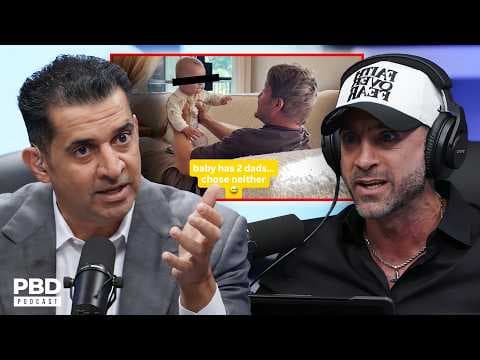
“Homophobic At 6-Weeks-Old?” - Gay Man Goes VIRAL As Adopted Baby Cries For Mother
Audio Summary
AI Summary
The discussion begins with a strong reaction to a viral video showing a baby crying for its mother while being mocked by two gay fathers who adopted it through surrogacy. The speaker expresses discomfort with the increasing acceptance of gay couples adopting children, citing concerns about the unknown risks and the potential impact on the child. It is noted that this acceptance is a relatively new phenomenon, having changed significantly in the last 30-40 years.
The video depicts the baby repeatedly crying "Mama," and the fathers are seen laughing and later posting content online, jokingly calling their child "homophobic." This behavior is condemned as "evil" and "disgusting," with the speaker asserting that it is not normal. The core argument is that children are biologically and spiritually wired to need a mother, and that choosing a gay lifestyle means giving up the right to biologically create a child, making surrogacy a transactional "purchase" of a child rather than a natural adoption. The laughter and filming of the child's distress for online content are highlighted as particularly disturbing.
The broad support for such actions online is also a point of concern, with thousands of people "clapping for it" and defending it as "progress," which is seen as a sign of a broken culture. The child's lack of agency in the situation and the emotional distress caused by hearing the baby cry are emphasized, suggesting that anyone not angered by it has something "off" with them.
Adam then weighs in, acknowledging the importance of loving homes for children. While he agrees that in theory, any family, including gay parents, providing a loving home is good, the video illustrates a crucial difference between theory and practice. The baby's natural cry for its mother in the video transcends politics and theory, highlighting a fundamental need. He clarifies that the fathers' online posts referred to their six-week-old son as "homophobic" in jest, but this act of recording and mocking the child for online engagement is deemed absolutely disgusting. The fact that these videos were posted to an audience of 140,000 people, calling their month-old son "homophobic," is reiterated as "disgusting and evil."
Tom adds to the conversation by focusing on the natural response of a human baby, which is to look for a mother. He argues that there is a natural order and a natural response "knitted there by God," encompassing the strength of a father and the nurturing of a mother. This natural aspect, he contends, cannot be debated. He expresses a significant problem with these types of adoptions because they go against this natural reaction. He emphasizes that his concern is not about denying anyone's rights to work or other aspects of life, but rather about the unnaturalness of these adoptions.
The increasing societal acceptance of same-sex couples adopting is then discussed, referencing a Gallup poll. It is noted that 50 years ago, support was in the low percentages, but it has dramatically shifted. In 1992, only 29% supported same-sex couples adopting, which jumped to 63% by 2003 and has continued to rise. This shift is attributed to a "real effort" to promote this idea.
The argument often made—that a wealthy gay couple adopting is better than a child staying in foster care—is addressed. The speaker distinguishes between adoption and surrogacy, defining surrogacy as a business transaction where a child is "bought." He reiterates his discomfort, stating that nothing about the situation makes him comfortable and never will, emphasizing the need to protect children. He believes that choosing a gay lifestyle means giving up the ability to have children naturally, and that paying for a child through surrogacy could "ruin that kid's life" due to confusion about having no mother.
The entire issue is framed as "political," where people are afraid to voice opposing arguments for fear of being labeled "homophobic." The speaker asserts that he adheres to his conservative Christian values, regardless of external judgment.
The segment concludes with an announcement from Vinny about a new "Faith Over Fear" hat being sold on vtmerch.com. This hat, featuring a cross and Hebrews 11:1, is presented as a way to represent faith in Jesus Christ and a mindset of no fear. The release of the hat is linked to a perceived shift in culture, referencing a Gallup poll showing a significant increase in young men (18-29) who consider religion very important in their lives (42%, up from 28%). The hat is described as a conversation starter and a way to share one's testimony.