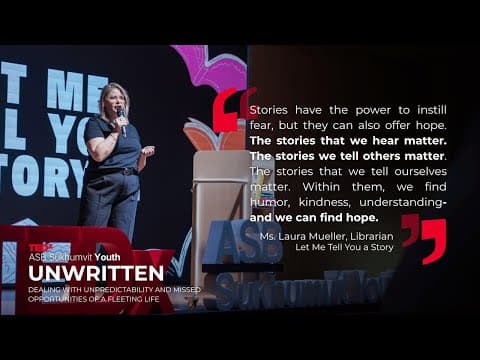
Let Me Tell You a Story | Laura Mueller | TEDxASB Sukhumvit Youth
Audio Summary
AI Summary
The speaker begins by referencing "If the World Were a Village," a concept that reframes global population statistics into a relatable village scenario to foster global understanding. They then introduce a humorous anecdote about counting, highlighting the importance of perspective. The speaker shares their personal journey, from humble beginnings as a strawberry picker to an ESL teacher in Korea and now a librarian in Bangkok, emphasizing how their love of stories has been a constant.
Stories, the speaker asserts, are powerful tools that teach life lessons, shape perspectives, offer solace, and provide hope. They illustrate this with three distinct narratives.
The first story is about Penelope, a tiny T-Rex who struggles with her primal urge to eat her classmates. Despite her attempts to connect through play and art, her predatory instincts repeatedly get in the way. Even her attempt to befriend Walter the goldfish ends in disaster when Walter bites her. This experience, however, becomes a turning point for Penelope; being eaten herself allows her to empathize with others, control her urges, and ultimately make friends.
The second story introduces Bruce, who arrives on Amnity Island excited to participate in the Fourth of July festivities. His enthusiastic approach to enjoying the abundant food and activities, however, is perceived as terrifying by the locals, leading to a negative outcome for him. This story is revealed to be a retelling of the narrative from "Jaws." The speaker explains how the fictional portrayal of sharks as monstrous villains in the book and film had devastating real-world consequences, leading to increased shark hunting, finning, and significant population decline, which in turn impacted ocean ecosystems. The speaker expresses their admiration for sharks, noting their ancient lineage and complex social behaviors, and argues that while a respectful fear is warranted, the media's narrative created a distorted and harmful perception. This example underscores the danger of a "single story," a concept explored by Chimamanda Ngozi Adichie, where a limited perspective leads to misunderstanding, mistreatment, and even destruction.
The third story is about Santiago, a young Andalusian shepherd boy from Paulo Coelho's "The Alchemist." Driven by recurring dreams of finding treasure at the Egyptian pyramids, Santiago embarks on a challenging journey. Despite being robbed and facing numerous hardships crossing the Sahara Desert, his resilience, determination, and hope remain unwavering. He learns that by following his heart and choosing courage over comfort, the universe conspires to help him. The speaker connects this story to their own life, explaining how "The Alchemist" found them at a crucial moment as they were moving to Thailand, restarting their life and rediscovering themselves. They felt the universe conspired to bring them the book when they needed to hear that they were on the right path, having chosen courage over fear with little money and no fortune teller.
The speaker concludes by reiterating the profound impact of the stories we hear, tell others, and tell ourselves. These stories contain humor, kindness, understanding, and crucially, hope. Their hope for the audience is that they will think twice before acting impulsively, strive for a better understanding of the world and its people, and continue to take steps forward even when afraid. The speaker reflects on how their own life story, which didn't include giving a TED talk, is still unfolding, reminding them to have hope in the uncertain and unwritten parts of their life and that following their heart leads to a life full of surprises.