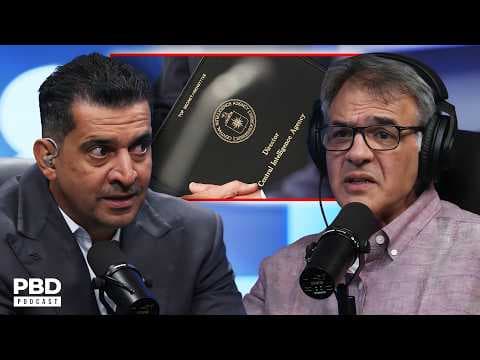
"King Charles Took $3.2 Million In CASH" - Ex-CIA John Kiriakou DETAILS Foreign Influence CORRUPTION
Audio Summary
AI Summary
The discussion begins with a hypothetical scenario: if the Director of the CIA asked to investigate who is receiving funds from various foreign entities like Israel or Qatar to promote specific messages (e.g., pro-Zionist, pro-Islam, or socialist), how quickly could this be determined? A former CIA officer clarifies that the CIA is legally prohibited from investigating American citizens, making this an FBI issue for domestic matters. However, the CIA could investigate foreign nationals, and it would likely take a couple of months to thoroughly uncover such information.
The conversation then shifts to real-world examples of alleged foreign influence and corruption. A member of the EU Parliament, Dominic Tarjinski, reportedly shared a story about multiple EU parliament members being caught in a corruption scandal in 2022. One Greek member was imprisoned for receiving $1.5 million in cash. There was so much cash in one duffel bag that $60,000 was reportedly dropped and later found. Another instance mentioned involves King Charles, who is described as pro-Islamist, and reports of him receiving $3.2 million in cash payments from the Qatari Prime Minister between 2011 and 2015. While confirmed, King Charles stated the money was immediately given to charity, with no illegal actions taken.
The speaker expresses skepticism about these explanations, highlighting the issue of buying influence. They suggest that if an official report were to reveal the funding sources of prominent influencers, it would clarify the motivations behind their public statements and reduce the "fog of war" in media. This underscores the need for robust, independent oversight rather than political "cheerleaders" in government.
A personal anecdote is shared by the former CIA officer about a conversation with a senator. The senator was concerned about classified documents from the 1970s that should have been declassified under mandatory declassification laws (after 30-35 years), unless they contained sensitive information like source names or ongoing operation methods. The CIA denied knowledge of the documents, which turned out to be Senate documents. The Senate, and Congress in general, are exempt from the Freedom of Information Act and often exempt themselves from their own laws. The senator sought help from leadership, who refused to get involved in a dispute between two committee chairmen. The other chairman allegedly told the senator to "go screw myself." This incident illustrates a complete lack of oversight within the legislative branch, where a senator could not even access documents relevant to their work.
The speaker notes that the Constitution outlines three co-equal branches of government—executive, legislative, and judicial—but in practice, the legislative branch has ceded much of its authority to the executive. This results in congressional members prioritizing support for their party's president rather than providing independent oversight. This lack of accountability is identified as a major source of public frustration.
The discussion also touches on leaked stories, such as one suggesting that Director Donald Trump reportedly wants Tulsi to resign after midterms. The speaker questions the veracity and purpose of such leaks, noting that they can be used to test public reaction.
A significant concern raised is the declining public trust in US government institutions like the CIA and FBI. A chart illustrating the history of trust in the US government shows a dramatic decrease from 72% in 1958 to as low as 15% in recent times, even after events like 9/11 where it was barely 50%. The speaker warns that if public trust continues to fall, it could lead to significant problems, especially among younger generations who may feel they have nothing to lose and might be willing to disrupt the entire system due to perceived lack of accountability and protection. The hope is that government institutions will take steps to regain public faith.
The former CIA officer, John Kuryaku, concludes by inviting viewers to find him on MC to discuss topics such as the CIA, FBI, Department of Defense, torture, secret prisons, international renditions, or even tips for applying for a job at the CIA.