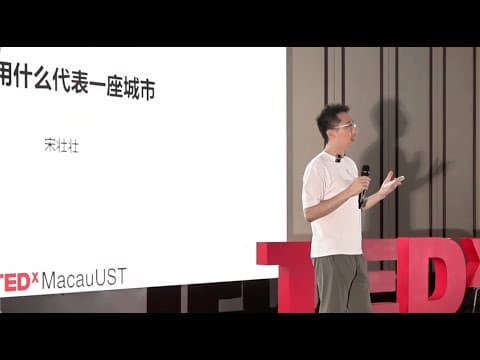
What Represents a City? | Zhuangzhuang Song | TEDxMacauUST
Audio Summary
AI Summary
The speaker, a researcher from the National Council, focuses their creative work on Beijing, making them highly familiar with the city. They note that this is their first time in the United States, which provides a different perspective. The core topic of the presentation is "What is the name of the city?" or "How do we see the name of the city?" This seemingly simple question is deemed significant and complex.
The speaker begins by exploring traditional methods of representing a city, often through its iconic buildings. For instance, Paris evokes images of the Eiffel Tower, and New York brings to mind the New York Times or skyscrapers. Google searches for these cities primarily return images of their famous structures. However, for a city like Macau, while some unique buildings appear, the results are not as distinct, often including casinos. This leads to a fundamental question: when seeking something to represent a city, should one look for unique, special elements or more everyday, common ones? Special elements are distinct but often far removed from daily life, while everyday items are ubiquitous and seemingly closer to the city's essence.
To illustrate this, the speaker conducted an experiment, using AI (Jimny) to create logos representing a city. The generated logos, while colorful and aesthetically pleasing, failed to capture a distinct sense of place for the speaker. This prompted a similar experiment for Beijing. The research involved analyzing how different entities represent Beijing. When government agencies and other organizations create logos for Beijing, the initial results often include the Forbidden City. However, the Forbidden City, particularly Tiananmen Square, is already widely used to represent China as a whole, appearing on national emblems. Using it again for a specific city, therefore, feels less appropriate and risks becoming clichéd. Ultimately, among iconic buildings, the Temple of Heaven (Tiantan) is considered the most suitable for Beijing, yet even this risks becoming overused.
The speaker argues that a city is rich and complex, and relying on a single, repeatedly used symbol can make the representation feel stale. To understand how Beijing is actually perceived, the research team analyzed official promotional videos and user-generated content from platforms like Douyin (the Chinese version of TikTok). For official videos, they meticulously tracked what objects or scenes were depicted each second. In 2018, official promotions highlighted traditional hutongs and courtyards, the Forbidden City, and the CBD, aiming for a balanced representation of both old and new Beijing.
In contrast, Douyin provided insights into what users found most engaging based on video views. In 2018, and continuing to the present, Tsinghua and Peking Universities, along with Sanlitun (a popular commercial and entertainment area), were among the most popular locations on Douyin. This suggests that user-generated content often emphasizes aspects related to student life and modern entertainment, which may not align with official narratives. The speaker questions whether these diverse elements can truly represent Beijing.
The discussion then shifts to the importance of traditional media, particularly local media, in shaping perceptions of a city. The speaker expresses admiration for The New Yorker magazine covers as an ideal example of city portrayal. For over a century, The New Yorker has consistently depicted New York City in its covers, creating a rich visual history that resonates deeply with residents and visitors alike. These covers often capture subtle, everyday moments or unique characteristics that are unmistakably "New York," such as commuters on the subway or steam rising from street vents. This approach has inspired derivative art projects in other cities, including Beijing and Shanghai, which create their own versions of "city people" covers.
Analyzing the Beijing versions, the speaker notes that while aesthetically refined, they differ from official propaganda by revealing another layer of information about the city. This leads to the concept of "Old Beijing" (Lao Beijing). When "Old Beijing" is mentioned, many images come to mind, even for those unfamiliar with the city. One such image is the ceramic pot yogurt. The speaker challenges the audience to identify the "Old Beijing" yogurt, revealing that only one brand remains, making it a de facto symbol of Old Beijing. However, the speaker points out that this yogurt is neither truly "old" (dating from after 1949) nor exclusively "Beijing," as similar products exist elsewhere. This highlights the tendency to represent cities with existing, often historical, elements.
The speaker then poses a provocative question: "Why can't American fried chicken represent Beijing?" This leads to the idea that we often rely on existing, long-established things to represent a city, but the most fitting symbol might not even exist yet. Just as fried chicken might have been unknown to people in the 1950s, a future symbol of a city might be contemporary or yet to be created. It's something that needs to be actively created, not simply discovered.
The speaker concludes by acknowledging the increasing difficulty of their work as they uncover the city's immense richness. While they don't have a definitive answer to what can represent Beijing, they are not satisfied with repeatedly using the Temple of Heaven. A great city, they believe, should have the courage and ability to continuously create new symbols for itself. This, they assert, is the fundamental work they are engaged in for Beijing.