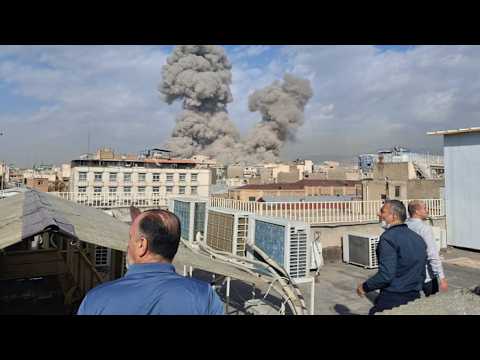
Paul Jorion - Israël et les États-Unis : la bisbille !
AI Summary
In this analysis, recorded on March 18, the speaker elaborates on a central thesis: Iran and Israel are locked in a mutual struggle for total destruction. While it is widely understood that the United States is militarily aligned with Israel, the speaker questions whether the U.S. truly shares Israel’s ultimate goal of annihilating the Iranian state.
According to the transcript, there is a visible rift between American and Israeli objectives. Donald Trump reportedly expressed dissatisfaction with the progress of the conflict, noting that he had hoped for a regime change. Trump apparently had a list of specific individuals he intended to put in power to replace the current Iranian leadership, but many of those candidates were killed early in the war. The speaker suggests that Israel was responsible for these assassinations, effectively dismantling the American plan for a transition of power. This left Trump frustrated, as he sought a quick victory to bolster his party’s standing ahead of the November legislative elections.
The speaker highlights a fundamental difference in strategy. While many political commentators argue that regime change cannot be achieved through aerial bombardment, Israel’s actions suggest they are not interested in regime change at all. Instead, they are pursuing the "absolute destruction of the enemy." This strategy involves the systematic elimination of Iranian leadership. The speaker notes that as Israeli forces successfully targeted leaders in buildings, the targets moved to sports complexes, and eventually to hiding spots in the woods. However, these leaders continue to be found and killed.
The transcript reveals an interesting internal dynamic within Iran. Although the Iranian public is not protesting in the streets—having been deterred by mass killings carried out by their own government in January—some citizens are reportedly cooperating with Israel. These individuals are providing intelligence on the whereabouts of their leaders. Furthermore, the speaker describes a psychological warfare tactic where Israelis call Iranian officials directly, speaking in Farsi, to offer them a choice: retire from their positions and "get out of the way," or face assassination.
A significant portion of the discussion focuses on the resignation of Joe Kent, a 45-year-old former U.S. counterintelligence chief. Kent, who is described as having neo-Nazi leanings, resigned while claiming that Iran did not pose a serious threat to the United States. He argued that the U.S. was being "dragged along" by Israel and the Jewish lobby. While the speaker acknowledges Kent’s controversial reputation, he points out that even some Democratic senators have noted that Kent’s observation about the U.S. following Israel’s lead is not entirely without merit.
The speaker is exceptionally critical of the intellectual capacity of the U.S. administration. He describes the cabinet surrounding Trump as being composed of some of the most "stupid" people in history, arguing that this lack of "light" or intelligence has resulted in a government that is unable to lead and is instead following in Israel's wake. He contrasts this with the leadership in Israel and Iran, whom he considers to be among the most intelligent in the world, though he is careful to distinguish between high IQ and being a "presentable" or "good" person.
Finally, the speaker addresses the shifting geopolitics of the region. Iran attempted to pressure the U.S. to withdraw its support for Israel by bombing American military bases in neighboring countries like Qatar, Bahrain, the UAE, Saudi Arabia, and Oman. However, this tactic has backfired. Instead of turning these nations against the U.S. or Israel, it has pushed them closer to Israel. These regional powers have concluded that their own safety depends on the total disappearance of the Iranian threat. They are now reportedly aligned with Israel’s vision of a "Balkanized" or fragmented Iran, rather than a mere change in leadership.
The speaker concludes by reinforcing the idea that while Iran and Israel are committed to destroying one another, the United States is caught in the middle, having been "embarked" on a path where it no longer knows exactly where it stands.