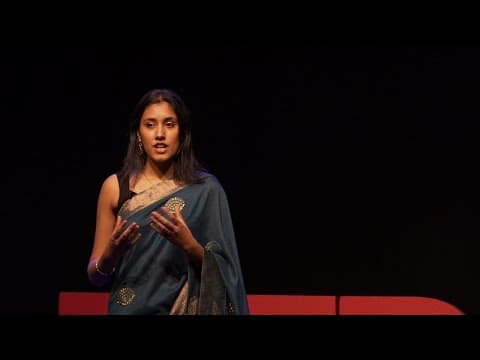
Think like a Renaissance person | Ishita Somwanshi | TEDxUniversity of Manchester
Audio Summary
AI Summary
The speaker reflects on seemingly random curiosities, like the bumps on keyboard keys, connecting it to Leonardo da Vinci's diverse interests and the concept of a "Renaissance person." This archetype, embodying knowledge across many areas, arose during the 14th to 17th-century Renaissance, a period of renewed interest in arts and sciences. Da Vinci, for instance, combined art with engineering, zoology, and optics. More recently, Bridget Mendler, a Disney actress, holds degrees from MIT and Harvard Law, and is now a CEO of a space startup, exemplifying this interdisciplinary spirit.
The speaker believes Renaissance thinkers are defined by insatiable curiosity and a refusal to accept boundaries. Growing up, she loved many things—swimming, football, books, painting, and Indian classical dance. This made choosing a university major difficult, as she was told "spreading herself too thin" would make her unfocused. Despite feeling pressure to follow a linear path, she chose material science and engineering.
In material science, she learned that a material's microstructure influences its properties and performance, revealing the interconnectedness of everything. She draws parallels between the mathematical rhythms in Indian classical dance and the principles of materials science. Similarly, her art teacher's rule against using black paint, based on the scientific concept that true black is the absence of light, showed her how science intertwined with art.
She realized that thinking like a material scientist is akin to thinking like an artist—analyzing visual compositions to understand underlying properties and meaning. The language used in labs, like "composition," "texture," and "contrast," are artistic terms. Different disciplines, she argues, teach transferable skills. Swimming taught grit, dance taught performance, and football taught acceptance of limitations.
Modern Renaissance thinking isn't about mastering everything, but about sustained curiosity and hunger for knowledge. In today's digital age, with abundant information and instant answers, it's easy to take shortcuts. However, the speaker encourages resisting convenience and actively exploring diverse interests. She emphasizes that "no knowledge is ever wasted," urging listeners to learn for pleasure and abandon themselves to curiosity. The bumps on the F and J keys, for instance, aid typing speed and accuracy—a seemingly trivial fact, but one that enriches understanding. Embracing this interdisciplinary approach allows individuals to be many things, thriving in the pursuit of intersecting passions.