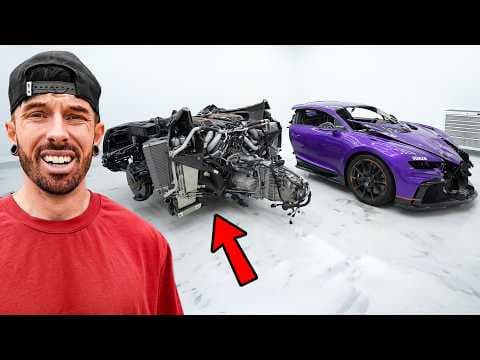
I MADE A BIG MISTAKE FIXING THE WRECKED BUGATTI CHIRON
Audio Summary
AI Summary
Welcome to the MK2 channel, offering a behind-the-scenes look at projects like the Bugatti repair. For instance, regarding the crash sensor wire, heat shrink was indeed used, just not shown in the main video. The solder's resistance was also checked, but deemed unentertaining for the primary content. This second channel allows for more detailed discussions. For example, the host has been without contact lenses for five days and is contemplating laser eye surgery, despite the 1% risk of blindness.
Returning to the Bugatti, it was running well in the last video, but some dashboard warning lights remained. The airbag light, for instance, is likely due to a pyro fuse. There are two pyro fuses: one for the starter motor, which surprisingly didn't blow in the accident, and another for the entire car's power, which also failed to activate. This suggests a potential fault in the system, as typically, Volkswagen Audi cars cut power in a crash. However, in this case, all airbags deployed, ensuring the occupants' safety, which is a positive. The intact power supply also made it easier to drive the car back.
The immediate tasks include resolving the airbag light and an engine control module (ECM) fault. The ECM fault stems from an unplugged pressure sensor in the fuel tank. This sensor is crucial because, in modern cars, fuel tank gases, which build up as the tank fills, are no longer vented into the atmosphere. Instead, they are circulated back into the engine to be re-burned, improving efficiency and reducing environmental harm. The pressure sensor tells the solenoids when to open and close to facilitate this circulation.
The problematic pressure sensor is located in the fuel tank, and the host inadvertently wedged it during assembly, preventing it from being plugged in. Undoing the titanium bolts to separate the car and access the sensor is risky, as these bolts, designed to snap in an accident, could break if repeatedly tightened and loosened. Therefore, the plan is to "butcher" the existing sensor out and replace it with a new one. The good news is that the sensor is a common Audi A3 part, costing only $129, and is expected to arrive today.
Another issue is a pyro fuse from a Mercedes-Benz, which needs to be adapted for the Bugatti. The goal is to replace only the explosive fuse part, as the existing cable is Bugatti-specific. The host considers cutting open the new pyro fuse to switch the cables, acknowledging the potential danger due to the explosive component. The first step is to plug in the new pyro fuse to see if it clears the airbag light.
Other minor tasks include replacing a missing washer fluid cap and a perished horn. The horn is also an Audi A3 part and will be replaced. The team decides to tackle the sensor first. After some struggle, the wedged sensor is successfully removed, albeit damaged. This allows for a new sensor to be installed from the other side.
While waiting for the new pressure sensor, the focus shifts to the pyro fuse. The pyro fuse has a CAN wire that sends a signal to detonate it, cutting power from the battery to the starter motor and other body electrics. The new Mercedes-Benz pyro fuse has a different cable than the Bugatti's. The plan is to plug in the new pyro fuse's connector to test if it clears the airbag light.
Upon plugging in the new pyro fuse, the airbag light successfully goes off and stays off, confirming the pyro fuse as the source of the problem. However, a check engine light persists due to the still-missing pressure sensor. Other lights, like the transmission light and ESC light, are also on. The transmission light cannot be cleared with the current fault code reader, and the ESC light is due to unplugged four-wheel drive computer modules in the rear quarters.
The next step is to permanently connect the new pyro fuse. The host plans to join the thick positive wire of the new pyro fuse to the car's existing wire, requiring a robust connection. He demonstrates a method of crimping and soldering the wires, aiming for an OEM-like repair.
The damaged pressure sensor is replaced with the new Audi A3 part. With both the new pressure sensor and the pyro fuse connected, the team hopes for no fault lights. Upon starting the car, the transmission electrics show seven passive faults, meaning they were present but are no longer active, yet the current code reader cannot clear them. The engine control module, however, now passes. An EPC light for the brake switch appears, which might be related to the rear quarter modules.
Plugging in the rear quarter modules, the engine light disappears, and the brake light appears. Still, an all-wheel drive control module "no signal" and steering angle sensor fault remain. The expectation is that driving the car will clear these.
The horn is replaced with the Audi A3 part. The team then tackles the permanent pyro fuse connection. The current Mercedes-Benz pyro fuse has terminals that are oriented differently, making a direct connection awkward and requiring wire extension, which is undesirable for a critical battery connection. The host finds a more suitable pyro fuse from a 2019 Mercedes Sprinter in Miami, which has the correct terminal orientation. This will allow for an OEM-like repair without splicing wires.
After acquiring the Mercedes Sprinter pyro fuse, the host removes its wire and prepares to connect the Bugatti's existing wire to it. He uses solder and heat shrink for a secure connection, aiming for an OEM-quality finish.
However, upon plugging in the newly adapted pyro fuse, a significant spark occurs, and the airbag light reappears. It turns out the new pyro fuse, likely sourced from a crashed car, is also faulty. This means the team got "scammed," despite the $100 cost. Since they are leaving tomorrow, they will order another one for their return.
For now, the host "bodges" a temporary solution: he plugs in the known-working pyro fuse (the one that initially cleared the airbag light) but leaves it disconnected from its proper mounting point, securing it with zip ties. This is just to get the airbag light off the dash temporarily.
The final task is to install the last piece of interior trim. The team visits Matt at E3 Customs, who demonstrates the process of removing old trim using heat-activated glue and installing new trim with pressure-sensitive glue and quick-set adhesive.
Finally, the wheels are put on. Driving the car is expected to clear the remaining lights, except for the airbag light (due to the faulty replacement pyro fuse). The transmission, tire pressure, and fuel lights are still on.
The new Miami workshop is now fully equipped with Beta tools, including workbenches and roll cabs, ready for future builds. This new setup promises a different working experience, complete with a pool for relaxation after work.
Alex, the Bugatti owner, arrives to drive his car for the first time in over a year since the crash. He expresses nervousness and excitement. Despite the remaining lights and the car not being fully assembled with body panels, he takes it for a test drive. He notes the car feels faster due to the lack of weight. The host, as a passenger, is visibly nervous about Alex's driving style and the car's incomplete state. The next video will focus on installing the front end, windshield, and headlights, which are custom-made and will take time to produce.