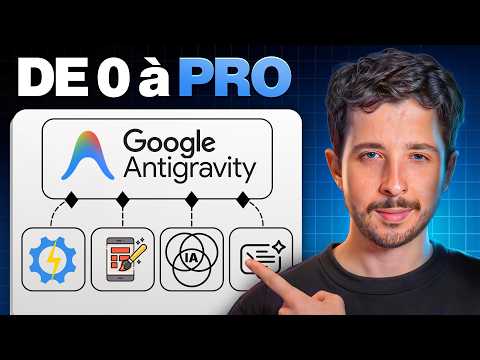
Cet outil GRATUIT de Google remplace tout (ANTIGRAVITY)
AI Summary
Antigravity is a powerful, free application development tool from Google that allows users, even those without coding experience, to create functional applications. What sets Antigravity apart is its integration of three AI models: Google's Gemini, Claude, and GPT, all accessible for free. The software is installed locally, similar to other desktop applications, and its primary function is to build software.
The tool features an Agent Manager that enables running multiple AI agents simultaneously to collaborate on application development. Users interact with these agents using natural language prompts. The interface displays project files on the left and the AI agent on the right, simplifying the development process.
The video demonstrates Antigravity's capabilities by recreating a Link Tree-style application, a common tool for aggregating social media links. The process begins with creating a workspace and then instructing an agent to build the Link Tree page. The user specifies details like their name, tagline, desired number of buttons, and the links they should point to. A key feature highlighted is the AI's ability to independently search for and retrieve the correct links for social media profiles.
Antigravity offers different AI models, with Gemini 3.1 Pro being used in this example. The "planning mode" allows the AI to develop a strategy for creating the application. During this phase, a to-do list is generated, outlining tasks such as link searching, profile picture generation, and HTML/CSS implementation. Users can modify this list, for instance, by adding a missing social media page.
The demonstration shows the AI retrieving links, generating a profile picture, and structuring the code for the Link Tree page. Once created, the application can be accessed and tested. The video also covers publishing the application, suggesting Hostinger as a hosting service. Instructions are provided on how to upload the generated files to a hosting account, making the application publicly accessible.
The video then explores the differences between the AI models: Gemini excels in design and UI, Claude is noted for its reliable code and logical calculations, and GPT is suggested for simpler, quicker tasks. To illustrate this, three identical prompts are used to create a portfolio website for a freelance photographer, with each prompt assigned to a different AI model. The results showcase significant variations in aesthetic quality and functionality, with Gemini and Claude producing superior outcomes compared to GPT for this specific task.
A crucial technique for achieving optimal results with Antigravity is presented: structuring prompts through separate instruction and brand guideline files. The `instruction.mmd` file defines the application's objective, functionalities, and technical constraints, while `brand_guidelines.md` specifies the graphic charter, including colors, typography, logo, and contact details. This approach allows for more efficient and context-rich prompts, as the AI can reference these files. The video demonstrates this by creating a quote generator application using these structured files, resulting in a professional and visually appealing output.
The power of Antigravity is further amplified by its ability to integrate with Google Chrome, allowing the AI to test the application live and automatically fix bugs without direct user intervention. This includes visual and functional testing, with the AI taking screenshots and making adjustments as needed.
Workflows, or custom commands, are introduced as a way to automate repetitive tasks and debugging. An "audit" workflow is created, instructing the AI to perform a visual and functional analysis of the application, assign a score, and suggest corrections. This workflow can be triggered by simply typing a command like `/audit`. The potential for creating other workflows, such as translation, is also mentioned.
The video culminates in a demonstration of using multiple agents concurrently to build a complex application: a weekly menu planner. Three agents are assigned distinct roles: a designer agent for the interface, a logician agent for recipes and shopping list calculations, and a research agent to analyze competitor websites. These agents work in parallel, with the designer and logician completing their tasks first. A fourth agent is then used to compile the work of the previous three into a fully functional application. The final application includes a visually appealing interface, custom recipes, a smart shopping list, and detailed recipe information.
The presenter offers an honest opinion on Antigravity, praising the parallel agent functionality, the live testing and debugging capabilities, and the integration of multiple AI models. The main drawback mentioned is the potential need for a paid subscription (AI Pro at €20 per month) as free usage limits are gradually imposed. However, the subscription is deemed valuable for enhanced functionality. The tool is recommended as an excellent entry point for anyone with an application idea, especially for entrepreneurs and freelancers. The video concludes by highlighting Antigravity's accessibility and power, especially when combined with the provided comprehensive guide and community resources.