Magnus Carlsen Teaches Us A GENIUS Way To Attack From Any Position! (Magnus vs Daniel Naroditsky!)
AI Summary
In this video, Magnus Carlsen demonstrates a genius attacking strategy from any position, playing against Grandmaster Daniel Naroditsky. The game begins with Daniel opening 1. E4, and Magnus responding with the Sicilian Defense, 1...C5, a sharp and combative choice. Daniel continues with 2. Nf3, and Magnus plays 2...d6. Instead of the open Sicilian with 3. d4, Daniel opts for 3. Bb5+ check, developing a piece and preparing to castle. Magnus responds with the combative 3...Nd7. While this knight placement is somewhat passive, it allows Black to gain tempo later by pushing the bishop with a6 and setting up b5, which aims for queen-side counterplay.
Daniel castles short, and Magnus plays 4...a6, pushing back the bishop. White has several retreat options for the bishop, but Daniel chooses the counterintuitive 5. Bd3. This move, while blocking the d-pawn, is considered the best alternative, as trading the bishop for the knight on d7 is generally not advisable in this early, open position. The idea behind Bd3 is for White to eventually play c3, Bc2, and d4, establishing a strong pawn center. White can also consider c4 for a Maróczy Bind-style position.
Black continues with 5...Ngf6, developing the kingside. White plays 6. Re1, a flexible move that places the rook on the soon-to-be semi-open e-file. Magnus then makes a critical choice: instead of immediately developing his kingside for castling, he plays the aggressive 6...b5. This move delays castling to immediately attack on the queen side, with the intention of placing the bishop on b7 and threatening c4.
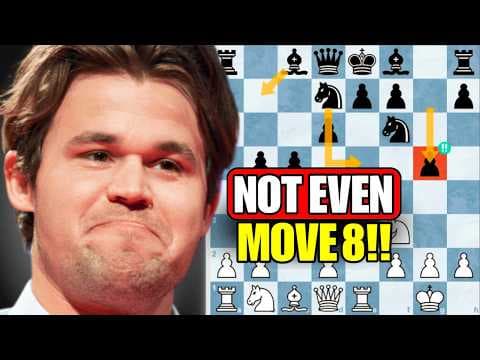
White responds with 7. c4, gaining space on the queen side and directly challenging Black's b5 pawn. With two attackers on b5, Black needs to address the tension. However, Magnus, in a shocking move, plays 7...g5, introducing a totally unexpected kingside attack. This "deflection sacrifice," first seen in a 2015 game between Grischuk and Carlsen, aims to draw the knight from f3. If White takes on g5, Black's knight on d7, previously passive, jumps to e5, forking the bishop and the c4 pawn. If White doesn't take, Black plans to play g4, attacking the knight and launching a massive kingside assault. This move is feasible because Black's central pawn structure (e7, d6, c5) is stable, allowing for a flank attack.
Daniel accepts the sacrifice with 8. Nxg5, and Magnus follows with 8...Ne5, forking the bishop on d3 and the pawn on c4. White is forced to retreat the bishop, as losing the bishop pair is undesirable. Daniel plays 9. Be2, freeing up the d-pawn. Magnus then takes on c4 with 9...bxc4, winning back the pawn and equalizing material.
Daniel counterattacks in the center with 10. d4, a strong move designed to open the center and exploit Black's exposed king and the open g-file. Magnus responds by taking on d3 with 10...Nxd3, relieving pressure on the knight on e5. White recaptures, and Magnus, instead of trading on d3, develops his bishop with 11...Bg7, emphasizing the importance of bringing all pieces into the game, even during an attack. Daniel continues with 12. Nc3, developing, and Magnus castles with 12...O-O, securing his king.
White plays 13. Bb2, activating the bishop and controlling a key diagonal. Black responds with 13...Bb7, developing the other bishop. Daniel then plays 14. F4, gaining space and attacking the knight on e5. Magnus retreats his knight to c6, eyeing the d4 square. Daniel plays 15. Bd3, opening up ideas like e5. Magnus, anticipating White's e5, plays 15...e5 himself, striking in the center. While typical for many Sicilian lines, this move weakens the d5 square.
Daniel exploits this by playing 16. Nd5, pressuring Black's position. Magnus plays 16...h6, questioning the knight's overextended position. Daniel retreats with 17. Nf3. This was not the optimal move; Stockfish recommended 17. Nxf6+ followed by 18. F5, a pawn sacrifice for a raging attack.
Magnus punishes White's retreat with 17...Nxd5, and after White recaptures, Magnus plays 18...Nb4, forking the d5 pawn and the bishop on e2. White defends both pieces with 19. Bc4. Magnus then plays his second ultra-aggressive move of the game, 19...e4, sacrificing a pawn to activate his g7 bishop, which now becomes a powerful piece.
White takes on e4, and Black plays 20...Qf6, doubling up on the f-file and pressuring b2 and f4. Daniel attempts to push back the knight with 21. a3. Magnus, instead of retreating, counterattacks with 21...Qf5, hitting the d5 pawn and the rook. This move also highlights that the knight on b4 is trapped. Daniel defends the rook with 22. Re1, and Magnus plays 22...Nxd5, winning a pawn and gaining a significant advantage with two strong bishops and active pieces.
Daniel plays 23. Nh4, attacking the queen. Magnus retreats with 23...Qf6, attacking the knight on h4. Daniel takes on d5. With little time left, Magnus forces a queen trade with 24...Qd4+ check, leading to an endgame. After the queens and bishops are exchanged, the material is roughly even, but Magnus demonstrates brilliant endgame play.
Daniel activates his rook with 27. Rd1, attacking the bishop on d4 and skewering it to the d6 pawn. Magnus saves the bishop with 27...Bc4, and Daniel takes the d6 pawn with 28. Rxd6. Although the engine indicates White is technically winning, Magnus, known for his ability to save lost positions, continues to fight.
Magnus activates his rook with 28...Rf8, challenging White's rook. White plays 29. Rc3, attacking the c4 and c5 pawns. Black defends with 29...Re4, then plays 30...H3 to create an escape square for the king. Black wins a pawn with 31...Rxf4, and White wins a pawn back with 32. Rxh6. Magnus continues to activate pieces with 32...Rd8, and after a series of exchanges, the game transitions into a rook and pawn endgame.
Magnus, known for his relentless piece activity, plays 36...Rd2, attacking the king and b2. Instead of taking on b2, Magnus plays 37...c4, defending the pawn before capturing. White plays 38. Rc5, attacking the c4 pawn. Black defends with 38...Rc2, and Magnus has found a way to equalize the game, despite being down a pawn.
White plays 39. A4. Black responds with 39...a5, a slight mistake, but White doesn't find the winning continuation. White takes on a5, and Black takes on b2. The advanced c4 pawn becomes Magnus's key to saving the game. After further exchanges and king activation from Magnus, the game eventually leads to a drawn rook and pawn endgame, where both sides trade rooks.
The game concludes in a draw, with Magnus Carlsen showcasing a genius attacking method with G5, particularly effective when Black has a sturdy, compact pawn center that provides a stable foundation for flank attacks. This game highlights the importance of understanding both strategic principles and tactical sequences, such as deflection sacrifices, to create attacking opportunities from seemingly impossible positions.