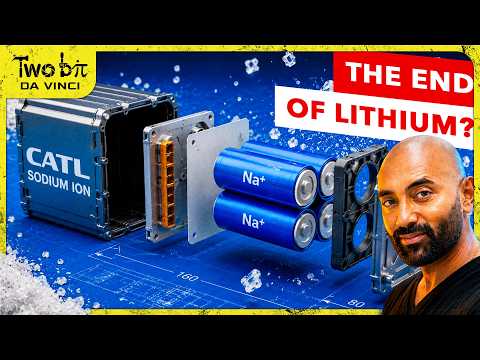
Sodium Ion Batteries Will be 80% Cheaper & Last LONGER!
AI Summary
CL, the world's largest battery company, recently unveiled a zero-lithium grid battery storage system called Tenor Sodium in Munich. This system, which is the size of a shipping container, is designed to store electricity from solar farms and runs entirely on sodium-ion batteries. CL claims it's the first proven real-world sodium grid system, boasting over 30 megawatt-hours of energy per unit, a 15,000-charge cycle rating (estimated 25-30 years of service), and retaining over 90% capacity at -20°C. Units launched in China in September and are set for global release next year.
Prior to this, CL secured a deal to supply 60 gigawatt-hours of these sodium-ion batteries to a single company, marking the largest sodium-ion battery agreement to date. This amount represents roughly half of all grid storage batteries CL expects to ship in 2025. CL also integrates this sodium technology into its Naxtra car batteries, which offer 175 watt-hours per kilogram, over 10,000 charge cycles, an 80% charge in 15 minutes, and 90% power retention down to -40°C. Tenor Sodium is the grid version, while Naxtra is for vehicles.
The significant aspect isn't just the specs, but why the leading battery company is investing billions in a chemistry that could have been developed decades ago. The core reason lies in the concept of supply chain and abundance, critical for scaling renewable energy. Just as aluminum became ubiquitous due to its abundance and ease of refinement compared to titanium, the future of batteries for renewable energy hinges on readily available materials.
Lithium, despite being a "wonder material" central to modern rechargeable batteries, faces limitations. While lithium batteries won't disappear, their supply chain is highly concentrated. About three-quarters of mined lithium comes from Australia, Chile, and China, with China refining 65% and building over 75% of the world's batteries. This concentration leads to extreme price volatility, with lithium prices surging tenfold between 2020 and late 2022 before crashing over 80%.
Beyond lithium itself, high-performance lithium batteries (NMC) rely on nickel, manganese, and cobalt. Cobalt is particularly problematic, with 76% sourced from the Democratic Republic of Congo, often under questionable conditions. This led to the development of LFP (lithium iron phosphate) batteries, which replace cobalt and nickel with abundant iron and phosphate. LFP sacrifices some energy density but offers greater affordability, safety, and stability, now dominating about half of EV batteries and grid storage. LFP’s reliance on abundant materials has significantly driven down battery prices.
Sodium, positioned directly below lithium on the periodic table, behaves similarly and was an early contender in battery development. Ford even built a sodium battery in 1966, but it required operating at 300°C with molten sodium, making it impractical. The breakthrough for room-temperature batteries came in the 1970s with Stanley Whittingham's work on lithium ions, leading to Sony's commercial lithium battery in 1991.
Sodium was left behind primarily due to graphite. Lithium ions are small enough to intercalate into graphite sheets, but larger sodium ions struggle. However, in 2000, researchers at Dalhousie University discovered hard carbon, a disordered form of carbon with gaps large enough to accommodate sodium ions, finally providing sodium with a suitable anode.
CL invested nearly a decade and $1.5 billion to overcome manufacturing challenges with hard carbon, such as its tendency to absorb water. They claim to have solved these issues, enabling mass production of sodium batteries on the same production lines as lithium batteries, requiring no factory upgrades. This makes sodium a near drop-in replacement.
The primary application for sodium-ion batteries is grid energy storage. The electricity grid requires constant generation-demand matching, a challenge exacerbated by intermittent renewable sources like solar and wind. Solar floods the grid at midday but drops off at sunset, coinciding with peak demand. This mismatch necessitates massive energy storage. The International Energy Agency projects a need for 1,500 gigawatts of total energy storage by 2030, a 14-fold increase from 2020. Batteries are crucial for stabilizing the grid and enabling 24/7 renewable energy.
For stationary grid storage, lithium's key advantage of high energy density (lightweight) is irrelevant. The weight of the battery in a steel box in a field doesn't matter. This makes sodium-ion batteries, which offer good safety and don't prioritize density, particularly appealing for this role.
CL's sodium batteries utilize sodium (the sixth most abundant element, over a thousand times more common than lithium, sourced from salt and soda ash) as the charge carrier. The positive electrode is a layered oxide, free of cobalt and nickel, likely composed of sodium, iron, and manganese (manganese is the 12th most common element). The negative electrode is hard carbon, avoiding graphite, whose supply is tightly controlled by China.
While sodium-ion batteries might not match the energy density of the best NMC or solid-state batteries (Naxtra claims 170 Wh/kg, close to LFP, but less than NMC's 280 Wh/kg or solid-state's 360-400 Wh/kg), they offer excellent cycle life (over 10,000 cycles) and maintain 90% power at -40°C, a temperature that incapacitates typical lithium-ion batteries. These are CL's internal lab numbers, awaiting independent verification, but CL is a trusted source.
Sodium-ion batteries are not meant to replace lithium everywhere. For applications requiring high energy density and light weight (phones, laptops, EVs, electric planes), lithium will remain dominant. Sodium is targeting LFP's domain: cheap, high-volume storage where weight is not a factor, such as grid storage and home batteries.
Currently, sodium-ion battery prices are comparable to LFP due to recent lithium price crashes. However, sodium's inherent abundance guarantees it will be cheaper in the long run, offering much-needed stability to an industry planning for decades ahead, unlike the volatile lithium market.
CL's decision to bet on sodium stems from solving the practical manufacturing challenges that kept this chemistry in the lab for 30 years. The global need is for batteries that can be produced by