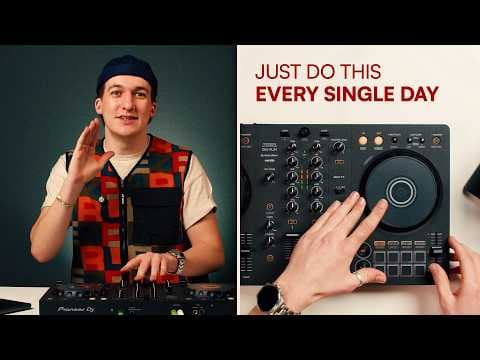
How to practice DJing everyday
Audio Summary
AI Summary
To enhance DJing skills rapidly, this guide presents five proven drills, suitable even for beginners, which move beyond simple song mixing. The first drill focuses on beat matching by ear, requiring DJs to turn off visual aids like BPM displays and waveforms, and disable sync. The exercise involves loading two identical tracks and listening for "phase cancellation," a useful indicator of accurate beat matching. When tracks are perfectly aligned, certain noises cancel out.
The practice begins by playing track one and slightly adjusting track two's tempo, then covering visual displays. The goal is to keep track two matched with track one using only the jog wheel. Short, sharp nudges on the jog wheel are used to correct speed discrepancies, listening for phase cancellation. If track two runs fast, the jog wheel is turned anticlockwise to slow it down. This trains muscle memory and auditory perception.
Once comfortable with jog wheel adjustments, the drill progresses to incorporating the tempo adjust. Track one's tempo is slightly offset from the middle to prevent cheating. With waveforms still hidden, the DJ attempts to align track two using the jog wheel while making fine adjustments with the tempo slider to maintain the match. This iterative process involves listening for phasing, nudging the jog wheel, and adjusting the tempo to achieve and sustain perfect alignment. The aim is not perfection but training quick thinking and adaptation.
The second drill addresses messy transitions by focusing on phrasing. Many DJs can beat match, but their transitions lack fluidity because they mix at incorrect times. This drill uses two techno tracks, practicing mixing in the second track at 8, 16, and 32 bars before the drop of track one. These points keep tracks in phrase but create distinct transitions. The process involves identifying the drop in track one, setting hot cues at these specific bar counts using beat jump, and then experimenting with mixing from these different phrase points. The DJ preps EQs, gradually introduces track two, and considers swapping basses, all while anticipating the drop of track two. This helps understand track structure, energy flow, and proper timing for transitions.
Drill three emphasizes creativity in transitions, encouraging exploration of different methods between the same points of two tracks. This involves delving into the effects section and practicing techniques to boost energy. Using two tracks, a cue point is set on the breakdown of track one, where track two will be triggered. Various transition styles are explored. A simple method involves fading in track two and exiting track one with a vinyl break just before the drop. More complex approaches include using less common effects like Mobius, which creates a riser effect that echoes out, or the echo effect set to half a beat to create a tail effect when the fader is killed. These techniques are applied to round off track one into the drop of track two, often incorporating filters. This drill helps DJs become more versatile and dynamic in their mixing.
The fourth drill is about understanding track selection in relation to energy flow and set direction. It involves analyzing a track's energy level by examining its waveform for rises and falls, build-ups, breakdowns, and drops. The DJ listens to different sections, such as the intro, main drop, and build-up, paying attention to elements like the kick drum's intensity, percussive sounds, and low-end presence. Using stems to isolate drums or other elements helps in assessing the track's inherent energy. For example, a track with a thumping kick, groovy percussive sounds, and a significant sub-bass presence indicates high energy, especially if it features big build-ups and melodic complexity. By comparing it to another track with a less dynamic waveform, duller musical content, and fewer changes, the DJ learns to categorize tracks by energy level, which is crucial for building a cohesive and engaging set.
The final drill simulates live performance pressure. A timer is set for 30 seconds, and every 30 seconds, the DJ must mix into a new track without preparation or cue point memory. This forces quick beat matching, faster track selection, and adaptation to imperfect situations. It sharpens instincts, quick thinking, and decision-making under pressure. Tools like BPM and key filters in DJ software are useful for quickly identifying compatible tracks, though the emphasis is on training adaptability rather than achieving perfection. This drill helps DJs develop the crucial skills needed to perform confidently and effectively in a live setting.
Consistent practice of these five drills—beat matching by ear, phrasing for smooth transitions, creative effect-driven transitions, understanding track energy, and high-pressure quick mixing—can significantly improve DJing skills.