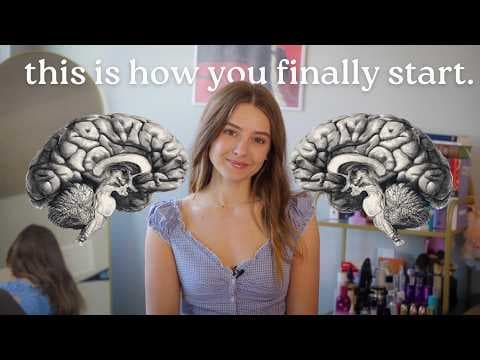
I DREAM BIG BUT DO NOTHING. the neuroscience behind why & how to fix
Audio Summary
AI Summary
If you've ever planned something significant and then failed to act on it, it's not due to laziness but a neurological cycle in your brain that hinders the pursuit of your goals. Procrastination is not a time management issue; it's an emotion regulation problem. When you contemplate an important task, such as starting a creative project or submitting an application, your brain generates negative emotions like self-doubt, overwhelm, or anxiety. To escape these unpleasant feelings, your brain seeks relief by engaging in avoidance behaviors like cleaning, reorganizing, or scrolling on your phone. This short-term relief acts as a reward, reinforcing the avoidance behavior. Your brain learns that avoiding difficult tasks leads to positive feelings of relief, creating an "avoidance loop."
In this loop, a difficult task triggers negative emotion, leading to avoidance, which in turn provides relief. This cycle strengthens the neural pathway for procrastination, making it a default behavior. When faced with a hard task, two systems in your brain compete for control: the amygdala, your brain's alarm system, which treats overwhelming tasks as threats and signals avoidance, and the dorsal anterior cingulate cortex, which pushes you to act. When you procrastinate, your amygdala wins, overriding your rational brain in what's called an "amygdala hijack," causing you to flee the task. This cycle physically strengthens the neural pathway for procrastination, making it faster and more ingrained.
To break this cycle, the solution is surprisingly simple: just start. You don't need to finish or perform perfectly; you just need to begin the task for 5 to 10 minutes without focusing on the outcome. The goal is to interrupt the avoidance loop. The first step is to "catch it and name it." When you notice yourself procrastinating, identify the emotion you're experiencing—overwhelm, anxiety, or fear of failure. Naming the emotion helps you shift from your emotional mind back to your rational mind. The second step is to make your task "stupidly small." Break down the task into the tiniest possible action to make some progress. For example, instead of thinking about writing an entire essay, aim to open the document and write for 10 minutes. This approach is powerful because the actual process of completing a task is almost always easier than the dread felt beforehand.
Research by Tim Pitchell supports this. In a study, students consistently procrastinated on difficult or unpleasant tasks, replacing them with more interesting activities. While they initially justified their procrastination, none were glad they waited when forced to start by a deadline. They all wished they had started earlier, realizing the task wasn't as bad as they thought. This indicates that you're not avoiding the task itself, but rather the way you *think* the task will make you feel, and your brain is often wrong about this.
Furthermore, your brain doesn't allow you to sit idly, as that triggers guilt—another negative emotion the amygdala tries to escape. So, it disguises avoidance as productivity through two main forms. The first is perfectionism, which makes you afraid your results won't be good enough, preventing you from starting. Perfectionist professors, for instance, publish fewer papers than their less perfectionist colleagues. The second is productive procrastination, a sneaky form where you're busy doing seemingly productive but less risky tasks, like researching or reorganizing, instead of the actual high-stakes work. This is a "short-term mood repair" where your brain swaps an anxiety-inducing task for a safer one that still offers a sense of accomplishment, without the risk of failure or judgment. Examples include color-coding notes instead of writing an essay, or endlessly perfecting a resume instead of applying for jobs. While you feel like you're making progress, the actual scary task remains untouched.
Ultimately, you're avoiding how you anticipate the task will make you feel. However, once you start, you often realize that the dread of beginning is far worse than the act of doing the task itself. Understanding the avoidance loop, its disguises, and how to break it can help you overcome procrastination.