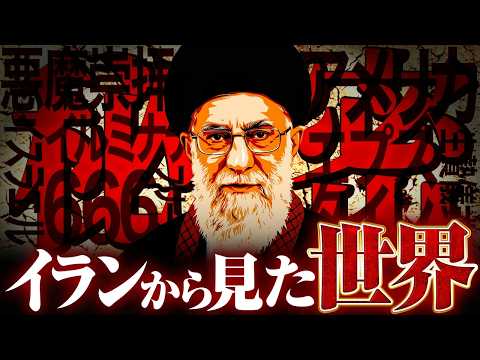
【閲覧注意】この世界は狂気に支配されている。
Audio Summary
AI Summary
This discussion explores the complex and often hidden forces behind current global conflicts, particularly focusing on the Iran-Israel war, and the intertwined beliefs and prophecies of various factions. It delves into the idea that dark forces, including those associated with Epstein, the Illuminati, and Freemasons, are manipulating events.
The investigation began by examining the true identity of the bull-headed god, revealed as Baal, a Canaanite deity. This symbol, a cow, is central to Iran's worldview, which posits that America and Israel are controlled not by divine figures like Jesus or Yahweh, but by these hidden forces. This belief is so deeply ingrained in Iran that it led to the burning and destruction of bull-headed statues, a logical action from their perspective.
A significant event that highlights this worldview is an AI-generated video released by the Iranian Defense Forces on March 24, 2026. This video depicts a girl in a dilapidated district and on Epstein Island, with everyone looking up at the sky. It culminates with an Iranian missile striking the Statue of Liberty, which has been replaced with Baal's head, and the goddess crumbles, holding the Talmud, a Jewish symbol. This video, surprisingly, gained traction among conservative influencers in America, who praised it for speaking "the truth."
The origin of Iran's worldview stems from its first Supreme Leader, Khomeini. In 1942, Khomeini, a descendant of Prophet Muhammad and a senior Islamic legal scholar, wrote a book that declared America the "Great Devil" and Israel a "little devil." His belief, a strong religious conviction, was that Jewish Freemasons and Western influence were corrupting Muslim society and perpetrating a conspiracy against Islam. This perspective, akin to the Illuminati and Freemason conspiracy theories, spread throughout the Islamic world. After the 1979 Iranian Revolution, Khomeini's book became the official state ideology, incorporated into school textbooks and taught as common knowledge. Iranian high school sociology textbooks, for instance, describe early Freemason organizations as Western Jewish capitalists spreading anti-religious conspiracies, part of a "Satanic plan" to weaken Islam.
A crucial event that solidified this worldview for Iranians was the 1953 coup. Iran's democratically elected Prime Minister, Mohammad Mosadegh, attempted to nationalize Iranian oil, which was controlled by Britain. However, Mosadegh was overthrown in a coup organized by the American CIA and British MI6, and a pro-American king, Pahlavi, was installed. The CIA later admitted its involvement. For Iranians, this provided tangible evidence that the Freemasons and Illuminati were indeed manipulating America and Britain to control the world, directly impacting their nation. Khomeini's ideology, which explained these events, became the national ideology after his successful revolution in 1979. In Islamic studies, the devil, Shaytan, also embodies deceit, suggesting that America's "great evil" status is not just about military power but its deceptive, devilish aspects.
The leak of the Epstein files in 2026 further fueled these beliefs. An American journalist made over 3 million pages of documents related to Jeffrey Epstein publicly available, causing a global shockwave. Epstein, a wealthy financier, was known for luring girls to his island under various pretenses, cutting off their contact with the outside world, threatening violence, and expanding the chain of victimization by paying victims to bring in friends. He also kept footage of powerful figures who visited as evidence. This reinforced the idea of a hidden, powerful network engaging in corrupt activities.
Among the leaked files, there were accusations that a mysterious building with a white and blue dome on Sani Island was used for "Satanic rituals," with claims of human sacrifices. Although the FBI closed its investigation due to insufficient evidence, the existence of such testimony in official documents shocked the world. Epstein's suspicious death in 2019, after his arrest for sexually abusing underage girls, also added to the controversy. Later files revealed a deep relationship between Epstein and former Israeli Prime Minister Ehud Barak. Even more shocking was an internal FBI document suggesting Epstein was an agent for Mossad, Israel's powerful organization. This raised the possibility that Epstein was not just a criminal but a figure who held secrets of those in power and manipulated events behind the scenes.
A single sentence that caused a social media explosion was Epstein's order to JP Morgan for "prize money." It was revealed that Epstein's "stage name" was "Obaal," which instantly spread globally, seemingly confirming the worship of Baal. This confirmation, however, was later revealed to be a misinterpretation of a scanned document. Nevertheless, the accumulated facts of Epstein's connections to powerful figures, criminal activities, rumors of sexual misconduct, and the perceived Baal connection, all happening rapidly in 2026, were quickly seized upon by Iran. The timing of this revelation, just 10 days before Iran's Revolution Day, allowed Iran to immediately leverage it. The Epstein files also mentioned President Trump's name numerous times, and the topic of Epstein vanished instantly when US and Israeli attacks on Iran began in late February 2026, leading to speculation that the war was a smokescreen for the Epstein files.
The discussion then shifts to the ultimate destination of this war, from the perspective of Iran, America, and Israel. In Iranian Shi'a theology, there is the concept of the Mahdi, the twelfth Imam, who disappeared in 874 and is believed to reappear during extreme global chaos to defeat the "great demon" and establish justice. The current Iranian government views itself as a temporary government until the Mahdi's return, and the final battle is seen as a divine plan to bring about the Mahdi's arrival. While not all of the Iranian government desired a final war, with many favoring negotiations to lift sanctions, a force known as the Islamic Revolutionary Guard Corps (IRGC) emerged. The younger generation within the IRGC interprets battling the "Great Demon" as the path to the Mahdi's arrival. The unexpected death of Iran's Supreme Leader Khamenei in a US and Israeli attack on February 28, 2026, eliminated the pragmatic faction and allowed the IRGC's "Mind" faction to seize control, believing "God's plan" had begun to unfold. This suggests the war was more forced upon Iran than willingly initiated, seen as an opportunity to destroy the "great devil." American intelligence agencies had even predicted that this attack would eliminate the benevolent faction and give rise to a stronger regime, implying intentional action by the US and Israel to provoke war.
This desire for a final war is not unique to Iran. President Trump's political base includes 44 million "Benevolent Christians" who believe Jesus will return when the Third Temple is built in Israel. The forces militarily threatening the Temple Mount are backed by Iran, and the other necessary element for this prophecy is the "perfect red bull," a mythical entity. Some factions in America aim to build a Third Temple after defeating Iran and bring Jesus back.
In Israel, Prime Minister Netanyahu stated immediately after the attack on Iran that this was something he had "been hoping for for 40 years," suggesting it was not merely a security emergency. A cabinet minister supporting Israel's coalition government suggested that the point of discussion was not whether to end the war, but to prolong it, as "each day of this war is an immeasurable blessing for Israel." This aligns with the Book of Ezekiel in the Old Testament, which prophesies that in the end times, a coalition army, including "great northern powers" (Russia) and Persia (Iran), will invade Israel. This prophecy, written 2500 years ago, is seen as perfectly aligning with the current situation in 2026.
For both pro-Indian factions in America and extreme Zionists in Israel, the final war is a necessary step towards fulfilling prophecies: the Third Temple is built, the Messiah descends, and Israel's enemies are destroyed. For Shi'a Muslims in Iran, it's a battle for the Mahdi's arrival. For American faithful, it's the path to a thousand-year golden kingdom under Jesus' rule after Armageddon, where Satan is sealed away, and there is no war, disease, or death. In Christianity, the "Rapture" suggests believers die once and are taken to heaven before Armageddon, returning to earth in resurrected bodies, making death a mere stepping stone. For Judaism, after the destruction of Iran and Russia, the Third Temple is built, and the first Messiah (distinct from Jesus) descends, making Jerusalem the spiritual capital of the world.
However, a "nasty contradiction" lies within these prophecies: the moment the war ends, the prophecies of these groups diverge, potentially making allies into enemies. Everyone desires the same "final war," but their envisioned futures are completely different. The religious reasons for the fight are cleverly concealed from the general public, with hostility fueled by more immediate fears and hatreds, driven by political and economic pressures. This underlying structure, where people are forced into war through fear, has remained unchanged for millennia, extending to the events of 2026.