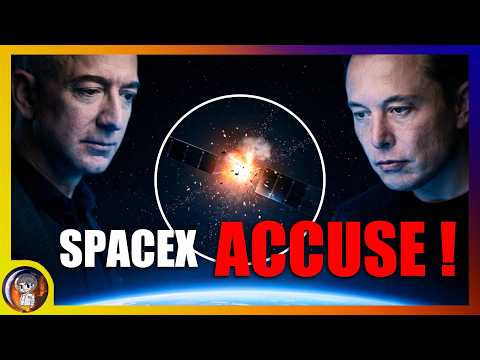
COLLISION en ORBITE : SPACEX et AMAZON se déclarent la GUERRE ! - Le Journal de la Starbase #353
Audio Summary
AI Summary
The space industry is experiencing a rapid transformation, likened to a "Phar West," with major players like SpaceX and Amazon vying for dominance in low Earth orbit. Astronaut Victor Glover's recent improvised speech before a lunar tour, emphasizing Earth as a spaceship and humanity as its crew, contrasts sharply with the escalating competition and disputes unfolding on Earth.
SpaceX has confidentially filed for an Initial Public Offering (IPO) with the SEC, aiming for an astounding valuation of $1.75 trillion. This would involve selling approximately $75 billion worth of shares. To put this in perspective, the previous global record was held by Saudi Aramco, which raised $29 billion in its 2019 IPO. SpaceX's target valuation is more than two and a half times this record. This ambitious valuation is largely driven by Starlink, its internet satellite constellation, which currently boasts over 10,000 satellites in orbit and millions of subscribers across more than 100 countries. Starlink has become a significant source of recurring revenue, exceeding many initial expectations.
Further bolstering SpaceX's valuation is the recent acquisition of XI, an artificial intelligence startup led by SpaceX's CEO, for $250 billion. Additionally, Intel has joined "Terrafab," an initiative by Elon Musk, to massively increase the production of semiconductors for AI, robotics, and space applications. Intel's expertise in designing, manufacturing, and assembling high-performance chips is expected to significantly contribute to Terrafab's goal of producing 1 terawatt per year of AI-dedicated computing capacity. Just four years ago, in 2022, SpaceX was valued at around $90 billion, highlighting its rapid and unprecedented growth in modern aerospace history.
The confidential nature of SpaceX's IPO filing means it is progressing with regulators without publicly disclosing its full accounts. Less than 5% of the total capital is expected to be offered to the market, but this still represents tens of billions of dollars, attracting institutional investors and index funds. If SpaceX is listed on a major stock index like the NASDAQ 100, hundreds of billions of dollars in passive funds could automatically flow into the company. The company aims for a NASDAQ listing, potentially in June 2026, with an unusual flexibility for existing shareholders to sell some of their shares on the first day, bypassing the typical 180-day lock-up period. Only five companies globally currently exceed a $1.75 trillion market capitalization (Nvidia, Apple, Alphabet, Microsoft, and Amazon). If successful, SpaceX would join this elite group on its first day of trading. This signifies SpaceX's transition from an ambitious space startup to a systemic player in the global economy, on par with major tech giants.
Central to this colossal valuation is the Starship rocket. Although not explicitly mentioned in the IPO discussions, the 121-meter tall steel behemoth underpins Elon Musk's entire financial strategy and projects. Without the prospect of a fully operational Starship capable of launching hundreds of Starlink B3 satellites in a single mission, this entire market valuation would be unsustainable. The market is essentially betting on a rocket that has yet to fully prove its reusability, which underscores the speculative nature of this venture.
Meanwhile, Amazon is not idle in this race. Facing significant delays, Amazon is reportedly attempting to acquire Globalstar, a historical satellite company, for approximately $9 billion. Founded in 1991, Globalstar specializes in satellite communications and reported annual revenues of about $273 million, a 9% increase from the previous year. While seemingly modest, this acquisition would provide Amazon's Project Kuiper (its satellite internet service) with valuable frequency spectrum, existing operational infrastructure, and satellite communication experience that it currently lacks. Project Kuiper's current deployment is relatively small, with over 180 satellites in orbit compared to Starlink's over 10,000, and time is pressing. Amazon has already secured in-flight internet connection agreements with JetBlue starting in 2027 and Delta in 2028, necessitating a fully operational constellation by those dates.
A complicating factor in Amazon's potential acquisition of Globalstar is Apple's 20% stake, acquired for $1.5 billion in 2024. In exchange, Apple reserved 85% of Globalstar's network capacity for its iPhone satellite messaging service, which allows for SOS messages in areas without cellular coverage. Any acquisition by Amazon would thus require direct negotiations with Apple, which could complicate the process. Despite no finalized agreement, Globalstar's shares have surged over 230% in the last 12 months due to acquisition rumors.
Beyond economic competition, a new dimension of conflict has emerged in orbit. On April 1, 2026, SpaceX sent an official letter to the FCC accusing Amazon of endangering low Earth orbit traffic. This was a direct response to Amazon Kuiper's 17-page letter to the FCC in early March, requesting the rejection of SpaceX's proposed constellation of one million satellites. Amazon had criticized SpaceX's plan as overly ambitious, questioning its ability to realistically fill such a vast number of orbital slots and radio frequencies, given that maintaining a million satellites would require replacing 2,000 per year. The FCC president himself publicly advised Amazon to focus on meeting its own regulatory deployment target of 1,000 satellites by July 2026.
SpaceX's counter-accusation is highly technical: Amazon is launching its Kuiper satellites at initial altitudes that are too high—between 50 and 90 kilometers above what was approved in the 2021 FCC orbital debris mitigation plan. Mitigation measures include injection altitude, end-of-life deorbiting speed, and coordination with other operators to prevent low Earth orbit from becoming a minefield. Amazon's initial commitment was to inject satellites at around 400 km before raising them to their operational orbit of 590-630 km. However, during a recent launch on February 12, 32 satellites were inserted at 480 km, which SpaceX claims created unmitigated collision risks with existing operational satellites. SpaceX asserts that Starlink had to perform 30 avoidance maneuvers in the hours following that single launch. SpaceX explicitly stated that "Amazon and Arian Space's negligence would unnecessarily and significantly increase risks for other systems, including crewed vessels."
Amazon, in turn, maintains it is adhering to regulations, having informed the FCC of actual altitudes around 400 km, which it claims provides sufficient flexibility for altitudes between 450-480 km. Amazon also skillfully pointed out that SpaceX has lowered its own Starlink orbits to 475-485 km, creating the problematic overlap in the contested zone. Ultimately, Amazon has committed to using lower initial altitudes from its fourth mission onward, and Arian has accepted several months of delays. This evolving battle for low Earth orbit is no longer just about technology and science but also finance and geopolitics, a "war of regulations" for the appropriation of space. While SpaceX is poised to become one of the world's most highly valued companies, Amazon is unlikely to allow Starlink to establish a monopoly in internet and telecommunications distribution, given the immense commercial stakes.
In other news, at Starbase, the "orange bags" filled with water were recently used on the second launch pad's Ship Quick Disconnect (SQD) Arm. These bags simulate heavy loads during resistance tests, typically for tower arms, to validate their capacity to support the weight of a Super Heavy booster during installation or in-flight captures. This unprecedented test suggests SpaceX needed to assess the SQD's resistance capabilities, particularly its connection systems and cryogenic networks.
Further testing is underway for the deluge system on the second launch pad, anticipating the B19 booster's static fire test next week. This system is critical, as without it, the booster's 33 third-generation engines would obliterate the launch pad upon ignition. At the production site, sections for the new S40 and B20 prototypes from the Star Factory have appeared. Despite media attention on NASA's Artemis II mission, the Megab teams have made significant progress on the booster for the 13th flight. The "crown" of this prototype, a new hot-staging separation section integrated into the first stage, appeared and was moved to the gigantic hangar. Meanwhile, the lifting device for the S39 prototype was also seen and positioned above it, indicating that the candidate for the 12th flight will soon head to the test site for its static fire test, the final hurdle before assembly with its B19 booster. The next Starship test flight is anticipated for the end of this month or early next month, representing the most pessimistic scenarios.