Pourquoi autant de Coffee Shops ? ENQUÊTE
Audio Summary
AI Summary
Paris Intramuros alone now boasts 1400 coffee shops, surpassing the number of bakeries, and new establishments continue to open weekly. In just a few years, coffee shops have evolved from a niche for hipsters to a cornerstone of the Parisian urban landscape, a trend observed across Western cities. This phenomenon extends beyond independent coffee shops, with major brands like Louis Vuitton, Tiffany, and Coach opening their own cafes. Capital One, a bank, operates 65 cafes, and Zara Home has launched an entire collection dedicated to coffee. The high-end espresso machine market is growing by 9% annually, indicating coffee's pervasive presence. Superficial analyses often attribute this to a mere trend or a desire for quality coffee, but the deeper question is, why now? Why this intensity and collective obsession?
The speaker admits to being one of those individuals whose well-being in a neighborhood is directly proportional to the number of coffee shops, someone willing to pay €6 for a cappuccino. An investigation into this phenomenon revealed that the explanation has little to do with coffee itself but rather with an underlying anthropological mechanism.
The history of coffee can be understood in three waves. For decades, coffee was a commodity, consumed solely for its caffeine content to wake up in the morning, regardless of quality—this was the "first wave." Then came Starbucks, which, after opening in 1971, truly exploded in popularity in the 1990s, popularizing lattes, macchiatos, and Frappuccinos. Starbucks also introduced the concept of the "third place"—a space that is neither home nor work, an in-between—marking the "second wave." Since the 2000s, we've entered the "third wave," where coffee has become an artisanal product, akin to wine or craft beer. Discussions now revolve around origin, terroir, extraction methods, and roasting, with a rich vocabulary developing around the cup. Coffee is no longer a commodity but an experience. In cities like Paris, new coffee shops open every week, each with unique bean selections, Pinterest-worthy aesthetics, and distinct vocabularies.
However, this official history doesn't fully explain the deep attachment many feel to these places. A scientific explanation, termed the "coffee shop effect," sheds light on this. The first factor is noise. A 2012 study by researchers Ravimeta, Ruizzu, and Amar Shima found that moderate ambient noise, around 70 decibels—the typical sound level of a coffee shop—enhances creativity. Neither complete silence nor loud noise is optimal; this specific level is the "sweet spot." This is why applications like Coffeitivity exist to replicate this sound.
The second factor is smell. A 2018 study by Adriana Matzarov demonstrated that the mere scent of coffee, even without consumption, improves cognitive performance. This is a placebo effect, where the smell triggers an expectation in the brain—e.g., "I will be more alert, more focused"—and this expectation then manifests.
The third, less measurable but more evident factor, is belonging. Coffee shop aesthetics signal a specific tribe: young, urban, digital, creative, freelance, expat, often with a MacBook. Being there signifies membership in this group, a declaration of identity. Thus, coffee shops create a protective, harmonious bubble, sanctifying these three dimensions—noise, smell, and belonging—against a perceived chaotic external world.
The phenomenon's global scope extends beyond independent shops. Unexpected players are entering the market. For instance, Louis Vuitton and Tiffany have opened cafes, and banks like Capital One are following suit. Joe Pine, author of "The Experience Economy," suggests that coffee is the simplest entry point into the experience business. It engages all five senses and encourages people to stay longer in a space. A €9 coffee at Louis Vuitton offers an accessible luxury experience, allowing customers to immerse themselves in the brand's universe, even if they can't afford a €3000 bag. Coach observed that retail sales doubled or tripled in stores equipped with a cafe, as people lingered to engage with the brand. For these brands, the goal isn't the coffee itself but immersion in brand values. For Capital One, cafes make a typically intangible service, like a bank account, tangible. The coffee becomes a physical embodiment of the brand, allowing customers to "touch, smell, and taste" their bank.
Beyond cafes, Zara Home's coffee collection, featuring V60 equipment, artisanal ceramics, and embroidered linens, reflects the desire to bring the coffee shop experience home. The domestic coffee machine market is projected to reach $11.6 billion in 2024, with high-end espresso machines growing by 9% annually. People want their own home coffee spaces, mimicking the coffee shop experience.
Common analyses often frame coffee consumption as an act of identity declaration. Ordering a flat white with oat milk instead of a café crème, or displaying a V60 at home instead of a standard machine, signals belonging and distinction. Products often transition from functional to cultural, then to identity markers. This pattern is seen in craft beer, running, and yoga. Craft beer moved from industrial product to artisanal, then to a connoisseur's identity. Running evolved from a sport to a lifestyle, then an identity. Yoga progressed from physical exercise to wellness, then to a connection with oneself. The coffee trend follows this exact path, with coffee shops serving as identity spaces and brands like Zara Home extending this lifestyle into the home.
However, this explanation of identity-seeking doesn't fully account for the daily, high-frequency nature of coffee consumption, even when alone. The deep integration into daily life suggests something more profound. Observing a friend's elaborate coffee preparation ritual—precision scales, specific water temperatures, tamping tools, exact gestures—revealed a deeper truth. It wasn't just making coffee; it was officiating. This mirrored the precise, codified gestures of baristas in coffee shops worldwide.
This led to the concept of ritual. In "The Disappearance of Rituals" (2020), philosopher Byung-Chul Han argues that Western modernity has systematically dismantled traditional rituals—Sunday masses, family meals, rites of passage. He posits that a society without rituals sees every day and moment blend into the next, lacking structure and anchors. Yet, the fundamental human need for ritual persists, re-emerging in everyday life. Scientific studies support this: a 2021 study by Wang, Sun, and Crammer found that even minimal, artificial rituals generate a perceived sense of meaning, which in turn reduces feelings of loneliness. Another study by Kathleen Vohs and colleagues at Harvard showed that chocolate consumed ritualistically (following specific codified gestures) is perceived as better, more flavorful, and more valuable. Ritual transforms the ordinary into the significant.
Applying a "Golden Lens" reverse-engineering tool (an inverse of Simon Sinek's Golden Circle) to consumer behavior reveals the deeper "why." Instead of starting with the brand's "why," this tool starts with the consumer's "what" (e.g., Zara Home, V60, €2000 machine), then the "how" (the precise, daily, repetitive sequence of gestures), to uncover the true "why." The conscious answer, "I like good coffee," is superficial. The deeper "why" is to create meaning and belong to something larger. In this context, the "how"—the ritual—is the trigger.
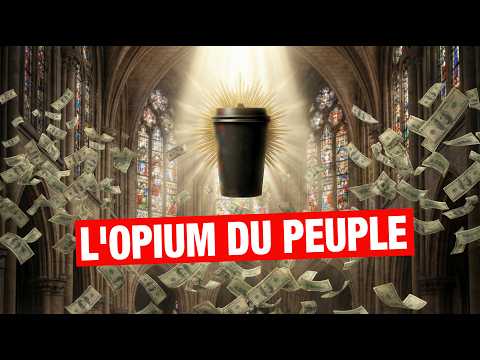
This structure is strikingly familiar: dedicated places for codified gestures, an officiant performing a precise sequence, prescribed actions transmitted immutably, a specific vocabulary for initiates, a sense of community, and a desire to replicate the experience at home. Coffee shops are not mere points of sale; they are temples where a precise liturgy is executed. Each gesture, each step, is part of a ceremony. Zara Home sells not just cups but a portable chapel, an opportunity to continue the practice at home, creating a domestic altar. The act of preparing coffee for guests becomes a transmission of this ritual, elevating the host from disciple to transmitter.
Western modernity, with its individualistic consumerism, has deconstructed traditional religious rituals, but the need for meaning, belonging, ritual to anchor time, and connection to something greater persists. This need, once cast out, returns. Coffee is no longer just a beverage or a culture; it has become a religion.