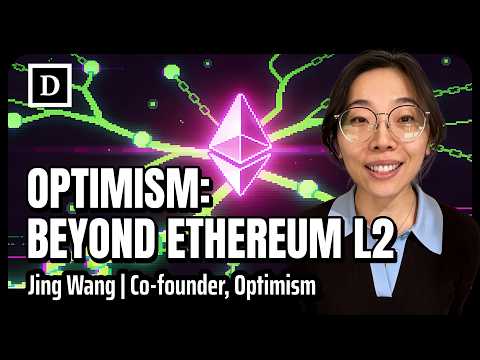
Optimism Is Done With “Ethereum Alignment” — Users Come First
AI Summary
In this conversation, Jing Wang, co-founder of Optimism, discusses the evolution of the protocol from a research-heavy scaling project into a robust infrastructure layer for global enterprises. The discussion covers the strategic shift toward institutional adoption, the technical philosophy behind the "Superchain," and a significant update to the OP token’s economic model.
**The Evolution Toward OP Enterprise**
Optimism began seven years ago with a focus on the fundamental research of blockchain scalability. Today, it has transitioned into a production-hardened network of interconnected blockchains. A major recent milestone is the launch of "OP Enterprise," a strategic move to onboard the world’s largest financial institutions and exchanges. Jing notes that Optimism has already successfully integrated major players like Coinbase (Base), Kraken, OKX, and Upbit.
The transition to an enterprise-focused model involves providing "knobs and dials" for customizability. Institutions require specific parameters for privacy, KYC, and regulatory compliance that differ from the standard permissionless DeFi model. Optimism’s infrastructure allows these entities to control their own economics and risk parameters while still benefiting from a shared standard of security and liquidity.
**The Superchain and the Role of Base**
A significant portion of the discussion centers on the "Superchain"—a network of chains built using the OP Stack. While OP Mainnet remains a flagship environment, its role has shifted. It now serves as a neutral launchpad and a "testbed" for alpha features. Jing emphasizes that the team’s primary focus is no longer just growing OP Mainnet, but rather removing bottlenecks for their partners.
Base, incubated by Coinbase, is currently the most prominent member of the Superchain. Despite concerns that an outsized partner might exert undue influence, Jing argues that building for Base is effectively building for the highest level of human usage and scale in crypto. The technical requirements Base demands—such as lower latency and higher throughput—are features that every other chain in the ecosystem eventually needs. Even as Base evolves its technical stack, it remains a core participant in the Optimism ecosystem under a mission-critical support tier.
**Market Sentiment vs. Institutional Reality**
Jing addresses the current "malaise" in crypto sentiment. While many long-time participants feel disillusioned by price action or the perceived dilution of "cypherpunk" ideals, she argues that the industry is actually achieving its original goals. Major entities like BlackRock, PayPal, and Stripe are now utilizing blockchain rails.
Institutions may not use the word "decentralization" with religious fervor, but they value the underlying properties: immutability, transparency, and 24/7 global markets. For these players, decentralized protocols like Aave or Morpho represent a superior way to manage risk and move liquidity without the friction of traditional banking jurisdictions.
**Technical Philosophy and Vitalik’s Roadmap**
The conversation touches on Vitalik Buterin’s recent critiques regarding the "stages" of Layer 2 decentralization. Jing provides a nuanced perspective, suggesting that the "Stage 2" definitions—which require 30-day delays on upgrades—were written years ago and do not fully account for the current realities of rapid R&D.
Optimism prioritizes a balance between security and the ability to fix bugs or iterate quickly. While they are committed to increasing decentralization, they believe the protocol must remain flexible enough to meet the demands of global financial systems that process millions of transactions per second. Regarding the future of Zero-Knowledge (ZK) proofs, Jing confirms that Optimism views ZK as the long-term goal. The OP Stack is designed to be modular, allowing the current optimistic proof system to be swapped for ZK infrastructure once it is fully production-ready.
**A New Economic Era: The OP Buyback**
A major announcement in the episode is the introduction of a buyback program for the OP token, marking a shift toward a "real business" model. For the first time, the token is directly tied to the growth of the entire Superchain.
Optimism generates revenue from every chain in its ecosystem, typically taking the greater of 2.5% of total revenue or 15% of on-chain profits. Under the new proposal, 50% of this accumulated on-chain revenue will be used to buy back OP tokens. This move is intended to ensure the token reflects actual network activity and revenue generation across its 33+ (and counting) partner chains, moving away from the "infinite yield" experiments of previous cycles.
**The Vision for the Future**
Jing concludes by reiterating the inevitability of finance moving on-chain. She views Optimism not just as a technology provider, but as the engine driving the transition of global liquidity. In her view, liquidity "yearns to flow freely," and the transparency and efficiency of blockchain infrastructure are fundamentally superior to legacy systems. For businesses to survive the next decade, she argues they must adopt these rails, and Optimism intends to provide the scalable, secure environment necessary to facilitate that migration.