The Orion Heat Shield Saga - Everything You Need To Know
Audio Summary
AI Summary
The Orion spacecraft, developed over 20 years, is nearing its return to Earth after a mission, with questions surrounding its heat shield performance. Its origins trace back to 2005 as part of the Constellation program, which was later canceled, though Orion’s development continued. A crucial aspect of its design was the selection of an appropriate heat shield. While materials from the Space Shuttle program were suitable for low Earth orbit, they were inadequate for lunar return missions. The knowledge and skills in ablative heat shields, prevalent during the Apollo program, had diminished over time.
To address this, NASA initiated the Crew Exploration Thermal Protection System Advanced Development Project. They investigated several ablative materials, including the shuttle material, but quickly determined the latter couldn't withstand the heating from a lunar return. The two primary candidates that emerged were Avcoat, used in Apollo missions, and PICA (phenolic impregnated carbon ablator). Both materials share a similar principle: they utilize a phenolic resin that, when heated, off-gases nitrogen and other gases, which carry heat away and create an insulating layer. The key difference lies in their matrix: PICA uses a carbon fiber matrix, while Avcoat uses a silica-based matrix, akin to fiberglass.
PICA offered modern technological advantages, whereas Avcoat had the benefit of Apollo heritage. However, Avcoat’s original formulation included asbestos, necessitating a modification and a re-establishment of its manufacturing process, as it hadn't been produced in a long time. The manufacturing process for Avcoat was labor-intensive, involving injecting the material into a honeycomb matrix by hand, a method used even for initial test samples and the first heat shield.
All candidate materials underwent extensive testing, particularly at NASA Ames' Arcjet facility, which simulates extreme heating conditions. These tests narrowed down the choice to PICA and Avcoat, with the decision favoring Avcoat due to its Apollo heritage and its ability to form a large, monolithic heat shield. PICA, being constructed in blocks, presented concerns about ridges and gaps that might not handle heating as effectively. Despite not being chosen for Orion, PICA technology proved valuable for other applications; it was used for the Mars Science Laboratory's heat shield and SpaceX developed its own version, Pika-X, for the Dragon spacecraft.
Orion's development progressed, leading to the Orion Exploration Flight Test (EFT-1). This flight, using a Delta IV Heavy rocket, served as the first real test of the Orion spacecraft and its heat shield. The Delta IV Heavy boosted Orion into a highly eccentric orbit, ensuring a high-speed re-entry to rigorously test the heat shield’s capabilities before lunar missions. The test was deemed a success, and the heat shield was thoroughly examined. The actual spacecraft from this mission is now displayed at the Kennedy Space Center Visitor Center, though its heat shield was removed for further testing.
However, the experience of building the EFT-1 heat shield sparked discussions about the quality control of such a laborious, monolithic manufacturing process. Concerns arose that a problem could necessitate discarding the entire heat shield. This led to a new design involving casting and machining perfect blocks of Avcoat material into tiles that fit precisely onto an underlying structure. This tile-based approach, while seemingly contradicting the earlier rejection of PICA's block design, was intended to save money and ensure quality control through individual piece analysis.
This new process was used for the Artemis 1 heat shield. Artemis 1 launched in late 2022, flew past the Moon, and returned to Earth, performing a skip re-entry. Skip re-entry, a technique considered but not used in the Apollo program, theoretically allows the heat shield to cool down and improves precision landing capabilities, expanding the windows for returning to waters near the United States.
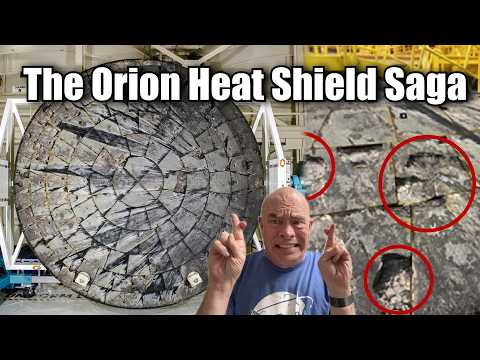
However, the re-entry did not go as anticipated. Upon recovery, chunks of the heat shield were found to have broken off, a process known as spallation. Initially, the cause and the extent of the danger to the spacecraft were unclear. Extensive work over several years concluded that gas formation underneath the surface of the material, expanding and finding flaws, caused cracks and subsequent spallation. This behavior was replicated in NASA Ames' arc jet facility.
Based on these findings, mission designers believe they can modify Artemis 2’s trajectory to prevent spallation. Ablative heat shields work by intentionally burning up; as the material heats, it undergoes a chemical reaction, evolving gas that forms a protective layer. This process creates a porous char layer through which gas escapes and heat enters, causing more material to "pyrolyze" (burn without oxygen). Scientists hypothesize that during the skip re-entry, when Orion briefly exits the atmosphere, the heat shield remains hot but cools down without generating the protective char layer. Instead, heat conducts deeper, causing gas generation without an escape route, leading to pressure buildup and spallation.
The proposed solution for Artemis 2 is to modify the trajectory by not skipping as high out of the atmosphere, thus maintaining a lower altitude for longer. This ensures continuous generation of the char layer, allowing gases to escape. Artemis 1’s trajectory reached an altitude of nearly 290,000 feet, whereas Artemis 2 plans to skip significantly lower. This modification aims to address the spallation problem, with scientific backing, though some detractors remain.
The original EFT-1 heat shield, built with a cellular matrix, likely avoided spallation because this structure contained any cracks, preventing them from propagating. The shift to a tile-based solution for Artemis 1, while leading to the spallation issue, was driven by reasons beyond just cost, including the ability to accurately test and analyze each section.
For Artemis 3, a further solution involves using a slightly more porous version of Avcoat. This modified material allows gas underneath the surface to percolate and release pressure, preventing spallation. This new material will be tested on Artemis 3. However, with Artemis 3's mission potentially being scaled back to not even go beyond low Earth orbit, there's no guarantee that this new heat shield will be fully tested for lunar return conditions before Artemis 4. Despite these challenges, the hope is that the ongoing work ensures the safety of the crew and the success of future missions.