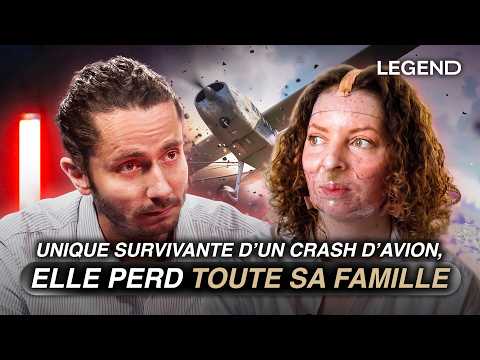
SEULE SURVIVANTE D’UN CRASH D’AVION : ON LUI A CACHÉ LA MORT DE SA FAMILLE PENDANT PLUSIEURS JOURS
AI Summary
Laura Vebelle, 22, is the sole survivor of a plane crash that killed her entire family. She shares her story, detailing the accident, her extensive hospitalization, and her journey of reconstruction.
The accident occurred five years ago. Laura, then 18, had just received her baccalaureate and was planning to study dentistry. She and her family were on a touring flight across France in a small, four-seater plane. Her father, a passionate pilot, owned a plumbing and heating business with her mother. Her brother, Alexandre, a year older, was exploring career options after disliking his initial studies in esports event management. The family was close-knit and happy.
Her father's passion for aviation led him to obtain a pilot's license in 2010. They lived near the Nantes aeroclub, where he regularly flew, often taking the family on short trips. This particular trip was a dream for her father, who was from Alsace, to fly from Nantes to Strasbourg to visit family, then continue to Annecy and Sarlat for a "Tour de France" by air.
On the day of the flight from Strasbourg to Annecy, her father noticed an issue with the pitot tube, which measures altitude. A technician at the aeroclub suggested it was due to water ingress from recent rain and simply blew into it to clear it. Laura, though uneasy, went along with it as her father didn't seem concerned. The flight to Annecy went smoothly.
They spent two rainy days in Annecy before preparing for the flight to Sarlat. Laura distinctly remembers buying a sandwich, taking the bus to the aerodrome, and her father preparing the plane. Due to cloudy weather, they had to wait, but once there was a clearing, they took off. Laura recalls the beautiful view as they flew over Lake Annecy, a "suspended moment."
Her father decided to take a detour through the mountains to Sarlat for the scenic views. After crossing the lake and entering the valley, the plane rapidly lost altitude. Laura's last memory is saying, "We're too low," before they crashed into trees.
The crash site was miraculously close to a road, about five meters away. A cyclist named Julien was the first to reach her. Laura was still strapped to her seat, gesticulating wildly, the plane reduced to a pile of debris around her. Julien unbuckled her, and she started walking away from the wreckage, fueled by adrenaline. She was agitated, repeatedly asking for her parents and brother, even though they were already deceased. Julien later described her as a "miracle," appearing as if protected by a "bubble."
Laura sustained severe injuries, including a traumatic brain injury where her brain was visible, a 30% body burn, and fractures to her cervical vertebrae and clavicles, and facial injuries. Her burns, caused by the heat of the flames and fuel trapped in her clothing, weren't immediately visible to rescuers. Delphine, an off-duty nurse and tourist, happened upon the scene and provided first aid, compressing Laura's head wound to control bleeding, until emergency services arrived by helicopter.
Laura never lost consciousness but has no memory of these events. She was taken to a hospital in Lyon, where she was placed in an artificial coma for two months to prevent suffering. Before losing consciousness, she remembers an anesthetist telling her they would put her in a coma. During this time, she was highly agitated, screaming her family's names. Her parents were Christophe and Fabienne.
Her prognosis was critical, with the brain trauma initially deemed more serious than the burns. She had circular burns on her legs, requiring incisions to prevent amputations, and multiple fractures.
While in the coma, Laura could react to her family's presence, nodding or shaking her head. Her grandparents, who visited daily, played music and messages from friends. She believes this connection helped save her. She had vivid dreams, continuing her life in the coma, including an argument with her family. Upon waking, she initially believed her family's absence was due to this dream or a car accident, not the plane crash. She lost nearly 10 kg and was intubated, which altered her voice permanently.
Her first awakening was disoriented. She was told it was early October and she was in Lyon, prompting concern about missing her studies. Her grandparents from Alsace visited, but were instructed by doctors not to reveal the truth about her family. Laura didn't ask about them, influenced by her coma dreams.
After a few days, she developed a lung infection and a high fever, leading to her being put back into a coma for another 3-4 days. Upon her second awakening, she was still intubated. Seeing her grandmother from Nantes accompanied by a friend of her mother's, she wondered why her mother wasn't there. She managed to utter "Mom," and her grandmother, unable to reveal the truth, said her mother was "resting." Laura sensed something was wrong. A letter with "condolences" further fueled her suspicions.
A week later, after being extubated, a doctor she hadn't seen before entered her room and announced the accident and the death of her family. Laura was in shock, unable to believe it, feeling her life was over. She questioned why she survived and not her family, a feeling compounded by the fact that she had taken her brother’s usual seat in the plane that day. This survivor's guilt was immense.
Her Alsatian grandparents stayed in Lyon for eight months to support her. Laura didn't blame them for withholding the truth, understanding it was for her own good. Initially, she wished she had died with them, but this feeling didn't last long. She couldn't sleep, haunted by images of flames, feeling her life was over.
Her parents and brother had been buried while she was in a coma, a "double punishment" that prevented her from saying goodbye properly. However, the funeral was filmed, and she watched it later when she was ready, finding some solace in hearing tributes from their friends.
The people who rescued her, like Christian the hiker and Delphine the nurse, stayed in touch. Christian visited her in the hospital, needing to see her well to process the event. Laura maintains a close bond with Delphine, meeting regularly.
Her physical recovery was extensive. She saw her face for the first time with a psychologist, realizing her appearance had drastically changed – red, swollen, with a partially closed eyelid and broken teeth. She was completely shaved due to the head trauma and the need for skin grafts from her scalp. This was a particularly difficult blow.
Later, she saw her body during a dressing change without anesthesia. The sight of her raw, purple skin caused her to faint. She was bandaged from head to toe and couldn't move her hands or eat alone.
Laura underwent intense rehabilitation, including two hours of physiotherapy daily. She wore a transparent compression mask 24/7 for three years to aid scar healing. This mask made her feel like an "alien" in public, facing stares and insensitive comments. During her first outing from the rehabilitation center, a woman asked if it was Halloween, highlighting the challenge of reintegrating into society.
The gendarmerie interviewed her for four hours, asking intrusive questions about her family and the accident without empathy, which she found very difficult.
Despite being offered further cosmetic surgery, Laura decided against it, choosing to accept her scars as part of her story. She now embraces her body, even wearing short sleeves and swimsuits, a stark contrast to her initial desire to hide her burns.
Financially, she inherited her parents' estate and business. She decided against taking over the company, as she was only 18 and still recovering. The business was sold, ensuring its continuity. She received support from a legal guardian and wealth manager to navigate her finances.
The investigation into the crash concluded that it was likely due to a combination of factors, including the plane's power, the complexity of mountain flying, and possibly being overloaded. Her father's attempt to turn back was noted as a correct reaction.
Psychologically, Laura continues therapy, gradually reducing her sessions. She was on antidepressants and underwent EMDR and hypnosis to cope with nightmares and trauma. She now tries to savor every moment, recognizing life's fragility. She visits her family's grave weekly, finding comfort in seeing planes fly overhead, interpreting it as a sign from them.
Her near-death experience has changed her perspective on life. She believes her family would want her to live happily. While still fearing death, she sees her survival as a "second life." Her faith has been challenged, but she believes in destiny.
Laura is writing a book about her experience and plans to get involved with burn survivor associations to offer hope. She acknowledges the difficulty of accepting her altered appearance but finds strength in her journey. She hopes to marry and have children someday, yearning for new family moments.
She can now fly on commercial planes but avoids small touring aircraft. Her first flight after the accident was a seven-hour trip to Canada. Despite a terrifying experience with severe turbulence on a subsequent flight to Spain, she continues to travel, refusing to let fear limit her life.
Laura has redirected her career aspirations from dentistry to wealth management, a field she discovered through her personal experience. She finds it fulfilling and is grateful for her new path.