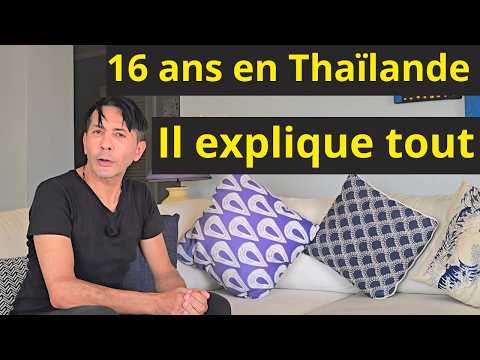
Son parcours en Thaïlande va te surprendre
Audio Summary
AI Summary
Eddie, who has been living in Thailand for about fifteen years, shares his unconventional journey to the country. It all began with a television advertisement around 2010, where a couple randomly chose a destination by pointing at a map. Inspired, Eddie, who owned a restaurant in the South of France at the time, did the same. His finger landed above Bangkok, and wanting to be by the sea, he adjusted it to Pattaya. This spontaneous decision led him to discover Thailand without knowing anyone or anything about the country.
Upon arriving in Pattaya, Eddie didn't immediately buy property. He first searched online for French apartment rentals and found a landlord in the building opposite his current residence. This landlord picked him up from the airport and offered him a tour of the city. However, the tour was humorously misaligned with Eddie's preferences. The landlord, unaware Eddie was gay, first showed him the "red light districts" of Pattaya, which he described as being for a "literal" clientele. Eddie, not wanting to offend his host and unfamiliar with the local culture, didn't voice his discomfort. The next day, after Eddie expressed his preference for a different kind of city, the landlord took him on a second tour, this time showing him the gay districts of Pattaya. This revealed to Eddie that a gay community existed and thrived there, a fact he appreciated after 16 years of frequenting the area.
Eddie currently lives in Jomtien, with a view of the sea. He owns a spacious 148-square-meter apartment with two bedrooms and two bathrooms, which he humorously admits is quite large for him alone. He bought this apartment in 2011, shortly after his initial visit. Initially, he purchased an apartment off-plan in Paradise Park in 2011, which took two years to complete. However, his experience with off-plan purchases wasn't entirely positive. About two years later, in 2013, he invested in another off-plan property with a different developer, which was never completed. This resulted in a significant financial loss, estimated at over 5 million baht (approximately €125,000), as the company reportedly absconded with the funds. Consequently, Eddie strongly advises against buying off-plan properties, preferring to purchase completed, tangible real estate.
Eddie's decision to stay in Thailand was solidified after a two-week vacation. He felt a strong connection to the country's welcoming atmosphere, the smiles, the respect, and the ease of life. This was a stark contrast to a negative experience he had in France – a homejacking incident – which had made him want to leave. Upon returning to France, he sold his restaurant within a week and returned to Thailand with the intention of living there permanently.
Regarding his visa status, Eddie initially obtained a student visa, which he held for three years, studying Thai. After that, he opened a French restaurant in Jomtien called "Le Café d'Eddie" with a Thai associate who knew his background in the restaurant industry. Eddie had 35 years of experience in hospitality in France. The restaurant was an immediate success, thriving from the first day due to his existing network and reputation. However, the partnership soured after a little over a year due to disagreements with his French business partner, whom Eddie found to be unprofessional and not contributing sufficiently. Eddie eventually sold his shares, deciding he hadn't come to Thailand to work such long hours.
Currently, Eddie is financially independent, living off his rental income from properties he owns in France. He has returned to France multiple times over the years to open and sell restaurants, including an "Hippopotamus" franchise in Avignon, which he sold about three to four years ago. Even when he owned restaurants in France, he frequently visited Thailand, having established a management team there.
Eddie clarified his tax situation. While he lives in Thailand, he maintains his fiscal residency in France. He initially changed his fiscal residency to Thailand in 2012 when he first settled permanently, but found it less advantageous due to his rental income from France. He consulted with a fiscal lawyer and re-established his French fiscal residency. He explained that as long as a significant portion of one's financial interests (around 80%) are in France, one can live in Thailand while remaining a French fiscal resident. He also pays taxes in Thailand on income generated there, though he describes it as "ridiculous."
Eddie's choice of Jomtien as his residence wasn't solely due to its gay-friendly atmosphere, although he admits it was a factor. He appreciates the area for its convenience, with shops and amenities open at all hours. He also utilizes the local "songthaews," shared taxis that operate on fixed routes, which are an affordable and convenient mode of transport. He also mentioned that the immigration office for reporting his 90-day presence is nearby.
Eddie highlighted the importance of respecting Thai laws and culture. He emphasized that even as a property owner, one is a guest in Thailand and must adhere to the rules. He advises newcomers to shed their preconceived notions and be open to a new culture. He shared that his biggest initial challenges involved understanding that Thai people often take things literally, and that their smiles can convey various emotions beyond simple happiness. He learned to adjust his communication style, sometimes needing to clarify that he was joking.
He also spoke about witnessing relationships between significantly older individuals and much younger partners, which initially surprised him due to cultural differences. However, he quickly adopted a non-judgmental approach, recognizing that as long as all parties are consenting adults, it is their personal choice.
Eddie also touched upon the perception that Thai people are solely after foreigners' money. He countered this by sharing an anecdote about a spontaneous act of generosity he witnessed: a person in a songthaew giving something to a child in another vehicle at a red light. He also recounted his own experiences of receiving help from strangers after a motorcycle accident, where people stopped to assist him, called an ambulance, and one woman even used her scooter to help transport him to the hospital. While he has international health insurance, he noted the high cost of medical care in Thailand, citing a hospital bill of nearly one million baht (around €24,000-€26,000) for a week-long hospital stay following his accident. He mentioned the high standard of medical facilities, particularly at the Bangkok Hospital, comparing them favorably to private clinics in France and highlighting advanced technologies available in Thailand. He strongly recommended that anyone living in or visiting Southeast Asia, especially expatriates, secure comprehensive medical insurance.