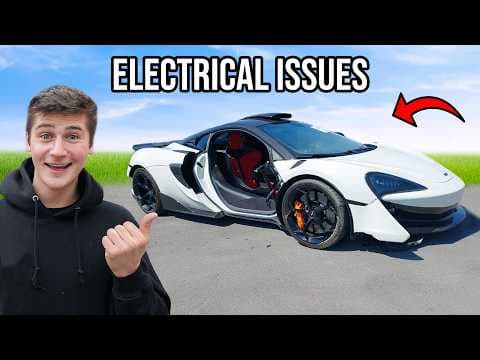
Rebuilding My Crashed McLaren 600LT
Audio Summary
AI Summary
The video documents the extensive process of rebuilding a McLaren 600LT that was purchased with significant damage, primarily a missing door and other components. The goal was to complete the rebuild in 24 hours. The presenter notes that despite the car's minimal visible damage, he managed to acquire it for well under market value.
The initial damage included a severely compromised door, which was PDR'd (paintless dent repair) and fixed, making it reusable. A new door card, interior piece, and carbon fiber parts from Darwin Pro were also acquired.
The first steps involved installing some carbon fiber pieces and then focusing on the repaired door. The door required wet sanding, painting on the repaired side, and painting the back due to extensive scratches, aiming for a perfect finish. Simultaneously, the presenter replaced missing 600LT badges.
Next, a cracked front blade, possibly due to the accident, needed attention. The front bumper, being modular, required disassembling several pieces to access and remove the damaged blade. The car was jacked up, and while removing the fender liner to access the headlight and side plate, an interesting discovery was made: "PDM brand JetTags," which the presenter believed confirmed the car's previous ownership. The car was identified as a white 600LT with a roof scoop, a rare configuration. The wiring for these tags resembled airplane connectors, leading to a humorous exchange about the presenter owning a "jet."
Further disassembly revealed a broken side plate, which was to be replaced with a new one from Darwin Pro, along with a new front and rear fin. The process of removing the sound system, which was obstructing access, was challenging. After removing the front, headlight, and gaining access to the side blade, the presenter removed the PPF (paint protection film) from the side blade before handing it to Val for repair.
Four hours into the process, it became clear the 24-hour goal for completion was ambitious due to the time required for paint to cure and dry. The new target was to finish within 24 hours of active work, excluding paint drying time, with the expectation of full completion by the end of the following week. This meant all parts needing paint had to be fixed and primed before Val left for the day. This included removing PPF from the rear blade, repairing holes from a missing blade, and tackling the front.
A carbon piece on the car was found to be cracked under the PPF, adding unexpected work. The shattered door hinge, a common issue with these aluminum hinges, was the next major challenge. It was replaced, and the door was test-fitted to ensure alignment and check for any remaining damage. After about six hours of work, the team concluded for the night, with Val taking parts for painting.
A week later, the presenter, now 25, provided updates. Val returned with the freshly painted parts. More significantly, the TikTok video about the PDM JetTags led to contact with a previous owner, who offered to mail a second key. This was a major relief, as replacing a lost key and module can cost around $10,000.
The timer was restarted, adjusted to 15 hours remaining to account for Val's independent work hours. The focus shifted to the rear, mounting the new Darwin Pro fin, which was a perfect OEM match. The presenter's wife began soldering wires on the door's wiring harness, which had been cut when the door fell off. The goal was to reconnect all wires to avoid error codes.
During the installation of the rear fin, the presenter initially used 3M adhesive for support but had to remove it because it caused gapping and an unsightly flare. The fin was then re-mounted without it.
The presenter also announced the possibility of racing the McLaren in the "Throttle Throwdown" event if his primary race car, a G82, couldn't be tuned in time.
The Darwin Pro side blade was installed, and work began on the front end, involving the removal of a blade and headlight to install new side blades and other Darwin Pro components like the undertray and frunk. The presenter's brother-in-law arrived to help mount the door, a significant milestone.
Reassembly continued in reverse order. Side blades, the radar system, headlights, side markers, and the frunk were installed. The mirror and two front splitters from Darwin Pro were added. The presenter then addressed the undertray, which required installing riv nuts for easier future removal and installation, as he preferred threading over nut-and-bolt assembly. A stubborn, bottomed-out bolt on the undertray, damaged in the accident, required a T20 tool to remove.
With the undertray on, the focus returned to the door and fender liners. A major issue arose with the window not functioning, despite the wiring harness appearing correctly reconnected by the presenter's wife. It was suspected that a disconnected airbag might be the cause, but even after connecting it, the door still wouldn't work, and an airbag light persisted. The car displayed a "passenger door internal release fault."
The McLaren began exhibiting typical electrical issues. The door wouldn't open, the window wouldn't work, and the mirror was inoperable. The speaker system, which was not OEM, was identified as a potential issue, as its wiring tapped into the main door harness. A new wiring harness was ordered, as the current fix was temporary, and the original harness was found to be only $180. Bent trim pieces also needed replacement.
Further investigation revealed a cut wire for the door switch. Despite efforts, including attempting to clear codes with an OBD tool, the passenger door functions remained inoperable. The presenter hypothesized that the cut harness and associated codes were preventing the door from working, similar to how an airbag light would disable airbags even if they were plugged in.
With 2 hours and 48 minutes remaining on the timer, it was evident the car would not be fully completed within the allotted time, although it might be ready enough for the Throttle Throwdown. The new harness was awaited as the primary solution.
A drive to Hurricane Motorsports was planned to clear the codes, hoping they wouldn't return. The car's performance was praised, especially its ability to shoot flames at 4,000 RPM. Launch control was confirmed to be working, which would be beneficial for the Throttle Throwdown. Clearing codes at Hurricane Motorsports revealed many voltage codes, likely from a dead battery upon delivery, and some instrument cluster codes. However, a "security body controller" code persisted, suggesting a bricked module in the door due to the cut wires.
NHRA rules requiring windows to be up for racing prompted a new approach. The presenter's wife tried flipping the CAN wires, a 50/50 shot, but this worsened the situation, causing a steering angle code. This suggested the module was fine and the problem lay in a break elsewhere in the line.
The window was manually installed and left in the upright position for racing. The presenter then realized the spare door he had purchased on eBay also had a harness, which they could use. This spare door also provided a perfect trim piece to replace a bent one on his car.
Despite installing the harness from the spare door, the issue persisted. Further investigation revealed that the aftermarket speaker system was tapped into the main door harness for its signal and ground, and since the rest of the sound system was missing, the circuit was broken, leading to no power. The team considered re-Deutsch connecting the wires from the speaker system to restore the circuit.
After attempting to reconnect the wires from the stereo system, the door still didn't work, but keyless entry randomly functioned when the key was close to the door, strongly suggesting a module issue. The presenter planned to borrow a module from Remy's 720S to test this theory on a second channel video.
The video concludes with the McLaren, now with a window, being driven. The roof scoop sounded incredible, and the car's flame-shooting capabilities were demonstrated. Despite the passenger door still not working, the presenter expressed his love for the car, declaring it his new favorite. The remaining issues include fixing the door module, tinting the windows, and re-PPFing the entire car to address mismatched and yellowed panels. The car was not fully "done" in 24 hours due to "McLaren gremlins" and electrical issues, but it was close to done visually.