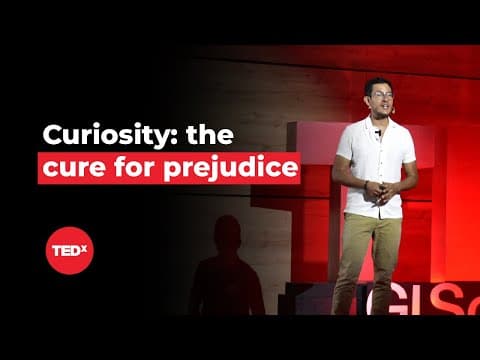
Prejudice can be unlearned—here’s how | Manuel Ríos | TEDxGI School Youth
Audio Summary
AI Summary
The speaker begins by sharing personal photos from international travels, highlighting the privilege of these experiences and the varied encounters they offered, such as eating a croissant in Paris, visiting temples in Indonesia, learning war history in Rome and Berlin, practicing Portuguese in Rio, and observing skyscrapers in the USA. These trips, while unforgettable, also revealed a pattern of uncomfortable follow-up questions and assumptions from people who, in an attempt to be friendly, often relied on stereotypes about the speaker’s country. This often led the speaker to feel compelled to correct misconceptions about Colombian culture.
The speaker, Manuel from Colombia, acknowledges that assumptions are often made about him based on physical appearance, nationality, accent, and clothing. This observation led him to research why such assumptions persist, even among well-intentioned individuals. His research brought him to the Clark Doll Experiment from the 1940s, designed by psychologists to study racial bias. In this experiment, Afro-North American children were asked to choose between two dolls, identical except for skin and hair color, and identify the "good" and "bad" dolls. The speaker was moved by the revelation that children, even at a young age, showed preferences based on skin color. What was particularly impactful was that some children hesitated and showed sadness when asked to identify which "bad" doll looked more like them, suggesting an early internalization of societal prejudices. The experiment has been replicated globally with similar findings, indicating that prejudice is learned from environments like schools, media, and family, rather than being innate. The powerful implication is that if prejudice is learned, it can also be unlearned.
Moving to the 1950s, psychologist Gordon Allport proposed the "contact hypothesis," suggesting that meaningful contact between members of different groups, under equal conditions, can reduce prejudice. The speaker, drawing from his experience as a teacher in Indonesia with students from diverse backgrounds (China, Japan, Singapore, India, Philippines), illustrates this. A simple project, like simulating a volcano, allowed students to interact and work towards a common goal, transcending language barriers, nationalities, backgrounds, religions, and traditions. This shared experience fostered a sense of unity, demonstrating the power of contact.
However, the speaker also acknowledges that contact doesn't always work, especially when faced with vastly different cultures, religions, or traditions. This led to further research, uncovering the "common in-group identity model" from the 1990s, proposed by psychologists Samuel Gaertner and John Dovidio. This model suggests that prejudice decreases when individuals perceive themselves as part of a larger, inclusive group. The speaker emphasizes that humanity shares a common identity as "global villagers" and that while differences are undeniable, focusing on similarities can foster unity in diversity.
The discussion then shifts to "implicit bias," which refers to the automatic, often unconscious, assumptions our brains make about people, groups, and identities. These biases operate quickly and quietly, influencing immediate judgments, such as assessing safety when encountering someone on a dark street. The speaker clarifies that the brain's tendency to make assumptions is natural, but the origin of these assumptions lies in societal patterns, images, and stories. He provides an example of choosing a culturally familiar name, Maria, over another, highlighting the need to pause and rethink such automatic preferences.
While some researchers argue that certain prejudices are evolutionary, helping small groups survive by distinguishing friend from stranger, these mechanisms can become harmful in modern societies. German philosopher Gadamer also noted that some prejudices are unavoidable as they help us understand the world before reflection. However, the problem arises when we fail to reflect, stop being curious, and make generalizations, turning natural predispositions into harmful prejudices.
To combat implicit bias and prejudice, the speaker proposes two steps: "pause and rethink." This involves pausing before making quick judgments and actively re-evaluating the assumptions being made about a person or culture. These steps can interrupt implicit bias and transform prejudices, recognizing that while prejudice is natural, it is not inherently right or fair. Another strategy is to expose oneself to contradictory stereotypes, such as female scientists leading research, male nurses providing compassionate care, or immigrant entrepreneurs building successful businesses.
The speaker notes that media, movies, and advertising have historically perpetuated stereotypes, but many creators are now working to increase representation. However, he cautions against "forced inclusion," where diversity is added superficially without context, deep stories, or real people, as audiences immediately perceive this as inauthentic. What is truly needed, he argues, is not just more representation, but *better* representation—real people with real narratives, not stereotypes. The images we consume today will shape the prejudices we hold tomorrow.
In conclusion, prejudice can be unlearned through curiosity instead of assumption, and through contact instead of distance. This process, which starts with each individual, can lead to a growing circle of understanding and reduced prejudice.