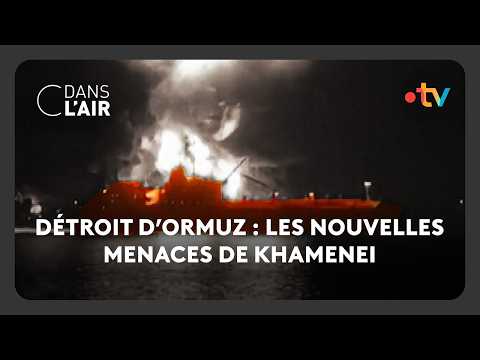
Détroit d’Ormuz : les nouvelles menaces de Khamenei - C dans l’air - 12.03.2026
Audio Summary
AI Summary
The newly appointed Iranian Supreme Leader, in an audio intervention four days after his nomination, called for avenging the blood of martyrs and maintaining the closure of the Strait of Hormuz. This move is perceived as an economic fragmentation bomb with global repercussions. The United States has reported destroying 28 minelaying vessels, with attention turning to Kharg Island, which accounts for 90% of Iranian exports. The Energy Agency has deemed this crisis the most significant disruption in the history of the global market. The vulnerability of desalination plants has also been highlighted, with one being struck, raising fears of a "water war."
Experts discussed the Supreme Leader's address. F. Encel, a geopolitics doctor, noted that the statements align with the regime's theological stance and are necessary to rally national energy during wartime. He suggested it also serves as a warning to Gulf Arab states that Iran can still inflict significant damage, aiming to pressure Trump, though he believes this is unlikely to succeed. The fact that the leader's address was audio-only, without visual presence, four days after his appointment, was seen as a sign of weakness. Encel suggested it indicates the regime is shifting from republican to dynastic, contradicting its past criticisms of Gulf states' "feudal" structures.
I. Lasserre, a diplomatic correspondent, found the message unsurprising, emphasizing continuity with past rhetoric and the leader's reputation for repression and cruelty. She believes the message is an external facade to project strength, not necessarily reflecting the regime's internal solidity. The absence of a visual appearance was considered a sign of fragility, possibly allowing the leader to gain time or indicating he might have been injured in the attack that killed his family. J.-D. Merchet, a journalist specializing in international relations, strongly supported the injury hypothesis, noting that a voice can be manipulated, and a visual appearance is needed to dispel doubts about his actual condition and leadership role, especially given his limited religious qualifications and background in repression. General N. Richoux, former commander, agreed that security measures are paramount for the new leader, considering the previous leader's elimination. He also acknowledged the possibility of injury. Richoux highlighted the new leader's background in the Iran-Iraq war and ties to the Revolutionary Guards, suggesting he is prepared for conflict and unwilling to yield.
The closure of the Strait of Hormuz was a key topic. Encel considered it a suicidal strategy for Iran, arguing that influencing Trump through Gulf Arab states is futile. He predicted that all regional states would blame Iran for the economic fallout. The "oil war" continues, with prices fluctuating. The US plans to release strategic reserves, while the "New York Times" reported that Trump underestimated Iran's response. Media clips showing US military operations and Trump dancing at a rally created an impression of a war taken lightly.
Meanwhile, in Lebanon, Israeli strikes have caused widespread destruction, with nearly 700 casualties. For the first time, Hezbollah and Iran coordinated a massive attack of 200 rockets, drones, and ballistic missiles. Israel's Defense Minister threatened to expand military operations, potentially taking Lebanese territory if Hezbollah attacks continue.
The panel discussed Lebanon's capacity to disarm Hezbollah. Encel stated that Lebanon lacks the means, as its army has been fragmented for over 50 years, allowing Hezbollah to flourish. He noted that even the Lebanese Prime Minister and allied Shiite party Amal are now asking Hezbollah to disarm, indicating political progress. Merchet emphasized that Hezbollah broke a ceasefire and entered the war for Iran, not Lebanon, and questioned the Lebanese army's willingness to disarm the group, given its Shiite components.
Richoux highlighted the use of Iranian-built Shahed drones in attacks, emphasizing their ease of construction and widespread use. He interpreted attacks deep within the Persian Gulf as a strong signal of Iran's nuisance power, aimed at global economic markets to force an end to the conflict. He disagreed that it was a suicidal strategy, seeing it as a calculated move to exert pressure.
The issue of mines in the Strait of Hormuz was debated. While Iran's vice-minister denied minelaying, experts suggested that even the *doubt* of mines is enough to deter shipping due to insurance concerns. Merchet clarified that the Strait is not currently mined, but the threat exists. He also noted that mining the Strait would trap Iran's own oil exports, primarily to China, suggesting it would be self-defeating.
The strategic importance of Kharg Island, Iran's main oil export terminal, was discussed. Lasserre explained that attacking it would cause severe disruptions to international oil trade and price volatility, which the US likely wants to avoid. Encel dismissed the military significance of Iran's threats regarding Kharg, stating that Iran's military capabilities are already at their maximum, with an outdated air force and a diminished navy. He emphasized the political suicide of such actions, pointing out that neither Russia nor China supports Iran's actions in blocking straits, especially those vital to their oil supply. He predicted that such actions would lead to the collapse of the Iranian regime due to economic isolation and internal unrest.
Merchet confirmed that the world can technically manage without Iranian oil, but price volatility is a concern. Richoux acknowledged that taking Kharg Island is militarily feasible but holding it would be challenging. He framed it as a "poker game," questioning who can endure longer: Iran without oil or the international markets and Trump facing elections.
The head of the IEA's statement that this is the most significant disruption in oil market history was met with skepticism by Merchet, who compared it to the 1973 oil shock where prices quadrupled. He argued that current global oil production capacity, especially from the US and Saudi Arabia, can mitigate price increases.
The conflict's impact on Dubai was highlighted, with missile and drone attacks shattering its image as a luxurious, safe hub. The Emirati authorities attempted to control the narrative, with influencers changing their tone after initial panic. Dubai's economy relies heavily on tourism and finance, making its reputation crucial. The city's Achilles' heel is its dependence on desalination plants for 80% of its drinking water, with only 45 days of strategic reserves. Economist E. Crauser-Delbourg emphasized that attacking desalination facilities, which are less protected than hydrocarbon sites, would be an attack on a human right and escalate the conflict significantly. She noted Dubai's high water consumption, three times that of France, highlighting the vulnerability of Gulf states' prosperity based on perceived unlimited water and cheap energy.
Encel criticized the reliance of Gulf regimes on "soft power" and urged them to develop "hard power" capabilities for genuine self-defense. Lasserre explained that the Gulf states, particularly Saudi Arabia, value stability and economic prosperity, which led them to reconcile with Iran despite past rivalries. Merchet added that Gulf Arabs fear Iran and rely on external protectors, buying security from the US, France, Britain, and implicitly, Israel.
The discussion also touched on Iran's threats against financial institutions and tech giants like Amazon, Google, and Microsoft. Richoux noted that drones provide a low-cost way to inflict economic damage. Lasserre and Merchet discussed the difficulty of seizing Iranian assets in financial hubs like Dubai, which have replaced Switzerland as havens for undeclared wealth, due to the pressure exerted by these financial centers.
The Mossad's role in covert operations and intelligence gathering was detailed, including infiltration of Tehran's surveillance systems, data analysis with AI, and recruitment of local agents based on financial or ideological motivations. The assassination of a nuclear figure and the simultaneous explosion of Hezbollah pagers were cited as examples of spectacular operations. Merchet suggested that fostering paranoia and distrust within the Iranian regime is a key strategy to destabilize it.
The challenge of recovering 450 kg of enriched uranium from tunnels in Isfahan was discussed. Encel and Richoux acknowledged the extreme difficulty and risk of such a ground operation. Lasserre confirmed that retrieving this uranium is a priority for Israel, and that intelligence operations have already set back Iran's nuclear program by several years.
Finally, the panel reiterated the uncertainty surrounding the war's outcome, which is unsettling markets. The possibility of more missile attacks from Iran was raised, though experts noted the sophistication and limited production of such weapons. Drones, however, are easy to produce and will likely continue to be used. The untapped threat of terrorist attacks by dormant cells, particularly in Latin America, was also mentioned as a potential avenue for Iran to target the US.