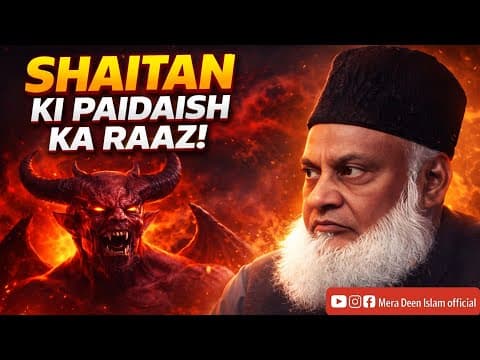
Shaitan Ki Paidaish Ka Raaz | Dr Israr Ahmed Bayan
Audio Summary
AI Summary
The speaker discusses various religious and historical topics, beginning with a brief mention of war and a passage of hatred. The conversation shifts to a discussion of several Surahs from the Quran, including Surah Arhaf, Surah Benes Raeil, Surah Khos, Surah Taaha, and Surah Mujadila. The speaker emphasizes a verse that describes Satan's intention to attack humans from all directions, front, back, right, and left, aiming to make them ungrateful. This is presented as an excellent challenge.
The discussion then touches on human nature, specifically pride and envy, which are described as the root causes of all evil. A Hadith is referenced, stating that anyone with even a speck of pride in their heart will not enter paradise. The speaker connects this to the story of Adam, who, despite being granted honor, was envied by Satan, leading to Adam's transgression against God's command. This act of disobedience resulted in Adam's expulsion from paradise.
The narrative shifts to the concept of chosen people and the historical context of Jewish communities. The speaker explains that non-Jews were often considered illiterate, foolish, and ignorant by some Jewish factions who believed they alone possessed the divine book (Torah) and divine law. This led to a belief that it was permissible to exploit, deceive, and rob these "illiterate" people without divine retribution. The speaker strongly refutes this ideology, asserting it as a wrong way of thinking and emphasizing that God is one and does not endorse such discrimination.
The discussion moves to historical events, mentioning the Bible and ancient times, with a focus on prophets and divine interventions. The speaker references Surah Benisrael in the Quran, noting two instances of divine punishment inflicted upon a community, first by the Assyrians (Syrians). The speaker then highlights the concept of two parties: Allah's party, consisting of sincere believers, and Satan's party, comprising hypocrites who outwardly claim Islam but inwardly serve Satan.
The speaker introduces the topic of human exploitation, suggesting that humans are prone to exploiting those who suffer. The conversation then returns to the historical context of Jewish communities, specifically their interactions with Prophet Muhammad in Mecca. The Jews are accused of inciting the Quraish of Mecca against the Prophet, prompting them with challenging questions to test his knowledge, as mentioned in Surah Banisrael and Surah Kahf.
The speaker then delves into the birth and life of Prophet Jesus (Hazrat Masih). It is stated that Jesus was born on December 25th, and the Christian calendar began one year before his birth. The speaker notes that God raised Jesus alive to the heavens at the age of 33. While Jews believe he was crucified and died, and Christians believe he died on the cross but was resurrected, the speaker emphasizes a common point between Muslims and Christians: Jesus was raised alive to the heavens. The key difference lies in the crucifixion: Christians believe he was crucified, died, and then resurrected, while Muslims believe he was neither crucified nor killed, but rather God raised him.
The discussion touches upon historical events related to the second coming of Jesus and the power dynamics of ancient times, including the influence of the Roman Empire. The speaker then shifts to the era of Hazrat Umar, who, after approximately 500 years, opened the path for Christians to visit sacred places in the region, but with conditions that prevented them from settling there permanently. This agreement by Hazrat Umar was later upheld by the Umayyad caliphate.
The speaker criticizes the historical role of the Pope in medieval Europe, describing kings as mere puppets while the Pope held real power. The speaker asserts that the Pope, as described in the Quran, was seen as a god by some, as Saint Paul had abolished Mosaic law, leaving the Pope with the authority to declare anything permissible or forbidden.
Finally, the speaker presents a severe critique of certain passages in the Old Testament, specifically from the Book of Numbers, chapter 31, verses 17-18. These verses command the killing of all male children and women who have known a man, while keeping virgin girls alive for themselves. The speaker questions how such a command could come from a divine book, labeling it as horrific and accusing prophets of heinous acts and severe immoralities. The speaker concludes by pointing out the extreme nature of these commands, questioning the divine origin of such texts.