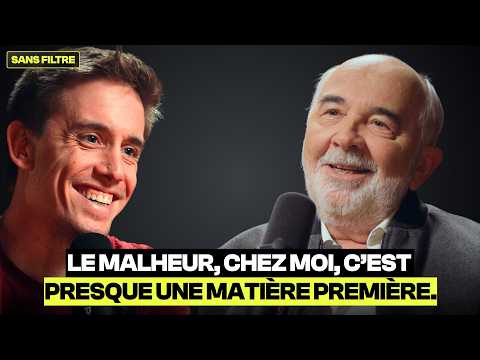
Gérard Jugnot : "Le Succès et l'Échec Habitent sur le Même Palier"
AI Summary
The speaker, Gérard Junot, discusses his approach to comedy, which, contrary to expectations, is rooted in a fascination with misfortune and darkness. He uses humor as a way to process and overcome these aspects of life. He reflects on the early struggles of his film "Les Bronzés" (French Fried Vacation), which, despite its eventual massive success, began with a poorly attended premiere. The solidarity of his group of friends, the "Splendid" troupe, was crucial in overcoming this initial setback. He feels a sense of pride in the enduring legacy of films like "Santa Claus" and "Les Bronzés," which have outlasted many critically acclaimed but now forgotten movies. This enduring appeal provides satisfaction and validates their creative choices in a profession fraught with doubt.
Junot emphasizes the importance of believing in oneself and daring to pursue the seemingly impossible. He credits his acting teacher, T Shelton, a significant maternal figure, for helping him navigate his fragility at 18 and for instilling the belief that acting is a calling for those who can do nothing else. This advice is presented as a key insight for young aspiring artists.
The conversation then shifts to the disturbing problems posed by his film, which he summarizes as "the madness of speed, the lack of nuance, and this abundance of news that we can't digest, and especially this race to the bottom." He expresses concern about the current media landscape, where a pervasive doubt has eroded public trust in information. The rise of artificial intelligence, while advancing in fields like medicine, poses a significant danger to communication by blurring the lines of truth and falsehood.
Junot details his inspiration for the film, stemming from an absurd real-life event where a man was mistaken for a fugitive. This incident, involving a media frenzy and a premature declaration of arrest, highlights the dangers of rapid news cycles and the pressure for scoops. He criticizes how media outlets often prioritize speed over accuracy, stating that even after a blunder, the apology or clarification is often a small footnote. The film explores the profound damage such media blunders can inflict on an individual's personal life, reputation, and community, even after an acquittal. The lingering doubt, like a virus, can infect even friends and acquaintances.
He contrasts this with the narrative of Monte Cristo, a wrongly accused man seeking to regain honor. In his film, the character's exoneration doesn't erase the suspicion, and the reputation, not the truth, becomes paramount. He also touches upon the ethical vacuum in journalism, where the pursuit of a scoop can override ethical considerations. The challenge of making such a serious subject a comedy lies in balancing drama with lightness, transforming tragedy into something that elicits smiles.
Junot reveals that his attraction to comedy stems from a deep-seated existential angst and a "vertigo of existence." This awareness of mortality and the void, which he first experienced around age 8, fuels his drive to find meaning and humor in life's absurdities. He likens the work of comedians to alchemists, transforming misfortune into pleasure. He draws parallels between comedy and tragedy, suggesting that laughter is a form of drama that stops or shifts perspective.
He discusses the actor's ability to inhabit different lives through costumes and roles, seeing it as a way to understand others and the world. He uses historical contexts, like WWII, to illustrate the complexity of human choices and the tendency to romanticize past actions, like the Resistance. He emphasizes the importance of historical memory, referencing films like "Nuremberg" as crucial in confronting difficult truths and the abominable nature of revisionism.
Junot expresses a preference for nuanced storytelling over extreme positions, though he acknowledges the paradox that nuance can sometimes be seen as a refuge for mediocrity in acting. He stresses the importance of contrast in comedy, playing both light and dark aspects of a character. He recounts acting experiences, like filming in a dramatic 1940s setting, where the atmosphere can be immersive, but humor often serves as a coping mechanism and an antidote to potential difficulties on set. He dismisses the idea that actors are permanently scarred by roles, seeing humor and distance as essential tools.
He reflects on the destructive potential of humor and the public's misunderstanding of comedians' personal lives, citing Robin Williams' suicide as a poignant example. He differentiates between laughing and making others laugh, comparing it to the difference between eating and cooking. He notes that laughter and tears share the same muscles, both serving as emotional discharges. In his own work, he aims for "laughter of empathy," a "laughing with," rather than "laughing against" or mean-spirited laughter, which he finds reactionary.
As a director, Junot finds himself more inhibited when working with long-time friends, preferring to direct actors he knows less intimately. He values the collaborative nature of filmmaking, seeing himself as a "coach" who plays within the team. He prefers a structured script over improvisation but is open to incorporating good ideas. He believes that editing plays a crucial role in shaping the final film, particularly for comedies that require rhythm.
He shares anecdotes about the risks and unexpected outcomes of filmmaking, including the near-disastrous explosion of a built chalet and the accidental destruction of a pirate ship intended for resale. These experiences, though costly, are recounted with a sense of amusement, especially when not personally financially impacted.
Junot emphasizes the strong friendships forged in the profession and the importance of community, citing the "Splendid" troupe as an example. He acknowledges the impact of his father and the need to prove himself, a common motivation among many successful men. He discusses his approach to fatherhood, focusing on adoption and acceptance rather than biological roles. He also laments his parents' lack of cultural curiosity, contrasting it with his own passion for cinema, which he views as a broad art form, not divided into "auteur" and "commercial."
He admits to having experienced more failures than successes, with his first major flop, "Sans peur et sans reproche," being a difficult but ultimately educational experience. He believes that success is important for personal growth and for navigating the industry. He finds satisfaction in the longevity of his films, which have endured for decades, unlike many critically acclaimed but forgotten works. He acknowledges the inherent doubt in the film industry and the need to project certainty, even when feeling uncertain.
Junot attributes his career longevity to curiosity, hard work, and luck, including being "co-opted by family" and maintaining a connection with younger audiences. He views retirement as a "debacle" for those who truly love their profession, and he intends to continue working as long as he is desired. He contrasts his own experience with those who pursue careers out of necessity, emphasizing the importance of "doing what you love."
He shares a personal anecdote about his father's advice to always have an "exit strategy," which he found discouraging, preferring to commit fully to his chosen path. He highlights the role of teachers like T Shelton in believing in him and helping him overcome his insecurities. He recounts a childhood fear of heights, overcome with the help of a friend, and relates this to the importance of shared journeys and collective strength.
Finally, Junot expresses his gratitude for his career and the enduring friendships it has fostered, emphasizing that "Splendid" was built on perfectly fitting, yet unique, individual pieces. He finds the experience of filmmaking, and particularly the creative process, to be a source of ongoing passion and surprise.