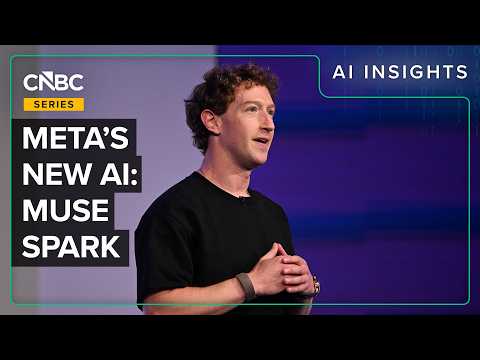
Why Meta's New AI Model Is Such A Big Deal
Audio Summary
AI Summary
Meta has launched its new AI model, Muse Spark, initially codenamed avocado, which is now live on the Meta AI app and website. It will soon extend to other Meta apps and AI glasses. This launch is significant as Muse Spark is the first product from Chief AI Officer Alexandr Wang's Meta Superintelligence Lab, Meta's primary R&D division, established with a $14 billion investment.
The release occurs amidst intense competition from leading AI companies and increasing scrutiny over Meta's capital expenditures, projected to reach $135 billion this year—nearly double last year's CapEx. This also follows previous disappointments with Meta's AI models, such as Llama. Meta claims Muse Spark is its most powerful model to date, though it's a gradual rollout rather than an immediate challenge to advanced models like ChatGPT and Gemini.
Initially, Muse Spark focuses on optimizing Meta's apps, offering features like a shopping mode, creator content suggestions, and visual coding tools for website and mini-game creation. Meta appears to be managing expectations and addressing potential criticism regarding its substantial AI investment. The company states this is just the beginning, with larger models under development, including a more sophisticated "contemplating mode" for Muse Spark, which Meta believes will be competitive with frontier models like Gemini, Deep Think, and GPT Pro.
To generate revenue from its AI investments, Meta plans to offer paid API access to Muse Spark, similar to Anthropic's Claude and Google's Gemini. Unlike the open-source Llama models, Muse Spark will be proprietary, though Meta hopes to release open-source versions eventually. Long-term, Meta aims to compete with rival AI frontier models, not only for reputation and talent acquisition but also to achieve Zuckerberg and Wang's vision of "personal superintelligence"—an AI assistant capable of helping individuals with critical tasks. While the current Muse Spark model isn't breaking benchmarks, Meta considers it a foundational framework for developing more capable models on its path to personal superintelligence.