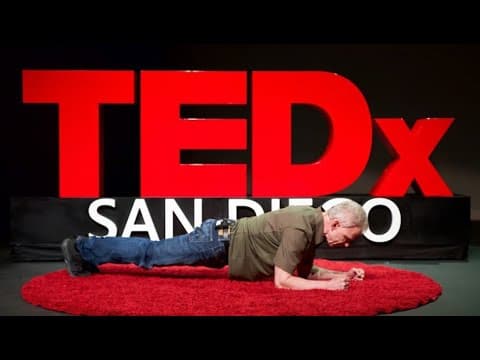
The Secrets and Science of Mental Toughness | Joe Risser MD, MPH | TEDxSanDiego
Audio Summary
AI Summary
The speaker begins by describing the mental and physical challenge of holding a plank, illustrating it with the story of George Hood, who set a world record by planking for over ten hours. George attributed his success to mental distraction, focusing on conversations and drawing energy from those around him. This leads to a discussion about grit, which is often seen as mental toughness but is also rooted in biology.
A key biological indicator for grit is Brain-derived neurotrophic factor, or BDNF. BDNF is a protein that acts like "fertilizer for your brain," helping neurons grow, stay healthy, and communicate effectively, which is crucial for memory and mental resilience. While many factors increase BDNF, exercise is the most significant, and the plank, a simple yoga pose, is suggested as one of the best exercises for building mental toughness due to its demand for mental effort.
The speaker, a clinical professor and diplomat in Preventive Medicine, shares his experience with medically destitute patients suffering from chronic pain and disability. He emphasizes that while a plank isn't a cure, further research into its potential benefits is warranted, especially given the compelling real-life examples of individuals enduring devastating conditions.
Research indicates that exercises requiring mental effort are most effective at raising BDNF levels. A 2005 study in the journal *Hippocampus* found that exercises demanding mental focus, like navigating mazes, produced more BDNF than purely exhausting physical activities. Similarly, activities such as yoga, which combine physical effort and concentration, have yielded some of the highest measured BDNF levels.
The speaker is designing a study to investigate if planks can relieve pain, citing Daniel, a patient with Complex Regional Pain Syndrome (CRPS), who managed to plank for over nine hours despite excruciating pain. This suggests that physically and mentally challenging exercises may help with painful conditions, with BDNF playing a significant role. Recent research in *Experimental Neurobiology* further supports this, showing exercise can double BDNF levels.
The speaker aims to raise awareness about the relationship between exercise, BDNF, and improving quality of life, encouraging further study. He concludes by challenging listeners to do a plank the next time they feel they need more grit, suggesting even a minute can be transformative.