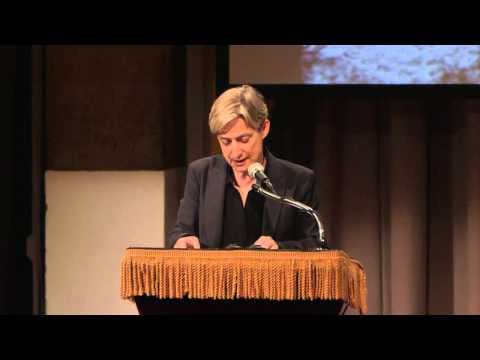
Opening Night of PEN World Voices: Judith Butler
AI Summary
Rage often masks sorrow, and understanding this connection is crucial for nonviolence. Grief can deflate rage's destructiveness. Anne Carson notes tragedy stems from rage, which is born of grief. The act of severing, like a headhunter's, can be a desperate attempt to discard unbearable grief. We see this in everyday moments, like an outburst during a funeral drive, where the grief is so intense it manifests as a destructive fantasy.
The transition from unbearable grief to uncontrollable rage and destructiveness is a profound mystery. Perhaps violence is sought to "kill" grief itself. Could a source of nonviolence lie in the capacity to bear grief, to stay with loss without converting it into destruction? If we could bear our grief, would we be less inclined to retaliate? And if grief is unbearable, is there an alternative to simply enduring it?
The destructive cycle of trying to end unbearable grief only redoubles loss. This destructive act might be a way of externalizing pain, making it someone else's problem. Yet, devastating another's life has never stopped personal grieving. The fantasy might be that destruction purifies the self, ridding it of passivity, or that it forces the world to share one's devastation. If everything is already destroyed by loss, destruction becomes a redundancy, a ratification. Or it's an attempt to stop grief by attacking the world that allowed it.
This furious form of grieving, destructiveness, unleashes an ineffable pain upon the world. Freud suggests some destructiveness yields no pleasure, repeating mechanically without satisfaction, even in revenge. Yet, war can offer terrible satisfactions that must be resisted. Peace is a continuous struggle against destructiveness, a practice of resisting these terrible satisfactions.
More grief isn't the answer, as grief defies mathematical measure. It's not just registering loss or incorporating the lost one. Mourning is an unwanted transformation, an undoing that cannot be willed. It hits like waves, stopping motion and gravity. This sudden halt reveals our deep ties to others; losing them makes us inscrutable to ourselves, life unbearable. We are not just individuals but bound in a "crossing" with others. Losing this ground risks self-destruction or harming others.
The capacity to live without a specific "you" doesn't mean we lose the "place of the you," the generalized addressee to whom we are bound in language. This "you" is the linguistic condition of our survivability, supporting our gravity and motion. Without it, we are wrecked. Loss, while personal, can reveal a political community, a premonition of nonviolence. Our lives are interdependent; denying this leads to destruction.
This interdependency is an ethical injunction to preserve bonds, even difficult ones, by guarding against destructiveness. Before loss, we are already lost in and without the other. This enthrallment describes social relations that sustain and break us, predating conscious choice. We are both done and undone by the other from the start. Refusing this is destruction; affirming it is nonviolence.
Nonviolence is the difficult practice of letting rage collapse into grief, revealing our interconnectedness. We often flee or drive into the unbearable. Patience with unbearable loss, however slow, can