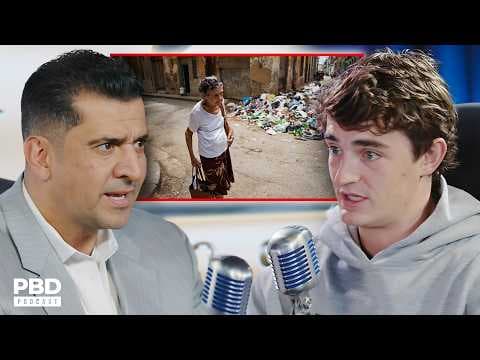
"Cuba Had SPIES Tracking Us" - Nick Shirley INFILTRATES The Communist Surveillance State
Audio Summary
AI Summary
The speaker recounts a recent trip to Cuba, motivated by a desire to document life in a communist country amidst the perceived rise of communism and socialism in the United States. Despite warnings from family and security, he proceeded, believing people deserved to see the reality. He traveled with two Spanish-speaking security guards, one of whom was Cuban American, both experienced in hostile environments.
Upon arrival at the airport, Cuban authorities confiscated most of his equipment, including GoPros, DJI microphones, and Meta glasses, despite having a journalistic visa. They missed a small microphone hidden in his backpack. He spent two hours explaining his purpose, facing intense questioning and scrutiny of his foreign gear, which seemed entirely unfamiliar to the officials. One official suspected he was sent by Trump, noting he was the only American in the airport. His confiscated items were returned the next day, and what was planned as a three-day trip became 24 hours. All his footage was captured on an iPhone with the small microphone.
The airport experience was public, not discreet. Officials manually recorded information on receipts, lacking computers. Immediately after leaving the airport, they were followed. The speaker explains that in communist societies like Cuba, many citizens, especially those in service industries like airports and hotels, essentially work for the government and report on others. This creates a surveillance culture where people "snitch" on each other to benefit themselves, a phenomenon he likened to what he heard about North Korea.
Within two hours of checking into his hotel, he began creating content. A hotel lobby employee recognized him from Facebook videos about Minnesota. While some locals were helpful, like the hotel employee, others, like an older tour guide, propagated government narratives, denying Cuba was communist despite its single-party system.
His observations of the streets painted a grim picture: empty streets, decaying buildings, and mostly 1950s cars, or Chinese and Soviet-era vehicles. He noted mass poverty and a pervasive sadness among the population. He ate only protein bars he brought and hotel food. The five-star hotel experience contrasted sharply with the outside world, designed to offer a pleasant experience unless one questioned the system. The hotel itself was government-run, further contributing to the feeling of being monitored. He witnessed a "spy"—a civilian working for the government—film him asking about communism and then report to another individual who had been following them earlier.
The most striking observation was the profound depression among the Cuban people, particularly Latinos, who he expected to be lively and happy. He described a lack of "life in their eyes," with many, especially women, avoiding eye contact. He also noted the decay of once beautiful architecture, now resembling a war zone. The lack of gas in the country meant garbage was being burned in the streets, contributing to smog. Despite the pervasive sadness, he did see beautiful women, but they, too, were visibly depressed and reluctant to discuss their lives.