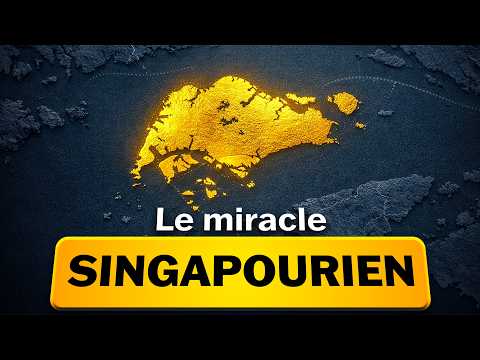
Le pays le plus pauvre devenu le plus riche (Singapour)
AI Summary
In 1965, Singapore was a nation born from rejection. Expelled from the Malaysian Federation due to ethnic tensions, the small island faced a bleak future. With 70% of its population living in poverty, no natural resources, and even its drinking water imported, Prime Minister Lee Kuan Yew famously wept, fearing his country could not survive. Yet, sixty years later, Singapore has orchestrated the most spectacular economic ascent in history, transforming from a slum into a global financial powerhouse where the average inhabitant’s wealth exceeds €330,000.
**The Strategy of Radical Pragmatism**
Singapore’s survival was not an accident but the result of a cold, methodical reconstruction led by Lee Kuan Yew and his advisor, Dutch economist Albert Winsemius. At a time when neighboring post-colonial nations were embracing nationalism and seizing foreign assets, Singapore chose the opposite path. Winsemius’s plan was simple: forget ideology and make Singapore irresistible to foreign companies.
To signal stability to the West, Singapore made two crucial decisions: they kept the statue of colonial founder Stamford Raffles to prove they were not a revolutionary state, and they purged communists from the government. By creating the Economic Development Board (EDB), they offered a "one-stop shop" for investors. "Pioneer Status" was granted to tech companies, allowing them to pay zero corporate tax for a decade. Today, setting up a business takes less than 48 hours, and the legal system is based on British common law, providing a secure environment for the $4 trillion in assets currently managed on the island.
**The "World’s Gas Station" and Maritime Dominance**
Singapore leveraged its only natural advantage: its geography. Situated at the entrance of the Strait of Malacca, the shortest route between China and Europe, it sits at the heart of 30% of global maritime trade. The Port of Singapore is now the most efficient in the world, with a ship arriving or departing every three minutes.
Despite having no oil of its own, Singapore became the "world’s gas station" by importing, refining, and reselling crude oil. It now possesses a refining capacity of 1.4 million barrels per day. Looking forward, the "Tuas Port" project aims for 100% autonomy by 2040, using driverless cranes and vehicles to handle 65 million containers annually.
**Social Engineering: Housing and Integration**
Lee Kuan Yew believed that "homeowners do not start revolutions." To ensure stability, the government created the Housing Development Board (HDB). Today, 80% of Singaporeans live in public housing, but unlike European social housing, these are high-quality apartments sold to citizens at subsidized rates.
To fund this, the Central Provident Fund (CPF) was established—a mandatory savings scheme where 37% of a worker's salary is set aside for housing, healthcare, or retirement. To prevent the formation of ethnic ghettos, the state enforces strict racial quotas in every building, ensuring that Chinese, Malay, and Indian communities are integrated. This forced integration has transformed a once-divided population into a highly educated, English-speaking workforce that consistently tops global PISA rankings in math and science.
**The War on Corruption**
In a region where corruption is often systemic, Singapore adopted a zero-tolerance policy. The Corrupt Practices Investigation Bureau (CPIB) is an independent agency with the power to arrest anyone, including ministers. To remove the incentive for graft, Singapore pays its officials the highest salaries in the world; the Prime Minister earns $1.6 million annually, ten times more than the French president. This intransigence was famously demonstrated when a minister committed suicide after being investigated for taking a bribe, with Lee Kuan Yew noting that "no one is above the law."
**The Price of Prosperity**
Singapore’s success has a dark side, often described as "Disneyland with the death penalty." To maintain order, the state exerts total control. Minor offenses like littering, spitting, or failing to flush a public toilet carry heavy fines. Vandalism can result in judicial caning, and drug trafficking carries an mandatory death sentence.
Politically, the People's Action Party (PAP) has held power since 1959. While elections are held, the opposition is often stifled through ruinous lawsuits or detention without trial under the Internal Security Act. Media is tightly controlled, and a "fake news" law (POFMA) allows the government to demand corrections on content it deems false.
**Future Challenges**
Despite its wealth, Singapore faces existential threats. It is one of the world’s most expensive cities, where a permit to own a car can cost $80,000. It suffers from a staggering inequality gap and relies on a million low-paid migrants who live in overcrowded dormitories. Demographically, the fertility rate has plummeted to 0.97, far below the replacement level.
The most significant threat, however, is geopolitical. Singapore has thrived by being neutral, but as tensions rise between the U.S. and China, the city-state may eventually be forced to choose a side. For a nation that built its fortune on global openness, a polarized world could be its greatest challenge yet. Singapore’s history proves that a country can move from misery to opulence through discipline and pragmatism, but it also suggests that such prosperity requires significant sacrifices in personal and political liberty.