Pourquoi la Bourse ne s’effondre pas malgré une crise historique ?
Audio Summary
AI Summary
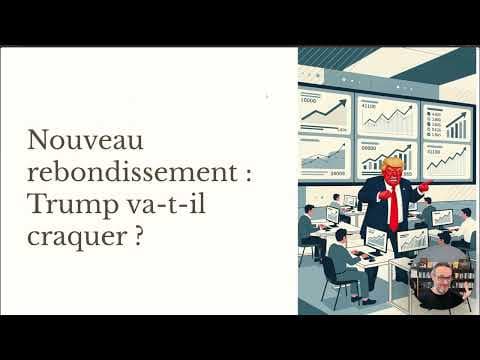
The speaker begins by posing the question of whether Donald Trump will "crack" again, referencing his recent statement about attacking power plants. This is humorously dubbed "Taco Tuesday," a contrast to his previous pronouncements of impending doom. The core of the discussion then shifts to the current geopolitical and market situation, highlighting divergent opinions between Trump and Iranian officials regarding the next steps in the conflict. Acknowledging the uncertainty and the "poker game" nature of the situation, the speaker notes reports of renewed hostilities, including the seizure of a ship and attacks on vessels.
Despite this tense backdrop, the stock market is performing remarkably well. The speaker explains that prior to recent events, there was a bullish gap above the 200-day moving average. The Alpha Zen team, which the speaker is associated with, had strategically moved out of the market when it was below this average, and then re-entered aggressively when it crossed the 100-day moving average, making numerous transactions in a single day. The portfolio has seen a 10.5% gain year-to-date, which the speaker considers excellent. The main point here is that market noise and expert predictions are often irrelevant; the market itself is the ultimate judge. The fact that the market was rising above the 100-day moving average, even amidst talks of a potential "World War III," was a clear signal to invest. This was communicated to students, emphasizing the need to act despite psychological unease about the ongoing conflict.
The speaker explores several reasons for this strong market rally, with a "short squeeze" being a primary candidate. Many investors, including hedge funds and individuals, had been heavily betting on a market downturn, anticipating a major crash. When the market began to recover, these short sellers were forced to buy back positions to cover their losses, driving prices up rapidly and vertically, particularly in the Nasdaq. This illustrates a key drawback of a purely fundamental approach to investing: it often waits for the reasons to emerge, by which time the market has already moved. The market, in this view, often dictates the necessary action.
Two main scenarios are presented for the ongoing crisis. The first is a rapid agreement, a sustained ceasefire, mutual concessions, and a de-escalation of tensions. This would lead to falling oil prices and rising markets. The second scenario involves an agreement within weeks, but with continued "noise." This would include Iranian threats to withdraw from negotiations and Trump making further aggressive statements. However, the speaker posits that Trump is not foolish and understands that further escalation against Iran would be counterproductive, delaying a potential resolution. The ultimate goal, for all parties, is to find an honorable exit from what is described as a "quagmire."
The speaker elaborates on why neither side has an interest in pushing too far. For the United States, rising oil prices negatively impact consumers, leading to inflation, pressure on households, and market nervousness, which can have significant political consequences, especially with upcoming midterm elections. For Iran, prolonged crisis exacerbates internal tensions due to high inflation and currency devaluation, which have already led to widespread protests. Therefore, both nations have a vested interest in finding a face-saving resolution.
The speaker then pivots to the underlying economic issues that remain, even if a geopolitical agreement is reached. The US still faces a colossal debt, massive deficits, and higher interest rates. Europe is experiencing weak growth, a fragile industrial sector, and strained public finances, with France facing significant interest charges on its debt. Globally, the speaker anticipates agricultural and food crises, as well as trade tensions and potential wars. Therefore, the world is not yet out of the woods economically.
The relationship between economic fundamentals and the stock market is then examined. While fundamentals are important, the market can sometimes operate with its own logic, even during dire economic times. Examples like Turkey and Lebanon are cited, where stock markets surged despite hyperinflation and catastrophic economic conditions. This paradox is explained by the market's dual nature: it anticipates future profits, but it also serves as a hedge against inflation and a speculative vehicle. In an environment of currency devaluation and high inflation, the stock market can act as a protection for one's capital.
Technically, the Nasdaq has broken historical highs. Even with minor corrections, the speaker is not concerned, attributing the recent surge to the short squeeze. The overall market sentiment remains bullish for now, with a correction being a normal occurrence after such a sharp rise. The speaker is not overly concerned about oil prices, believing an agreement is likely, though it may take weeks. The economic imperative for an agreement, the speaker argues, outweighs ego.
The summary concludes by reiterating that the stock market's resilience can be attributed to the temporary nature of oil shocks, the possibility of an agreement, central bank adaptability, and ongoing innovation. The Alpha Zen program's success (10.5% year-to-date) is highlighted, emphasizing its ability to manage both downturns and upturns. The speaker's current sentiment is that the market remains rational, overcoming panic.
However, the speaker acknowledges significant risks, including the possibility of a severe crisis and a stock market collapse, stating these risks are at their highest. Paradoxically, despite these risks, inaction is seen as a path to losing money. This leads to the core of the speaker's philosophy: automating investment decisions to remove mental burden and reliance on personal opinions or instincts. The Alpha Zen system is designed to perform well in all market conditions – rising, falling, or sideways. The speaker shares personal experience, including navigating a traumatic period in Dubai while their automated portfolio continued to function, achieving significant returns. The emphasis is on having a strategy that capitalizes on market movements, limits losses, and generates gains regardless of the scenario. The speaker encourages joining Alpha Zen, suggesting it might be its final year. The ultimate message is to rely on scientifically tested strategies and automation rather than subjective analysis.