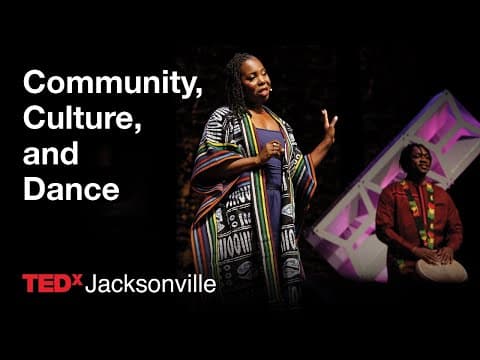
More Than Dance: Africana Traditions as Living Memory | Christa Sylla | TEDxJacksonville
Audio Summary
AI Summary
The speaker recounts a powerful performance of Lamba, a Mandinka rhythm and dance, at a TEDx event, highlighting that the preparation for this performance began not just months or years prior, but over 800 years ago in the 13th-century Mali Empire. This longevity of knowledge is attributed to how it is carried through embodied practice within communities. Beyond technical training, African dance communities foster deep familial bonds, creating a microcosm of the larger world and enabling embodied knowledge to survive across time.
The speaker addresses the common perception of African dance forms as mere entertainment, often dismissed in professional dance spaces as primitive or lacking structure. This reductionist view, which flattens the diversity of an entire continent into a single image, is rooted in a history of intentional devaluation and erasure, particularly in the United States. Following the Stono Rebellion in 1739 and the subsequent harsh slave codes, drumming was outlawed, with severe punishments for its practice. This was because the drum served as a powerful tool for communication, organization, and invocation, capable of uniting people across linguistic and geographical barriers – a threat to oppressors.
While drumming traditions persisted openly in places like Cuba and Haiti, in the US, the rhythm went underground, transforming into foot stomps, claps, field hollers, and ring shouts, eventually re-emerging in forms like praise dance, jazz, and hip-hop. The speaker emphasizes that the dismissal of African dance forms as primitive is not simply a matter of unfamiliarity but a lingering effect of censorship and fear.
Every rhythm and movement carries a story, serving specific communal purposes. Examples are given of West African rhythms like "soro" signaling the need for communal support in farming, "will" celebrating young men's rites of passage, and "yanki" providing the soundtrack for youthful romance. These are presented not as random movements but as sophisticated systems of communication. Modernity's separation of dance from knowledge, prioritizing disembodied intellect over embodied wisdom, has led to disconnection from our bodies, communities, and shared humanity. Losing connection to rhythm also means losing connection to nature.
The speaker clarifies that "our bodies remember" is not a metaphor but refers to living memory encoded in rhythm, movement, and communal practice, evident even in infants' innate responses to rhythm. While appreciating professional spaces, the speaker stresses that dance is a fundamental human activity, not solely for elites or entertainment.
Recent neuroscience research highlights the benefits of movement for brain plasticity, memory, and emotional regulation. Group dance, particularly live performances where dancers make eye contact, has been shown to synchronize brain waves and heart rhythms, literally syncing nervous systems. This space between modernity and tradition offers an opportunity to reclaim embodied knowledge and transform how science perceives it.
The speaker notes how these rhythms have traveled from various global settings to contemporary forms like TikTok challenges, choreography, and Afrobeat concerts, underscoring the importance of recognizing their origins. The intentional silencing of African rhythm and movement aimed to break cultural memory, but its continuity is evident today. Observing an ampiano dancer, a church praise break, a synchronized crowd at an Afrobeat concert, or a popular dance trend reveals ancient communal synchronization, the same neural and spiritual entrainment that built ancestral communities.
As a descendant of these lineages, the speaker views their dance practice as invocation, communing with ancestors whose stories were silenced and ensuring their continuation. Teaching is seen as inviting the community into this sacred exchange. The speaker urges listeners to look and listen differently to these forms, to question the memories their own bodies carry, and to recognize the vast archive present in any performance or class. Ultimately, "our bodies remember," and through rhythm, reverence, and resistance, this memory is kept alive.