Il peut rendre n'importe quel appareil intraçable
AI Summary
This video introduces Cyber Moustache, a "real-life Q" who customizes everyday devices for law enforcement and special clients. He modifies items to adapt them for specific needs, often focusing on enhancing privacy or surveillance capabilities.
One of the key modifications Cyber Moustache performs is on smart glasses, such as Meta Ray-Ban glasses. Law enforcement agencies are interested in these glasses for evidence capture and training purposes, like shooting practice. However, the standard Meta Ray-Ban glasses have a blue LED light that flashes when an image or video is being captured, making them easily detectable. This is problematic for covert operations.
Cyber Moustache's solution involves a hardware modification. He opens the glasses, removes the protective lens, and then uses a heated paperclip to puncture a plastic bulb, gaining access to the LED. He then activates the camera to make the LED flash, allowing him to locate and physically disable it using a Dremel tool. After cleaning, he applies black felt to cover imperfections and reseals the area with UV resin, which hardens under UV light. This process effectively disables the blue LED without affecting the glasses' functionality.
He explains that a software solution to disable the LED would be vulnerable to updates from the manufacturer, whereas a physical modification is permanent. He also clarifies that simply covering the LED with a black sticker doesn't work because the glasses have a light sensor around the lens that detects obstruction and triggers an error message. The LED's original purpose is to alert people that they are being filmed, similar to camera shutter sounds mandated in Japan to prevent surreptitious photography.
Due to the sensitive nature of these modifications, Cyber Moustache is selective about his clients. He requires proof of company registration (Kbis) and evidence of their field of work to ensure the devices are not used for illicit purposes, such as filming people in private spaces.
Beyond disabling the LED, these glasses have potential for advanced applications like real-time facial recognition. Cyber Moustache gives an example of security personnel at a high-end event using modified glasses connected to a security PC. When a guest claims to be on a list, the security officer, through a remote earpiece, can verify the guest's identity with someone at the PC who has access to the guest list, allowing seamless entry. He also mentions a video he saw of university students creating glasses that performed real-time facial recognition and social media lookups, highlighting the potential for misuse. He acknowledges that, like any tool, these gadgets have both positive and negative applications.
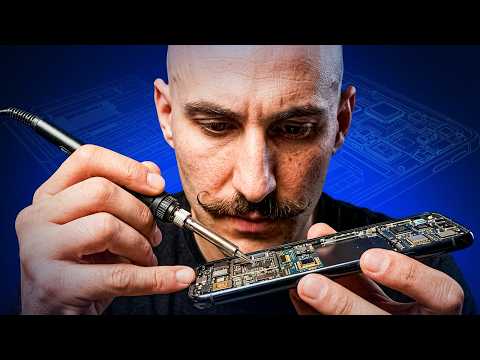
Cyber Moustache also modifies mobile phones, focusing on enhancing privacy and making them untraceable. He emphasizes that he is a "tinkerer" rather than an electronics expert but has specifically learned electronics to perform these modifications correctly. His process involves opening the phone and removing components based on client requests. For instance, if a client wants to avoid being listened to or tracked, he removes the front camera, microphones, and the sensor chip responsible for accelerometer and gyroscope functions, which contribute to geolocation and movement tracking. He even showcases a personal phone he made transparent to reveal the removed components, including the induction charging coil (to prevent overheating), both microphones, the sensor chip, and the front camera. He leaves the rear camera but is working on a magnetic aluminum cover for it to prevent remote activation. He can also remove the USB-C port, relying solely on induction charging, to prevent data exfiltration via cable. These modified phones typically run on GrapheneOS, a highly secure Android-based operating system that prioritizes privacy by removing Google services, preventing data collection, and offering features like randomized PIN pad layouts.
His typical clients for these modified phones include law enforcement agencies like OFAC, who want to ensure their agents cannot be traced or recorded while on duty. The phones are delivered with pre-installed pseudonyms and disabled front cameras to prevent accidental self-recording or exposure of their identity.
Cyber Moustache demonstrates the phone modification process, starting by heating the phone to soften the adhesive, allowing him to open the back cover. He uses specialized tools, including a soldering station with a voice-controlled hot air gun. Once open, he systematically disassembles the phone, removing screws and disconnecting flex cables. He then removes the front camera, the two microphones (including one for ambient noise cancellation), and the sensor chip. The sensor chip is a tiny component that requires precision desoldering using flux and a hot air gun at specific temperatures (around 420°C for microphones, but differing for the sensor). After removal, he cleans the area. He explains that while specialized, secure phones exist (like those from Thales, reportedly costing €50,000), his clients prefer off-the-shelf, high-end phones that are then physically modified, giving them confidence that components are truly removed, not just disabled via software. This approach also allows them to use modern phones with up-to-date features and good cameras, which GrapheneOS can't fully guarantee in terms of hardware control. He also applies this approach to laptops, creating "ghost computers" by removing cameras, microphones, and speakers. He mentions a MIT study that showed speakers could be repurposed as microphones.
His expertise extends to creating Faraday bags. He explains that these bags are made from a fabric woven with ferrous components, designed to block all electromagnetic waves. This prevents devices inside from connecting to Bluetooth, Wi-Fi, or being tracked. He started making these for clients concerned about data exfiltration, especially during events like the Olympics. He learned to sew to integrate the Faraday fabric into existing bags. These bags pass through customs without issue because X-ray scanners can still see the contents.
Cyber Moustache's unique skill set has earned him the nickname "the wizard" among some law enforcement agencies like the BRI. His journey began with a personal interest in gadgets and fraud detection. He always carried various tools, which intrigued a colleague working in defense. This led to a request to create "bug-out bags" or "repatriation bags" for individuals in crisis zones, containing items like water purification tablets and crank-powered chargers.
He receives unusual requests, such as creating a remote car immobilizer for "top-level" arrests. This device would allow officers to remotely cut a car's engine before it starts, preventing high-speed chases and potential harm. He researches existing solutions, sometimes with the help of electronic contacts, and then adapts or recreates them. He even modified a scooter to remove its speed limiter for a law enforcement client, for "reconnaissance" purposes.
He also showcases a rugged, militarized phone (XCover 6) in a custom case. While the phone itself is relatively small, the case makes it massive, offering enhanced protection, customizable buttons, and features like hot-swappable batteries and push-to-talk capabilities. He has added a tripod and light to it.
Another interesting gadget is a non-smartwatch that, despite its traditional appearance, incorporates a powerful 300-lumen flashlight activated by a button. This is popular with US law enforcement for tactical entry, allowing them to illuminate a room without needing a separate light source. He also integrates NFC chips into watch glasses, allowing users to embed information like website links or, more interestingly, a secure communication app. This allows users to cross borders without a phone, then scan the NFC chip with a new phone to access a secure messaging platform, useful for sensitive communications. He also notes the potential for NFC chips in rings or watches to trigger "dead drops" or emergency signals, such as scanning point A for "all clear" or point B for "need help."
Future projects include miniaturizing SOS functions, similar to Garmin's tactical watches, into belts or bracelets. These would have an embedded SIM card to send GPS location and an emergency message to predefined contacts or even directly to law enforcement.
He also modifies Samsung SmartTags (similar to Apple AirTags). He removes the internal speaker, which normally makes noise when triggered, to enable covert tracking. He also flattens the tag and adds parallel-soldered batteries for extended autonomy. These flattened, silent trackers can then be discreetly sewn into clothing or shoes. Samsung SmartTags also offer augmented reality search, guiding users to the tag's location with visual cues, which is useful for locating individuals in complex environments.
Reflecting on his work, Cyber Moustache admits that his initial "fun" activity has evolved significantly. He now realizes how far advanced defense and security technologies are compared to what is publicly known, stating that he has gained access to a "sea" of knowledge that makes his initial tinkering seem like playing in a "puddle." He emphasizes the incredible technical capabilities of people working in these fields.