Space Cowboys Plan to Build Massive Satellite - Deep Space Updates May 13th
Audio Summary
AI Summary
Here's a summary of the provided transcript:
**Launches and Spacecraft Updates:**
* **May 3rd:** A SpaceX Falcon 9 launched from Vandenberg carrying Korea's CAS-500 observation satellite. The launch also included numerous other payloads, like six satellites for Planet, six for Earth Daily, and seven for Earth observation. This mission resembled a rideshare but wasn't officially designated as such, with all payloads heading to a sun-synchronous orbit.
* **May 6th:** Another SpaceX Falcon 9 launch from Vandenberg deployed Starlink satellites.
* **May 11th:** China launched the Long March 7 from Wenchang, carrying Tianzhou-10, their cargo spacecraft for the Chinese Space Station. Tianzhou-10 docked with the station, delivering supplies, equipment for future Shenzhou missions (23 and 24), spare parts, a new spacesuit, and a treadmill. China plans to continue expanding its space station.
* **May 11th (Monday night):** A SpaceX Falcon 9 launched from Vandenberg carrying NROL-72, part of a proliferated architecture of spy satellites on Starshield buses. Approximately 20 spacecraft were aboard. The launch involved a downrange landing on a drone ship, indicating a maximum payload capacity was utilized.
**Artemis Program Developments:**
* **Artemis 2:** The capsule has returned to the Space Coast. Deservicing operations are underway, including payload removal, hardware analysis, and heat shield examination to gather data for Artemis 3.
* **Artemis 3 Hardware:**
* The booster core has arrived at KSC and is being integrated with the boat tail section. Engine installation and other equipment, like mounting points and strakes, are ongoing.
* The Orion spacecraft is at the Cape undergoing functional testing, with the heat shield and service module already installed. Airbus has attached the solar panels to the service module.
* **Artemis 3 Timeline:** The original optimistic plan for two launches in 2028, requiring a spring Artemis 3 launch to maintain a 10-month cadence, now appears unlikely. Artemis 3 is now projected for mid-to-late 2027. This shift might allow for only one Artemis 4 launch in 2028. The timeline is heavily dependent on Human Landing System (HLS) suppliers delivering their hardware on schedule. SpaceX and Blue Origin indicate late 2027 as a more likely timeframe for their contributions.
* **Artemis 3 Communications:** NASA has issued a request for information for an alternate high-data-rate communication system to provide 4K video during mission phases like docking. The existing TDRS system is oversaturated. The new system needs to provide a 12 Mbps downlink and 500 kbps uplink from a 250 nautical mile orbit with a 33-degree inclination. Two options exist: hardware fitted to the service module (due by fall of the current year) or hardware operable from inside the cabin (deliverable by 2027). This requirement may be influenced by the Starlink optical relay terminal tested on Polaris Dawn. The goal is to capture high-definition footage from low Earth orbit.
* **Artemis 3 Upper Stage:** NASA has confirmed that Artemis 3 will use a custom-built spacer instead of the Interim Cryogenic Propulsion Stage (ICPS). The ICPS will be saved for Artemis 4.
* **MDA Space:** This company, building the robot arm for the Gateway (Canada's contribution), continues to build it despite the Gateway's cancellation, as they are still receiving funding.
* **Artemis 2 Images:** 12,000 images taken by the Artemis 2 crew have been published. These raw images are being analyzed, with useful data to be incorporated into the planetary data system. Some images uniquely capture the human element, showing parts of the spacecraft window or crew members. A sequence of night-side images revealed moving auroras, thunderstorms, and glinting satellite reflections, offering a dynamic view of Earth.
**Lunar Missions and Technologies:**
* **VIPER Spacecraft:** Blue Origin has released a video demonstrating how they will offload the VIPER rover from their Blue Moon Mark 1 lander, a 7-meter tall vehicle. The process involves using davits and cables to lower the rover onto the lunar surface, with capabilities to handle up to 10-degree slopes.
* **Astrolab Flip Rover:** Astrolab has developed a new rover called Flip, which began development about two years ago. Videos show the rover with its distinctive flexible wheels performing test drives.
* **Helium-3 Extraction:** NASA has awarded a $6.9 million contract to Interlune to test hardware for extracting helium-3 from the Moon. The company aims to scoop regolith and test methods for volatile extraction, including helium-3. Helium-3 is a rare isotope, costing around $20 million per kilogram, and is sought after by quantum computing companies. Interlune reports $500 million in confirmed orders if they can deliver the material at their projected price.
**Other Space News and Developments:**
* **Blue Origin Boosters:** Two New Glenn boosters, "Never Tell Me the Odds" and "No It's Necessary," were seen side-by-side, prompting speculation about their role in future launches.
* **Mars Trajectories:** A Brazilian scientist's claim of a 36-day shortcut to Mars was widely reported. While the method requires exceptionally high speeds, it highlights the use of asteroid flybys and optimizing trajectories, similar to "pork chop plots" used in mission planning to find low-energy transfers.
* **F-14 Aircraft:** The 40th anniversary of "Top Gun" brings attention to the F-14. A proposed "Maverick Bill" could transfer three F-14s to the Marshall Space Flight Center for restoration or display by private groups. Jared Isaacman is involved in this effort.
* **Avio Lancia Program (Italy):** This Italian program for air-launching rockets has released images of its HAX25 demonstrator being released from an Alpha Jet. Jared Isaacman's Alpha Jets were identified as being used in this program, suggesting his involvement in air-launch technology.
* **Starfighter Space:** This Florida-based company uses F-104 Starfighters for potential rocket launches, aiming to leverage their high-speed climb capabilities.
* **Niu Space (China):** This Chinese company has secured funding for a smaller version of a belly-flopping rocket with side-mounted landing rockets, eliminating the need for vertical transition during landing.
* **JPL Mars Helicopter Innovation:** JPL has optimized the Mars helicopter rotors to achieve tip speeds of up to Mach 1.08 in the Martian atmosphere, an improvement over Ingenuity's Mach 0.7 limit. This advancement could benefit future missions like Skyfall.
* **Rocket Lab:** The company reported its strongest quarter yet with $200 million in revenue and a $2.2 billion backlog, including over 70 launches. They are expected to surpass 100 launches this year. Rocket Lab has also acquired Motive Space Systems, expanding its capabilities in robotic arms and actuators for spacecraft. Footage of a ground-based test stage separation for their Neutron rocket has been released. An Archimedes engine test at Stennis showed clean burn marks and gimbaling, indicating progress towards flight status.
* **Cowboy Space Corp. (formerly Ether Flux):** This company has secured significant investment for space-based solar power and space data centers. Their strategy involves transforming rocket upper stages into orbital data centers with radiators and solar panels.
* **SpaceX Starship:**
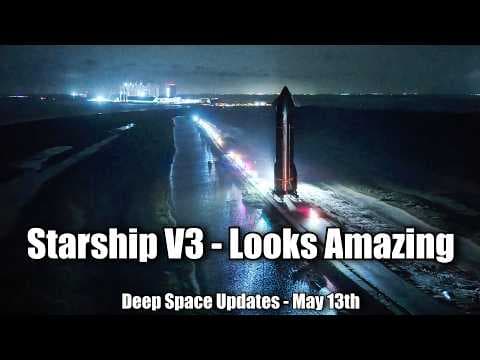
* The V3 Super Heavy booster has undergone a 14-second static fire test. Significant design improvements are visible, including cleaner lines, a new interstage with trusses, a different dome shape for hot staging, and only three fins whose actuators are integrated into propellant tanks.
* Starship V3 also features design refinements, including moved fins, more plumbing, and a cleaner skirt area with nozzle-like vent structures for attitude control, useful for orbital docking. Ports for anchoring spacecraft are present on the top.
* A wet dress rehearsal was conducted, and the vehicle is being destacked. The next launch attempt is tentatively scheduled for May 19th, but could be delayed further.
* For launch number 12, two Starlink satellites will carry cameras to investigate the heat shield and photograph Starship from an external perspective, a long-requested capability.
* **CRS-34 Cargo Mission:** The Commercial Resupply Services Mission 34 on a Dragon spacecraft is en route to the ISS, with docking and unloading as key events to observe.