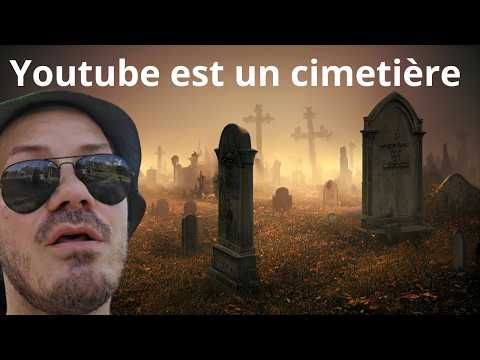
Autopsie. YouTube est un cimetière
Audio Summary
AI Summary
Many YouTubers fear silence more than failure or criticism – the silence of posting content that no one sees. The common belief that YouTube is a permanent library for content is mistaken; it is more accurately described as a vast digital cemetery filled with millions of buried videos, ghost channels, and disappeared creators. This can happen abruptly, as exemplified by a friend named Marc whose "Blue Sky TV" channel was deleted without warning, erasing years of work, ideas, and subscribers. This violent erasure has also affected other creators, yet it's rarely discussed because people assume they are protected until it happens to them. However, YouTube owes creators nothing; they are tenants whose lease can end without notice.
Even worse than deletion are channels that remain but are effectively dead, with hundreds of thousands of subscribers yet only receiving a couple hundred views. This feels like speaking to an empty stadium, with creators constantly refreshing stats in a futile hope for change. If content doesn't perform, YouTube quietly buries it without ceremony. The idea of "community" is misleading because subscribers only see what the algorithm decides to show them, creating a filtered relationship that can render creators invisible. YouTube is not a democracy where the best content wins; it's a mechanical system that rewards click-through rates, watch time, retention, and strong emotion, often at the expense of truth, depth, or nuance. If content makes people think but doesn't generate clicks, it gets suppressed, leading to a cycle where reduced visibility further diminishes existence on the platform. This mechanical nature lacks empathy, disregarding years of effort, help provided to others, or a loyal community if engagement metrics aren't met.
Initially, creators join YouTube to share and exist, but they soon discover the importance of numbers like CTR, retention, watch time, and impressions, transforming them into analysts. The realization that packaging, rather than content, drives engagement can be dangerous. This pushes creators to be more provocative, dramatic, and decisive in titles and thumbnails, not out of dishonesty but for survival. This often leads to clickbait, where titles exaggerate or mislead to attract views. A common example is a YouTuber who announces "leaving Thailand" for a week-long vacation. This behavior stems from the fear of declining views, as reduced visibility by the algorithm creates a downward spiral of even fewer views and increased stress, leading creators to push for stronger, more shocking content.
This pursuit of clicks can lead creators to cross lines, resulting in strikes, demonetization, age restrictions, video blocking, or even channel deletion. The system, in its perverse logic, rewards extremism—anger, fear, clashes, and scandals generate clicks, while nuance and reflection perform poorly. Creators are thus faced with a tension: remain true to themselves or optimize for the algorithm. The speaker admits to considering intensifying language for more views, highlighting how the trap subtly shifts intensity rather than ideas. The problem isn't just clickbait but the habit of constantly pushing for more radical content, as returning to a "normal" approach means losing performance and becoming invisible. YouTube doesn't explicitly demand sensationalism; it merely presents the numbers, and creators' brains adapt, self-regulating and self-optimizing until they question if they are truly speaking or just playing a game.
Despite understanding this, creators continue because they want to exist and be seen, finding disappearance worse than losing. The speaker recounts a personal experience with a video titled "French Arabic," which garnered 35,000 views in days before being censored and made invisible in French territory—the primary audience. This "amputation" felt like a profound fragility, a realization of being on rented land where building, speaking, and performing can be limited or restricted without clear reasons. Such experiences lead creators to internalize the possibility of punishment, causing them to self-censor in future content by questioning words and topics. This anticipation of censorship, rather than direct censorship, profoundly changes creators, making them more strategic, calculating, and less spontaneous or authentic.
The real danger isn't criticism or fewer views, but the identity becoming dependent on the platform. A successful video makes one feel strong, while a blocked one diminishes self-worth, linking personal value to a fluctuating graph. The speaker and his friend Marc even deleted successful videos preemptively due to anticipated algorithm changes, a sad consequence of this dependency. The most dangerous aspect of YouTube is addiction—the constant checking of YouTube Studio, obsessing over views, retention, and impressions, rather than the message itself. This links self-worth to performance, leading to self-doubt when numbers decline. Some creators eventually crack, slowing down and disappearing silently into the digital graveyard.
The system rewards regularity, performance, and retention but punishes fatigue, doubt, and breaks. A six-month hiatus can mean starting almost from scratch. While the internet promises freedom, YouTube imposes an unrelenting rhythm of publishing, analyzing, optimizing, and relaunching. Despite these insights, the speaker continues because YouTube remains an incredible stage, a powerful lever, and an amplified voice. However, it's crucial not to confuse self-worth with views, CTR, or retention. The individual behind the camera is separate from these metrics.
The solution isn't to abandon the platform, but to recognize the illusion of ownership. Creators don't own their views, reach, or audience; they rent them. Understanding this shifts the perspective from building *on* YouTube to building *using* YouTube. The platform should be a tool and an amplifier, not an addiction or an identity. Diversification through newsletters, private communities, or off-platform businesses provides stability, preventing dependence on a single algorithm. Loyalty to oneself is paramount; chasing sensationalism for too long can attract an audience that no longer aligns with the creator, leading to being trapped by one's own character—a form of death. The speaker prefers fewer views and peace of mind over millions and losing self-recognition, fearing artificiality more than censorship. Ultimately, while YouTube can bury, block, and amplify, the real question is whether creators lose themselves in the process. The advice for aspiring YouTubers is to create for themselves, for passion, for fun, or for business, but always with a clear trajectory, understanding that they use YouTube to elevate themselves, rather than YouTube helping them.