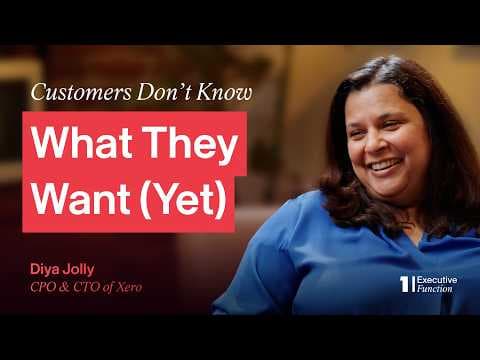
AI killed the product roadmap | Diya Jolly (CPO & CTO of Xero)
Audio Summary
AI Summary
An excellent Chief Product Officer (CPO) focuses on setting the vision and direction for the product, aligning it with the company's overall vision, and building a strong team to execute the details. It's not about micro-managing features or roadmaps, but rather about strategic leadership. A CPO must deeply understand customers to make informed bets on product development and effectively allocate resources, a process that requires frequent re-evaluation due to the dynamic nature of the market.
The CPO role adapts to the company's leadership structure. With a founder-CEO, the CPO must co-create the product vision, heavily influencing the founder by leveraging their deep customer understanding. Founders often rely on gut instinct, having nurtured their vision for years, whereas executive CEOs are typically more data-driven. This requires a CPO in a founder-led company to possess high emotional intelligence, understanding what influences the founder beyond just business metrics, and being willing to cede some autonomy. Regardless of the CEO type, aligning on the outcome—building a great company and product—is crucial. The CPO's role is not necessarily to originate every vision, but to synthesize insights from various stakeholders and customer understanding.
When it comes to value creation, the belief is that if you add significant value to the customer, you will eventually find a way to capture that value for the business. These two aspects are intertwined; if value cannot be captured, then the value added to the customer might not be sufficient. For large-scale planning, general rules of thumb exist, such as allocating 30-40% to existing customers, 30-40% to new areas, and 20-30% to moonshots. However, these rules need to be adapted to the current environment, especially with rapid technological changes like AI.
The current technological landscape, particularly with AI, demands taking more risks in product development. Many traditional assumptions about workflows and product interaction are being challenged. For example, automating bank reconciliation, initially met with customer skepticism, achieved 97% accuracy, saving small businesses significant time. The key learning was that customers become comfortable when they can clearly see and understand the automated processes. This era requires CPOs to take leaps of faith, as customers themselves often don't know what they'll be comfortable with. Relying solely on current customer requests risks falling behind.
In 2026, an effective CPO needs to understand customers not just by what they ask for, but by anticipating their needs through technological innovation. This means delving deeper into customer problems and leveraging new technologies to deliver more value than customers even realize they need. The focus shifts from delivering capabilities to collapsing workflows and creating new outcomes like time saved or business growth. This is a profound shift, changing the very concept of an "app." Instead of building tools for humans to conduct work, the goal is to design software to achieve specific outcomes, such as ensuring a customer gets paid, by integrating various communication channels and proactive actions.
This shift necessitates CPOs to operate at a lower altitude, engaging more deeply in technical architecture discussions and fundamental product decisions. Every decision becomes strategic, influencing the product's long-term direction and tech stack. Unlike three years ago, where teams could autonomously build features based on understood requirements, today's environment requires senior leaders to be catalysts for change, involved in the initial "sausage making" of innovation.
On the topic of organizational politics, it's present whenever more than two people are involved, rooted in misaligned incentives and friction towards achieving common goals. A CEO can mitigate politics by setting up an effective incentive system that rewards collaboration and prioritizes the company's interests over individual or team self-interest. Recognizing and rewarding collaboration, even in imperfect outcomes, and valuing putting the company first (even if it means a less "perfect" solution that motivates teams) helps foster a less political environment. Creating a culture of safety and support also reduces political maneuvering, as people tend to act in the best interest of a stable environment when they feel secure. Incentives should balance autonomy, purpose, growth, and compensation, as people are not solely "coin-operated."
A CPO must balance demanding high performance with providing support and psychological safety. Demanding results without allowing for risk-taking and learning from failure leads to a fear-based culture where innovation stagnates. It's crucial to set realistic expectations for success rates (e.g., 70-80% batting average for OKRs, allowing for some failures) and to celebrate failures as learning opportunities. A CPO's primary job is to raise the ambitions of the organization, leveraging a broader perspective and data on team trajectories and industry benchmarks to push teams beyond their perceived limits.
One of the trickiest aspects of being a CPO is recognizing that the role evolves into making a few big, irreversible decisions that require deep thinking rather than extensive execution. This necessitates building a strong team of lieutenants who can handle day-to-day operations and tactical issues. The CPO's focus shifts to long-term vision and ambiguous problems, delegating tactical tasks and smaller impact decisions. For critical, ambiguous decisions, a CPO might spend 50% of their time, requiring dedicated blocks of uninterrupted thinking time, often by aggressively protecting their calendar from meetings and emails.
A successful approach to tackling ambiguous problems involves extensive external exploration, gathering information, structuring potential debates, and then iteratively refining solutions through documentation or prototypes. One example of a successfully "nailed" ambiguous problem was Zero's acquisition of Milio to compete in the US market. The insight was that for small businesses, cash flow management is paramount, and bills payment is often the first financial interaction. Betting on a payments company early in the small business flow, with the right tech, founders, and culture, proved to be a strategic entry point. Another example is the development of a financial insights chatbot, Finits, despite concerns about accuracy and hallucinations in accounting. This high-risk bet forced the development of robust AI infrastructure and achieved high accuracy, giving them a market lead. This demonstrates that raising the bar often forces the necessary enabling pieces to fall into place.
In the current uncertain environment, CPOs are typically focusing 18-24 months out, laying groundwork for fundamentally different future states rather than incremental changes. This requires making multiple hypotheses about future trends (e.g., headless apps, agentic actions, the evolution of SaaS) and allocating resources accordingly, while continuously learning and being prepared to pivot.
Being an excellent executive team member requires understanding multiple domains, not just one's own, and shifting between problem-solving at a functional level to solving company-wide strategic issues. The advice for aspiring CPOs is to focus on continuous growth and impact, seeking diverse experiences across different company stages and domains, rather than fixating on titles. Common bottlenecks include discomfort with demanding high performance, difficulty accepting not knowing everything, and struggling to delegate and focus on fewer, high-impact tasks. The key is to hire capable people, empower them, and actively protect time for strategic thinking and learning.