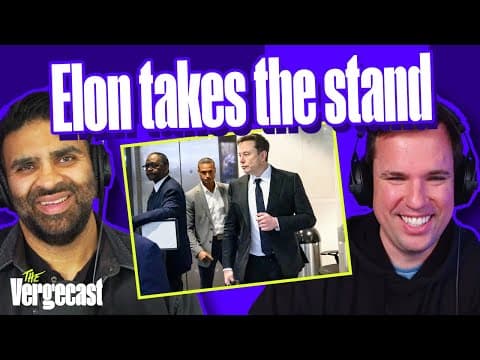
Elon Musk had a bad week in court | The Vergecast
Audio Summary
AI Summary
Welcome to the Birdcast, the flagship podcast of unfair questions. This week, the major news revolves around Elon Musk versus OpenAI. The hosts discussed the basics of this trial with Liz Lato previously, and this episode delves into unexpectedly spicy early testimony from Elon Musk himself.
Elon Musk, who filed and insisted on driving this lawsuit to trial, is reportedly not enjoying being the main character on the stand. He was called as the first witness after a two-day jury selection process. The hosts observed that Musk, who presumably wanted this moment to publicly criticize others in the AI world, performed poorly.
One of the hosts, Neil, who has experience being deposed, noted that trials are unpredictable and not deterministic, especially with a jury. He emphasized that witnesses can do themselves favors by being charming, warm, and receptive, acting like a human being on the stand, particularly when they are the plaintiff. The hosts agreed that making the jury like him would be crucial for Musk, especially in a battle he is widely expected to lose.
They characterized Musk as uncharming and unpersonable when removed from his controlled social media environment where algorithms amplify his supporters. Under cross-examination by a lawyer paid to make him look bad, Musk appeared unprepared. OpenAI's lawyers even got Musk to admit that XAI, his AI company, distilled OpenAI's models as part of its training. Distillation is a process where a less powerful model learns from a more powerful one, which companies like Google and Anthropic view as a form of intellectual property theft. While the hosts found it ironic that these companies, which scraped the entire internet for their own models, would object to distillation, they acknowledged that it is generally frowned upon and ethically questionable, especially when one is simultaneously suing the company whose models were distilled. Musk attempted to downplay this admission, claiming "everyone does it," but the hosts considered it a significant scandal.
Liz Lato, a member of their team, has been covering the trial live from the courtroom. Jury selection itself was a source of amusement. The challenge was to find impartial jurors regarding AI, Sam Altman, and Elon Musk – a seemingly impossible task. It quickly became apparent that many potential jurors disliked Elon Musk. Questionnaire responses included statements like, "Elon Musk is a greedy, racist, homophobic piece of garbage" and "Elon Musk is a world-class jerk." The judge, Yvonne Gonzalez Rogers (YGR), who also presided over the Apple Epic trial, eventually had to acknowledge that "the reality is that people don't like him," but expressed trust in the selected jurors to set aside their disdain. YGR also instructed all main characters in the trial to stay off social media, a directive prompted by Musk's ongoing social media posts about the case, which OpenAI's lawyers had moved to strike from testimony.
The hosts then tried to briefly explain the two sides of the argument. Elon Musk's stance is that he helped fund and start OpenAI as a charity, believing it was his idea and that he was the driving force. He claims that OpenAI then "stole it from me," forced him out, took his money, and built a for-profit company on its foundation.
The opposing argument from OpenAI is that Musk attempted to take over the company, demanding all control and board seats. When he didn't get what he wanted, he left, even trying to subsume OpenAI into Tesla to compete with Google. OpenAI suggests Musk's lawsuit stems from anger over OpenAI's success and Sam Altman becoming the face of AI, rather than himself. Furthermore, a key point in OpenAI's defense is that Musk allegedly did not read the relevant contracts.
The hosts then highlighted some "greatest hits" from Musk's testimony. On the first day, during direct examination by his own lawyer, Musk was reportedly "flat" and lacked conflict. However, during cross-examination, he became a "raging jerk." He accused OpenAI's lawyer of asking "tricky questions" and refused to acknowledge basic facts, even the "nature of linear time," when questioned about chronology.
A particularly notable moment involved an email from 2018 outlining the for-profit structure of OpenAI. Musk stated on the stand that he only read the very first section, specifically a "highlighted box with important warning" that contributors should consider their investments as donations with no return. When he then claimed he "didn't read the fine print" of the document, OpenAI's lawyer pointed out, "It's a four-page document." This brutal exchange underscored Musk's apparent lack of preparation and his discomfort under direct questioning where he couldn't control the narrative.
Another instance involved Musk claiming, "I don't lose my temper and I don't yell at people," only to be successfully baited into yelling at the lawyer moments later when confronted with inconsistencies in his previous deposition.
The hosts also discussed an email Musk wrote expressing concern that OpenAI, as a nonprofit, was not moving fast enough to catch up with DeepMind and that "setting it up as a nonprofit might in hindsight have been the wrong move." When confronted with this email, Musk initially tried to dismiss it as a "hypothetical," leading to a protracted exchange until he finally admitted to writing it. This behavior, likened to a high school mock trial participant trying to trick their way out of a direct question, further solidified the impression of Musk being argumentative and difficult. Liz Lato noted that the courtroom atmosphere was "testy and uncomfortable."
The hosts observed that Musk's contentious testimony inadvertently made Sam Altman look "incredibly reasonable and kind" by comparison. While acknowledging that the pendulum could swing the other way when Altman testifies, they noted that Elon's current performance was not swaying the jury.
In another bizarre courtroom moment, Musk interjected during questioning, saying, "I understand leading questions. That's a leading answer." Judge Gonzalez Rogers then had to remind him, "He can lead. He can lead all he wants. Let's remind everyone you are not a lawyer and you've never taken a class in evidence." Musk's response of having "taken law 101 technically" was seen as further evidence of his self-perception as the smartest person in the room, even when demonstrably unprepared for a legal setting. The hosts speculated that Musk, accustomed to flattery from those in his orbit, was ill-equipped to handle a situation where someone was directly challenging him without regard for his wealth or influence.
Judge Gonzalez Rogers's closing remarks on one day of testimony, stating that Musk "was at times difficult," and that "part of management... is to just get through the testimony. It's bad. This is all bad," were deemed highly unusual for a judge. The hosts compared it to judges addressing "sovereign citizen" defendants who deny the court's jurisdiction, suggesting the severity of Musk's behavior. They concluded that Musk's attempts to "steamroll" the legal process, much like he does in other aspects of his life, were failing in the structured environment of a courtroom.
Moving on from the trial, the hosts discussed other OpenAI news, particularly the restructuring of the deal between Microsoft and OpenAI. For years, they had a complex and lucrative revenue and technology sharing agreement, which included Microsoft owning a significant portion of OpenAI. A key, almost mythical, aspect of this deal was a clause that would trigger a re-evaluation or even shutdown of OpenAI if someone achieved Artificial General Intelligence (AGI). The hosts mockingly referred to AGI as a "fake concept" and "immeasurable and nonsensical." The latest development is that the AGI clause has been removed, and their deal is now a "normal contract for compute."
This decoupling is seen as OpenAI's move to pursue deals with other companies, particularly to access more customers and revenue for an eventual IPO. Immediately after the Microsoft news, OpenAI announced a "gigantic deal with AWS" and has begun positioning itself as an "AWS first product." The hosts explained that this shift reflects the reality that AI is primarily an enterprise product, and businesses often store their data and run their operations on AWS. Microsoft's push for companies to migrate to Azure for AI services was evidently not as successful as anticipated, leading OpenAI to seek broader cloud partnerships.
This pivot to enterprise, the hosts argued, is also driven by a growing sentiment among "regular normal human people" who are increasingly expressing disinterest in or dislike for consumer AI. They cited data from Sensor Tower showing a significant increase in uninstall rates for AI apps (e.g., Claude uninstalls up 90%, ChatGPT up 257% year-over-year) and a slowing pace of downloads.
The hosts further elaborated on the "tension" felt by young people who feel "obligated to use AI" for academic or career reasons, despite disliking the tools. They noted that while ChatGPT achieved rapid growth initially, it hasn't yet reached a billion users, a milestone many anticipated sooner. Reports also indicate that OpenAI's CFO, Sarah Frier, believes the company "can't withstand the scrutiny of going public right now," suggesting internal financial and operational challenges.
The hosts criticized the tech industry's reliance on "revealed preferences" – the idea that if people use a product, they must like it – despite clear user feedback to the contrary. They argued that people use AI tools out of perceived necessity (e.g., to stay competitive in the job market), not because they genuinely enjoy the products, which are often "straightforwardly bad," filled with ads, and designed for engagement rather than quality. This echoes the trajectory of social media, where widely used platforms often provide poor user experiences.
They then discussed a New York Times story about Meta and Google's advertising models. Previously, advertisers would target specific demographics with their "creative" (ads). Now, using AI, these platforms analyze the ad creative itself and then find the most likely customers. This new model, where "the creative is the targeting," has been a massive success for Meta and Google, particularly for small businesses. While acknowledging the economic benefits for some, the hosts expressed concern about the "creepy kinds of targeted advertising" and the potential devaluation of creative work. They concluded that this shift illustrates how AI is primarily being used as "enterprise software" to enhance existing business models, even at the expense of user experience.
The podcast then transitioned to the "Hype Desk," featuring Ross Miller and Ashley Escata, to discuss cool new gadgets and TV shows. Ashley recommended "Widow's Bay" on Apple TV, a horror-comedy likened to "Twin Peaks" for its modern weirdness and praised Apple for its weekly release schedule. Ross discussed "Coyote vs. Acme," a fully finished live-action/animated hybrid film that Warner Brothers initially shelved for a tax write-off but is now finally being released by an independent distributor. The hosts found humor in the meta-narrative of the underdog film's release, hoping it would either be a smash hit or a spectacular failure.
Next, the hosts played "Does Neil Care About This?" with new gadgets. The first was the Steam Controller, which Jay Peters reviewed positively, highlighting its customization, haptic feedback, and features like being able to ping it if lost, use it as a mouse/keyboard, and connect wireless headphones. Neil, despite not being a PC gamer, acknowledged it as a "great gadget" and appreciated its design for tinkerers, contrasting it with big tech products that treat users as "stupid." However, he maintained that game controllers and TV remotes should remain distinct.
The second gadget was a leak of Samsung's first smart glasses, "Samsung Galaxy glasses." Neil expressed strong disinterest, stating, "I'm never going to wear glasses and say Samsung on the temple." The hosts agreed on the low probability of success, citing the social cost of wearing smart glasses and their current lack of a "killer app" beyond being "cameras for your face." They reiterated Neil's long-standing "theory of wearable [ __ ]" that the app must be so transformative to justify the social and privacy concerns.
Following this, they discussed leaks about Samsung's "wide foldable" phone, potentially called the "Samsung Galaxy Zfold 8 wide." The hosts found the name ridiculous and the concept uninspiring. They questioned the utility of foldable phones, noting that many users don't unfold them, and that most people don't prioritize larger screens for media consumption, as evidenced by vertical YouTube viewing habits. They also mentioned Mark Gurman's report that a rumored 20-inch foldable iPad is unlikely, which Neil found more appealing than foldable phones.
They briefly touched on the new Motorola Razr Ultra, a "pretty" flip phone with "utterly confusing software" and a higher price. Despite its flaws, the hosts acknowledged the appeal of flip phones for their ability to intentionally disconnect.
Finally, they discussed the Asus ROG Zephyrus Duo, a gaming laptop with two 16-inch OLED screens, a powerful GPU, and a hefty $5,