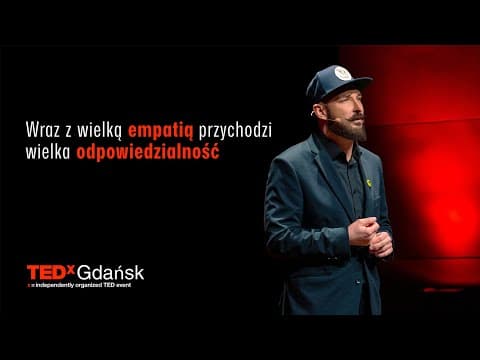
Z wielką empatią przychodzi wielka odpowiedzialność | Adam Van Bendler | TEDxGdansk
Audio Summary
AI Summary
The speaker, a stand-up comedian, began by playfully admonishing an audience member for recording on their phone, highlighting how attention has become a valuable currency in today's social media-driven world. He noted that everyone with an active social media account, regardless of profession, becomes an actor on this stage, often obsessing over what others think of them, while paradoxically, others are equally preoccupied with similar concerns.
He confessed to undertaking various risky ventures online—sketches, music videos, commercials—all to gain acceptance and a sense of self-worth. Despite achieving considerable success in stand-up comedy over 13 years, attracting hundreds of thousands to his shows, he found that feeding his ego with awards, applause, money, sex, admiration, and envy ultimately led to an emptiness. He admitted to becoming arrogant and, at one point, a high-functioning alcoholic and drug addict, making increasingly poor professional and personal decisions. His life spiraled, marked by loneliness, screaming at managers, and a profound loss of meaning, even contemplating suicide daily.
A turning point came in 2017 when he was invited to Kuba Błaszczykowski's charity football tournament. He was deeply moved by Błaszczykowski, a highly successful footballer, who despite his achievements, spent hours after the game engaging with children, posing for photos, and thanking sponsors. This selfless act made the speaker realize there are two kinds of attention: the kind he had craved his whole life, and the kind Błaszczykowski was giving to the world.
Inspired by Błaszczykowski's dedication to helping children through his foundation, the speaker, recalling his childhood love for animals, decided to establish his own charity, the Przekrew Foundation, in 2018, to help animals. Initially, the plan was modest, but with the support of his stand-up comedian friends, they organized charity matches and galas, raising funds to help seven animal shelters across Poland. The foundation grew, attracting empathetic individuals, and eventually led to the creation of "Animal Helper," Poland's first 112-like app for animal emergencies, operating in 10 voivodeships.
He emphasized the importance of speaking out about good deeds, not for self-promotion, but because the reach of artists and influencers is most powerful when it helps those who cannot ask for help themselves. While acknowledging the risk of help becoming a trend or appearing as showing off, he stressed that genuine help is crucial, especially when distinguishing real efforts from staged ones.
The speaker then addressed influencers and those with resources who feel unhappy despite having "everything," urging them to try helping others. He explained that redirecting attention from oneself towards a meaningful goal leads to truly amazing things, filling life with positive emotions and beautiful vibrations, which are more valuable than money, sex, or admiration.
He cautioned that helping is not an endless source of dopamine and has its difficult moments. He shared rules for sustainable helping: recognizing you can't save the world alone, setting personal limits to avoid burnout, and not using helping as a form of self-punishment. He advocated for a motto where the good deed is not about the helper, but about inspiring others to join in.
He shared a personal story about adopting a dog, Rambo, evacuated from Ukraine, highlighting that taking responsibility for another being provided something his ego-driven life had always lacked. He concluded by reiterating that attention, often squandered on trivialities, can be used for warmth, presence, and rescue, urging everyone to use their power to help, whether it's saving an old man, a child, an elderly lady, or even just carrying snails across the street.