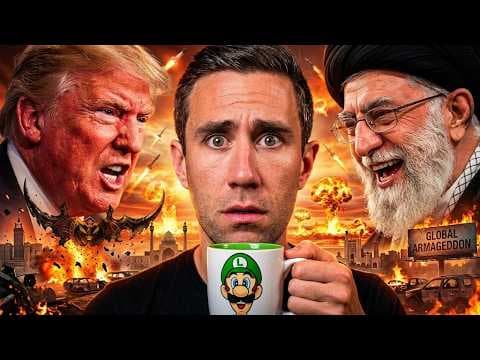
So WTF now...
Audio Summary
AI Summary
The Wall Street Journal is questioning Donald Trump's declaration of victory regarding Iran and the reopening of the Strait of Hormuz. They suggest that Trump might be prematurely claiming success to prop up the stock market ahead of an election, making future negotiations with Iran more difficult if the regime calls his bluff. Confusion persists regarding the Strait of Hormuz, with some analysts and an IRGC-linked news network stating that Iran has not broadly approved ship passage, maintaining the same restrictions as the past two weeks. This raises doubts about the true extent of the strait's reopening.
Another significant issue highlighted by the New York Times is "Pickax Mountain," a deep underground facility in Iran that remains untouched and possibly beyond the reach of current bunker-busting bombs. Satellite imagery indicates ongoing development at this site, including hardening its entrances, even during the war. This facility is suspected to be where highly enriched uranium was moved before B2 bomber strikes.
Further concerns include Iran's deployment of a Chinese satellite, TE01 Bravo, acquired for $36 million in 2024. Leaked Iranian military documents suggest this satellite, launched with their ballistic missile program, has been photographing US bases in the Middle East daily, potentially aiding Iran in targeting US assets.
Bank of America's game theory analysis suggests a unique dynamic in Trump's approach to international conflicts and the stock market. They argue that the market anticipates Trump's tendency to escalate situations but then de-escalate when the stock market shows signs of weakness. This expectation leads the market not to sell off significantly during escalations, as participants anticipate a "taco" – a quick reversal or resolution to support market stability. This dynamic, Bank of America posits, has already priced in Trump's "bull in a china shop" approach, where he might disrupt things but ultimately prioritize market performance.
Drawing parallels, Trump's past actions, like the "repeal and replace Obamacare" promise that never materialized beyond a "concept," and the numerous "trade deals" that were mostly temporary truces rather than comprehensive agreements, illustrate a pattern of declaring victories or progress without fully resolving underlying issues. The stock market, however, tends to respond positively to these declarations, creating a perception of success.
This pattern is anticipated to continue with Iran. Despite Trump's recent statement about potentially not extending the ceasefire if no deal is reached by Wednesday, implying renewed strikes, he also reiterates China's alleged happiness about the strait being open, even if its full openness is unconfirmed. The market, in essence, bets on this "taco" dynamic, where Trump's actions, even if partial or temporary, are sufficient to prevent a significant market downturn.
Regarding the broader economy, while some worry about oil prices crushing the consumer and leading to a recession, it's argued that higher oil prices primarily affect the low-end consumer, who represents only 15% of consumption. The middle and upper classes, who spend the majority, tend to benefit from rising stock prices, offsetting the negative impact of higher oil prices or interest rates. Therefore, as long as Trump can prop up the market, it can mask underlying economic weaknesses.
Retail sales, however, are not performing well, showing negative growth on an inflation-adjusted basis over the last four months. Yet, recent card spending during the war has held up, suggesting the consumer hasn't been significantly affected by the conflict, though the economy is slowing.
The labor market is showing signs of stabilization and even "firming up," according to Deutsche Bank's analysis of BLS statistics and ADP data. This stability in the job market, coupled with the consumer's resilience, contributes to the current economic outlook.
Crucially, artificial intelligence (AI) investment is booming, playing a vital role in preventing a recession. Goldman Sachs has previously stated that the economy would be in a recession without AI. Inflation-adjusted AI-related investment has seen massive growth over the past year, in stark contrast to non-AI investment, which is negative or barely up. AI is effectively propping up the market.
In summary, the current economic landscape is characterized by a stable labor market, a resilient consumer (largely due to stock market performance), and robust AI investment. These factors, combined with Trump's market-propping tendencies, make a sudden recession unlikely in the near term. A major risk would be a significant rollover in AI investment or a collapse in the stock market leading to widespread layoffs. However, the prevailing sentiment is that as long as the stock market continues to rise, it can cover a multitude of other issues, including policy missteps.