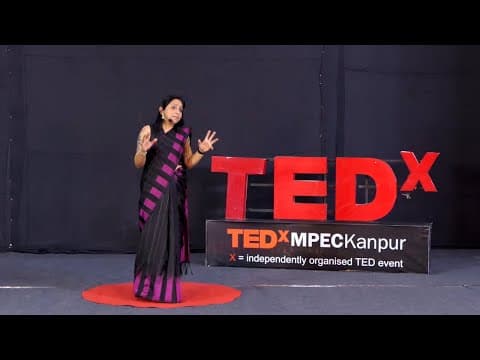
Lose the cape. Build the team- Leadership during disruption | Archana Grover | TEDxMPEC Kanpur
Audio Summary
AI Summary
The speaker, Archana Grover, begins by asking the audience to raise their hands if they've ever given advice that was completely ignored. As a mother of three teenagers, she states she experiences this daily. She describes her children as "Zalphas," a generation born with smartphones and skepticism, who question everything. She finds parenting teenagers to be a more humbling leadership laboratory than her two decades in corporate life, where millions of dollars are discussed, and cutting-edge AI is debated.
Grover emphasizes that in her corporate environment, while dealing with complex projects and global teams, nothing impresses her children. This highlights a core leadership lesson: authority is not the same as influence. Children, like employees in a VUCA (Volatile, Uncertain, Complex, Ambiguous) world, might obey due to compliance or lack of choice, but this is not true leadership.
She proposes that over the next 10-12 minutes, the audience can gain a new perspective on leadership, a simple framework applicable anywhere, and a shift in understanding what truly appreciated leadership looks like versus what is merely tolerated.
Grover questions when disruption truly began, suggesting it's not solely tied to AI, ChatGPT, or COVID, but has been a constant throughout human history since the invention of fire and the wheel. What distinguishes the current era is the "insane, unforgiving pace" of disruption. Citing the World Economic Forum, she notes that many students will work in jobs that don't exist yet, like prompt engineering, which was unknown a few years ago. This means we're preparing people for a journey, not a fixed destination, requiring a different kind of leadership.
She contrasts "hero leadership," where a single visionary drives change, with the true definition of leadership. Heroes are called geniuses or visionaries, not leaders, because leadership, in her view, is not about individual accomplishment but about building something that endures. She asks the audience to think of someone they genuinely admire, suggesting this person likely doesn't have a corner office or a prominent title. Instead, it might be a supportive friend, a patient relative, or a considerate colleague who ensures others' well-being out of intrinsic motivation. This, she argues, is the essence of leadership: a behavior, not a designation. It's about intentional and consistent presence for one's people.
In this disruptive world, leadership requires a shift in operating system: from "follow me" to "let me help you win"; from "I know all the answers" to "let's ask the right questions"; from "I know everything" to "let's learn together"; and from hero leadership to servant leadership. She defends servant leadership, stating it's not soft but demanding, requiring both courage and humility – humility to admit not knowing all the answers and courage to take responsibility for outcomes.
Grover breaks down leadership into three key elements, the "three E's":
1. **Empower:** Allowing those doing the work to make decisions. She uses the Mumbai Dabba Walas as an example, highlighting their high accuracy and efficiency without a single person in charge. They operate with "aligned autonomy," understanding their roles and executing without needing constant permission. A great leader, she states, builds a team that doesn't need saving.
2. **Empathy:** This is presented not as a soft skill but as "pure data." Research shows that empathetic leadership and psychological safety lead to better performance. Even with the best product or vision, disengaged or undervalued people will lead to failure. Empathy must be proactive; leaders should seek to understand and address issues before they are explicitly stated, actively "sniffing for smoke" rather than just dousing fires.
3. **Be Early:** Being proactive rather than reactive. Great leaders ask tough questions in advance about potential problems and blind spots. Proactivity is framed as the highest level of preparedness, essential in a VUCA world.
Complementary to these three E's are other crucial behaviors:
* **Agility and Adaptability:** The need to learn quickly and gracefully unlearn outdated information, as knowledge has a short shelf life.
* **Inclusive Leadership:** The ability to connect with and adapt communication to diverse individuals across cultures, genders, sexual preferences, and ages. Without this, one is merely broadcasting, not leading.
* **Humor:** Presented as a vital leadership competency. Humor reduces fear, allowing truth to emerge. Appropriately used humor makes leaders seem more motivating and trustworthy, acting as infrastructure rather than mere ornamentation.
Returning to her opening question, Grover reflects on her own experience. Despite her professional achievements, she finds herself navigating the "humbling chaos" of her home. Here, she is not a hero, doesn't have all the answers, is often wrong, and is outnumbered. However, by laughing at herself, she connects with her teenagers, making the atmosphere warmer. She sometimes acts as the supportive friend or the responsible guardian, but often, she just orders ice cream. These unglamorous, unheroic, and un-Instagrammable moments, she concludes, are when she does her best leading.
Her final message is that aspiring leaders don't need all the answers but should ask better questions. They don't need to make all the decisions but should empower others to make the right ones. They don't need to be the most impressive person but should strive to make the room impressive. Leadership in a disruptive world is about building a team capable of finding answers, not being the one with all of them. She encourages the audience to "lose the cape and build the team."