On a pris 100 ans pour trouver une solution à ce puzzle...
Audio Summary
AI Summary
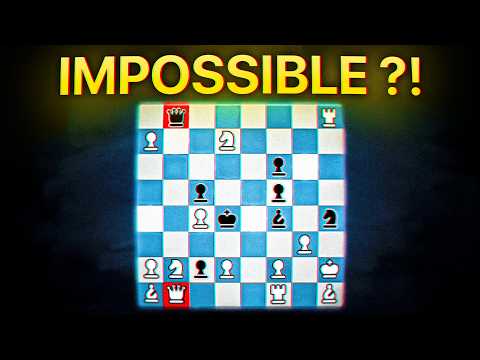
The position currently displayed is not an ordinary one; it represents the solution to a century-old problem, hailed by brilliant minds as one of the greatest positions in chess history. The question then arises: what makes it so special, and why did people spend over two decades searching for it without success? To grasp this, one must first delve into the world of chess composition.
Chess composition involves inventing a position to fulfill specific objectives. Many encounters with such compositions might have occurred through online puzzles, where a given position requires finding a checkmate in a few moves. These are the most common and straightforward compositions. However, others exist, such as those aiming for a draw with an elegant solution, or more advanced compositions where the goal is to force a self-mate, regardless of the opponent's moves. These are more sophisticated.
Compositions are created through trial and error, moving pieces on a board until the final, working position is achieved. A crucial criterion for a composition to be valid is that the position must be legal, meaning it must be obtainable from a real game's initial setup. For instance, a board with 32 queens is impossible, whereas a position resulting from a specific sequence of moves is legal. This legality criterion is highly restrictive and significant for understanding the problem at hand.
The world of compositions is fascinating, with some positions being so intricate and beautiful that they take years to discover. This extended discovery time is often due to the stringent conditions and objectives set by the composers. While creating a forced mate in five moves might be easy, designing a position where, after a white queen move, black must respond symmetrically until white self-mates, is considerably more challenging. While such complex conditions are rare and usually take weeks to solve, one particular task terrorized composers for nearly a century.
For almost 100 years, no one managed to find a working position that met the imposed conditions for this task, which was long considered impossible. This is known as the Babson task, or simply the Babson problem. First published in 1884, the Babson problem states: White makes a move, and then Black has four different defensive options through the promotion of a specific black pawn. For each of these defenses, White must deliver a checkmate by choosing *exactly* the same promotion.
Consider a random position: White makes a move, and Black can choose one of four promotions: knight, bishop, rook, or queen. White must then promote to the identical piece to achieve checkmate as quickly as possible. This is the core difficulty. The only way to deliver checkmate is by promoting to the exact same piece as Black. This is extremely challenging because, for example, if Black promotes to a bishop, why shouldn't White promote to a queen, which has a bishop's movement capabilities? The answer is that in a Babson problem, if Black promotes to a bishop, there will inevitably be a reason why White cannot promote to anything other than a bishop. Adding to the complexity is the requirement that the position must be legal, which is very constraining.
To quickly reiterate the rules: White plays first. Black can make four different promotions. White must respond with the same promotion and achieve a forced checkmate. Furthermore, the checkmate must always occur after the same number of moves, 'X', regardless of Black's promotion. These rules were set by Joseph Ney Babson in 1884. Babson himself hadn't solved it but believed others would eventually find a solution. He didn't realize that these seemingly simple conditions would haunt the greatest composers for nearly a century.
The first officially published partial solution appeared in 1912, 28 years later, by German composer Wolfgang Pauli. He found a Babson position for three of the four promotions. His puzzle starts with pawn B3, and Black can only promote here. Understanding these problems often involves discerning White's mating strategy, which here depends on the promoted piece. If a queen, White mates by bringing the queen to F3. If a rook, by capturing the pawn on C3. If a knight, by bringing the knight to F4. White's promotion is thus dictated by Black's, as Black's choice creates specific defenses.
For example, if Black promotes to a queen, and White also promotes to a queen, the checkmate pattern works (e.g., Queen A8, Queen B2, Queen F3 checkmate). However, if Black promotes to a rook and White promotes to a queen, after pawn A2, White might not have time for Queen A8 because Black could be stalemated, resulting in a draw. The same applies if Black promotes to a knight; after Queen A8, Knight D4 could control F3, preventing mate. While White might still win, it wouldn't be checkmate in the same number of moves.
If Black promotes to a rook, White's only winning move is to also promote to a rook. After the resource pawn A2, which would be a stalemate with a queen, Rook F6 blocks the bishop's diagonal, allows Black to capture the pawn, and then leads to mate. This wouldn't work with a queen, as Queen F6 would defend the pawn, preventing the king from taking it. The same logic applies to the knight promotion. The only piece for which Pauli's puzzle doesn't work is the bishop. If Black promotes to a bishop, White doesn't need to promote to a bishop; a queen promotion would still lead to mate. Thus, Pauli's beautiful puzzle only works for three out of four promotions and is not a true Babson puzzle.
Pauli's partial solution excited people, making them believe the problem was close to being solved. But they were far from it. For years, no progress was made. Many dedicated their lives to this "diamond," their reason for being, yet failed. A Babson puzzle had never been found, and many began to believe none existed.
Then, in the 1960s, Pierre Drumard became interested. For the next 20 years, he spent nights trying to compose such a position, failing repeatedly until he finally found one in 1980. This was the first Babson puzzle in history. However, it was not a valid composition because, although it worked, the position itself was not legal—it couldn't be obtained in a real game. Despite its invalidity, Drumard's position offered hope, showing that a Babson puzzle could exist, and the search must continue.
In 1982, Pierre Drumard abandoned his research, deeming it impossible. But the following year, in March 1983, an unknown composer, Leonid Yarosh, proved him wrong. Yarosh published his position in a Soviet newspaper with the headline: "The Babson task has been resolved." Tim Krabbé, a renowned composer and Babson problem specialist, said reading this announcement felt like discovering the meaning of life. A 99-year-old problem had been solved, and Yarosh's position was the solution.
This position is magnificent and legal. No matter how Black promotes their pawn, White has a forced checkmate in four moves. Explaining all variants would take hours, but the core idea is that White wants to capture the bishop on F4 with their rook, which would be checkmate if not for the queen on B8 defending it. So, White must capture the queen and promote their rook. Depending on Black's promotion, different defenses become available.
If Black promotes to a queen, their defense is to capture the knight on B2, allowing the black king to escape to C4 or D3, preventing mate. If White promotes to a rook here, Black captures the knight, and White's recapture doesn't lead to mate in four. The only way to prevent this is for White to also promote to a queen. After Queen takes B2, Queen B3 defends the pawn on C4 and the D3 square, strangely forcing mate as Black cannot stop Rook takes F4 checkmate.
If Black promotes to a rook, White cannot promote to a queen because after Queen takes B2 and Queen B3 (defending the pawn), it's a stalemate. Black has no legal moves, resulting in a draw. The only way to prevent this is for White to promote to a rook. After Rook takes B2, Rook B3 is played again, but this time the king can take the pawn because the rook doesn't defend it. Then, after King takes C4, Rook takes F4 is checkmate.
If Black promotes to a knight, White cannot repeat the same moves because Black wants to capture the pawn on D2 with their knight, giving the king access to C3 and then B4 to escape. The only way to prevent this is for White to promote to a knight. After Knight takes D2, Knight C6 check, King C3, White's knight defends B4, preventing the king's escape. Then, Rook C1 is checkmate because the knight is the only piece that can defend B4 in this position.
Finally, the "horrible" piece: if Black promotes to a bishop, White must also promote to a bishop. If White takes the bishop on F4 with the rook, it's a stalemate. If White promotes to a queen and takes the queen, it would also be a stalemate because the queen attacks like a rook. The only piece that prevents stalemate is the bishop. After Bishop takes F4, Black is forced to move their bishop, allowing White to play Bishop E3, checkmate.
Thus, for every Black promotion, there is only one correct White response: to make the identical promotion. The Babson puzzle was solved. This position has been hailed as one of the greatest compositions in chess history and inspired many others. Today, dozens of Babson positions are known, a remarkable feat considering the century-long struggle to find just one.
I invite you to try finding your own Babson position if you have the time. Even though several are known today, they are so rare that each new discovery garners global recognition. Just be prepared to dedicate about 20 years to the task. If this video taught you something new, please consider subscribing. We're aiming for 100,000 subscribers by the end of 2026. I'd also appreciate feedback on whether you enjoyed this chess-focused video compared to others, or if you prefer stories about the game. Remember, a free comprehensive guide on chess openings is available in the description if you struggle with that phase of the game. This was Lux. Ciao!