Alpha Zen dans le top 2 mondial des Hegde Funds ?
Audio Summary
AI Summary
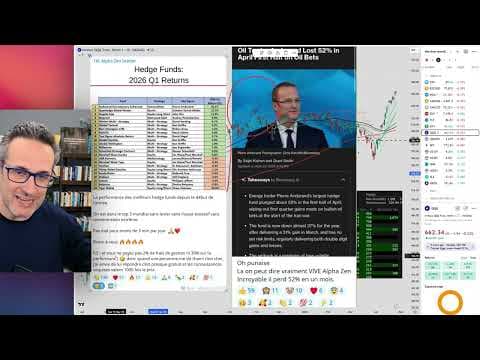
The speaker begins by highlighting the current "crazy" and volatile market conditions. He uses the example of Pierre Andurand, described as one of the best French and global traders, who started the year with a remarkable 31% performance, leading the pack. However, due to extreme volatility, particularly in commodities like oil, Andurand's performance plummeted to -37% year-to-date, with his fund losing 52% in just two weeks in April. The speaker emphasizes that this is not an amateur but a highly skilled professional whose performance was severely impacted by market conditions.
This leads to a discussion about hedge funds and their strategies. The speaker points out that hedge funds often focus on specific strategies that perform well under certain market conditions but poorly under others. He provides a snapshot of various hedge fund performances for the year: Quant Edge Global Master at 12%, Fangry Asja at 11.5%, while legendary trader Chase Coleman is at -10%, Viking at -1%, and established names like Point 72 and Citadel are showing modest gains (3.8% and 2.9% respectively). This illustrates that even top hedge fund managers are struggling this year.
The speaker then pivots to a more personal angle, addressing the common belief that individual investors cannot outperform professionals due to lack of resources and analysts. He calls this a "dangerous and fallacious discourse" designed to mislead. He references economist John Kenneth Galbraith, who criticized economists for using complex jargon to appear intelligent rather than to genuinely explain concepts. This "expert syndrome" is seen as a way to condescend to and belittle individuals, making them feel incapable.
In contrast, the speaker proudly states that his own venture, Alpha Zen, has achieved a 16% performance year-to-date. He claims this places them in the top 2 or 3 globally among hedge funds, even surpassing Andurand's initial performance without excessive leverage or concentration in positions. He highlights that this was achieved with minimal daily time commitment (under 5 minutes) and without the hefty management and performance fees charged by traditional hedge funds (typically 2% management fee and 30% performance fee).
He draws a parallel to the passive investing movement, where he was an early proponent. The core argument for passive investing is that 96% of portfolio managers fail to beat their benchmarks. The speaker criticizes the awe people have for institutions like Goldman Sachs, arguing that their pedigree doesn't guarantee superior results and that many professionals rely on their credentials to justify their services and fees. He reiterates the cost of these services, pointing out that a million dollars in assets could incur $20,000 annually in management fees, plus performance fees. Alpha Zen, he suggests, is "almost free" and also provides valuable knowledge.
The speaker emphasizes that his approach is based on scientific research, specifically mentioning "momentum." He counters skepticism by pointing to hundreds of research papers supporting the efficacy of such strategies. He questions why, if it's so simple and proven, so few people succeed. He attributes his and Alpha Zen's success to a straightforward, scientifically validated anomaly rather than a complex, proprietary trading secret. He dismisses the credentials of individuals from prestigious institutions like Polytechnique or those with economics degrees if they cannot demonstrate tangible results.
He explains the genesis of Alpha Zen, born from frustration with empty promises and a desire for transparency. His commitment was to show students exactly how he trades, sharing all decisions—buys, sells, and rationale—in real-time. He recalls the initial apprehension of students when the portfolio launched in October, with fears of an overvalued market or impending crashes. His advice was simple: there's no perfect time to start; the best time is now. This active participation, he argues, allows for learning, skill development, and error correction.
He illustrates the journey with Alpha Zen, noting that it began with a market downturn, followed by consolidation, and another significant drop. While investing in the NASDAQ might have yielded a 4% gain, it also involved a substantial 12% drawdown. In contrast, Alpha Zen maintained a mostly positive trajectory, outperforming the NASDAQ by 12%. He stresses the documentation of all trades and account statements, emphasizing transparency as a key learning tool.
The speaker acknowledges that many of his students are busy professionals—CEOs, doctors, lawyers—who cannot dedicate extensive time to trading. Alpha Zen was designed to meet this demand, offering accessible strategies. The results, he states, are "incredible," positioning them among the top global hedge funds with minimal time and energy expenditure and low volatility. He contrasts this with Andurand's strategy, which, while effective at times, involves extreme volatility and significant drawdowns, something the speaker, as a more conservative investor, aims to avoid. His goal is strong performance with low volatility, a dimension he actively manages.
Regarding the broader market, the speaker observes a "one-shot" upward movement without significant corrections, both in general markets and on the NASDAQ. He suggests a correction would be logical but acknowledges the market's unpredictability. He attributes the recent sharp upward moves to short squeezes, where traders who had bet against the market were forced to buy back positions, amplifying the rally.
He briefly analyzes other markets: Bitcoin is becoming interesting but is below its 200-day moving average; gold and silver are "mou" (sluggish) without clear direction; bonds offer nothing; the dollar is falling but lacks direction; and the IWM shows consolidation within an uptrend. Oil remains dangerous, as evidenced by Andurand's losses, with significant volatility observed. He believes markets might consolidate, with no immediate danger unless unforeseen events occur.
The speaker criticizes the overreliance on economic news and analysis, arguing that it's often just "blabla" and distracts from what truly matters: performance. He reiterates Alpha Zen's 16% year-to-date return and challenges economists to prove similar results. He champions technical analysis for its ability to cut through noise and focus on price action. He anticipates skepticism but remains committed to his method, showing his trades transparently to his students.
He dismisses the hype around certain investments, like cryptocurrencies, and the subsequent disappointment of many investors. He shares an anecdote about a multimillionaire friend who invested heavily in Bitcoin and gold, only to suffer significant losses when their prices dropped. This illustrates how emotions can dominate investment decisions. The speaker's philosophy is to be agnostic about markets, assuming anything is possible. This approach, he argues, isn't about being "right" but about winning by applying a consistent method.
He highlights successful trades within Alpha Zen, including over 100% gains on a specific stock bought in October and continued gains on MU and SNBK, emphasizing the strategy of holding good stocks as long as they are trending upwards. This is aligned with "trend following," a methodology supported by research. He contrasts this with fundamental analysts who tell "beautiful stories" but often fail to disclose their portfolio performance. He recounts an example of a YouTuber who promoted Novo Nordisk with compelling narratives, only for the stock to plummet 72% after breaking its 200-day moving average—a signal a technical analyst would heed.
The core message is to develop and adhere to a solid investment method, ignore the noise and stories, and focus on concrete results. He states that his opinion on the markets is less important than the demonstrable performance achieved by himself and his students. Technical analysis, with its quantitative and mathematical signals, provides clarity and eliminates ambiguity, which he values above all else. He concludes by inviting students to share their results to further demonstrate whether an individual can indeed outperform professionals, reiterating his mission to democratize financial education.